
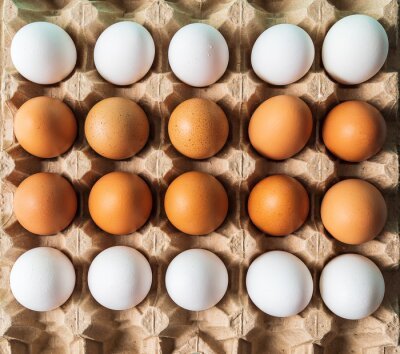
Brown eggs cost more, so they must be healthier. Right? That’s what the price tag wants you to believe, and it’s one of the most persistent myths in the grocery store. I’ve heard it from smart, careful shoppers for years, and I believed a version of it myself before I learned the truth.
Here’s the short version: the difference between white and brown eggs is shell color, and shell color tells you exactly one thing — what color feathers the hen had. Nothing about nutrition, taste, or quality. But the full story is more interesting than that, because there ARE meaningful differences between eggs — they’re just not the ones printed on the carton in big brown letters.
The Real Difference Between White and Brown Eggs
Shell color comes down to breed genetics. White-feathered hens with white earlobes (like Leghorns) lay white eggs; red-feathered hens with red earlobes (like Rhode Island Reds) lay brown eggs. The pigment, protoporphyrin, is deposited on brown shells late in the shell-forming process — it’s literally paint on the outside. Crack both open and the insides are identical.
Multiple studies have compared the nutritional content, and the verdict is consistent: no meaningful difference in protein, fat, vitamins, or cholesterol between white and brown eggs of the same size and production method. Taste tests agree — in blind tastings, nobody can tell them apart. What you’re paying for with brown eggs is mostly economics: brown-egg-laying breeds tend to be larger birds that eat more feed, and that cost gets passed to you.
What Actually Makes Eggs Different (and Worth Paying For)
If shell color doesn’t matter, what does? The hen’s diet and living conditions. Pasture-raised eggs from hens that actually roam and eat bugs and greens show measurably higher omega-3s and vitamin D in some studies — that’s a real nutritional difference worth considering. The feed matters too: hens fed omega-3-enriched feed lay omega-3-enriched eggs, regardless of shell color.
Freshness matters enormously and gets zero marketing. A week-old white egg from a local farm beats a month-old brown egg from a warehouse every time. Check the Julian date on the carton (the three-digit number showing the pack day) — lower is fresher. And size grades (large, extra-large) are about weight, not quality; most recipes assume large eggs, so that’s the safest default buy.
Reference: USDA egg grading and labeling information.
Reference: American Egg Board’s Eggcyclopedia.
Egg Buying Guide: What the Labels Really Mean
Ignore shell color. Read these instead:
- Pasture-raised: hens with real outdoor access and space. The most meaningful welfare and nutrition label, and the priciest.
- Free-range: hens have some outdoor access, but standards vary widely. Better than caged, less rigorous than pasture-raised.
- Cage-free: hens aren’t in cages but may still live entirely indoors in crowded barns. A modest step up.
- Organic: organic feed and no antibiotics, plus outdoor access requirements. About the feed more than the lifestyle.
- Omega-3 enriched: hens fed flaxseed or fish oil. A real nutritional upgrade if you don’t eat much fish.
- Grade AA vs A: about shell and white firmness at packing, not nutrition. AA is slightly fresher-feeling; both are fine.
- The Julian date: the 3-digit pack date on the carton. Combine with the sell-by date to judge actual freshness.
Storing Eggs for Maximum Freshness
Keep eggs in their carton on a middle shelf of the fridge, not in the door. The door’s temperature swings every time you open it, and the carton protects against both odors and moisture loss. Contrary to European practice, American eggs must stay refrigerated — they’re washed during processing, which removes the protective bloom.
The float test for older eggs: place an egg in water. Fresh eggs sink and lie flat; older eggs stand up or float as the air cell grows. A floating egg isn’t automatically bad — crack it into a bowl and sniff. Your nose is a flawless spoilage detector. And hard-boiled eggs peel easiest when they’re a week or two old, since very fresh eggs cling to their shells.
Quick Answers to Common Questions
Are brown eggs really more nutritious?
No — this is one of the grocery store’s most persistent myths. Shell color reflects the hen’s breed, not nutrition. Multiple studies find no meaningful difference in protein, vitamins, or cholesterol between white and brown eggs of the same size and production method. Brown eggs cost more because brown-egg breeds are bigger birds that eat more feed — you’re paying for the hen’s appetite, not the egg’s nutrition.
What do the different egg labels actually mean?
Pasture-raised (real outdoor access) is the most meaningful welfare and nutrition label. Free-range means some outdoor access, with widely varying standards. Cage-free means no cages but possibly crowded indoor barns. Organic is about feed and antibiotics. None of these relate to shell color — a white egg can be pasture-raised and a brown egg can be conventional.
How can I tell if an egg is still fresh?
The float test: place it in water. Fresh eggs sink and lie flat; older eggs stand up or float as the air cell grows. But the real test is cracking it into a bowl — a fresh egg has a proud, domed yolk and thick white; an old egg spreads flat. And the sniff test is flawless: bad eggs smell unmistakable. When in doubt, throw it out.
More from Daily USA Post
- Keep reading: how do I cut an onion without crying
- Related: how can I use up leftover vegetables before they spoil
- what are the best family movies on Netflix for a weekend, explained in detail
The difference between white and brown eggs is just the hen’s breed — brown shells come from bigger birds that eat more, which is why they cost more. Nutrition and taste are identical. Spend your egg budget where it counts instead: pasture-raised or omega-3 labels if those matter to you, the freshest Julian date you can find, and proper fridge storage. Shell color is marketing; everything else is substance.




1 Comment