
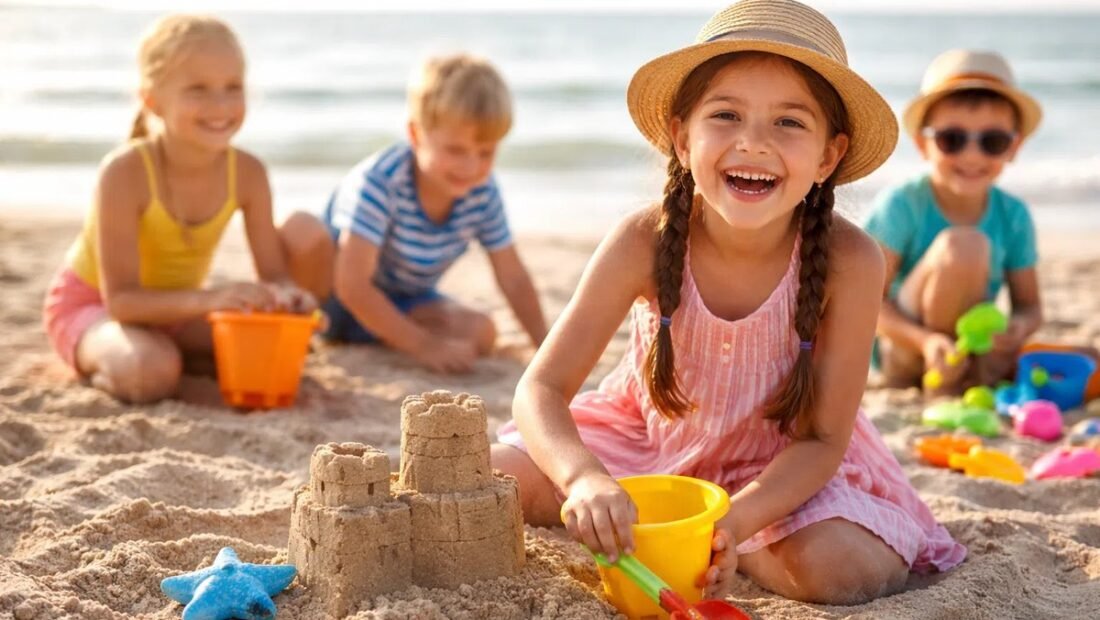
A beach can be postcard beautiful and still be a miserable place to bring a four-year-old. The surf that thrills a teenager knocks a toddler flat; the famous party shoreline has no shade, no bathrooms, and a parking lot in another time zone; the “unspoiled” strand everyone recommended turns out to be unspoiled by lifeguards, too. Family-friendly is a technical specification, not a vibe: gentle entry into calm water, a lifeguard chair with someone in it, shade and bathrooms within a small child’s walking distance, sand that does not burn small feet, and enough nearby food and ice cream to reset a meltdown. Judged by that spec, these fifteen American beaches rise to the top — five on the East Coast, five on the Gulf, five on the West — and the sections after the list explain how to use them.
The fifteen
- Siesta Key, Florida — sand that is 99 percent quartz, cool underfoot even at noon, with a gentle Gulf entry and a full-service beach pavilion.
- Clearwater Beach, Florida — wide, soft, shallow-sloping, with a nightly sunset festival at Pier 60 that entertains kids for free.
- Outer Banks (Nags Head), North Carolina — broad beaches, modest crowds, and rental houses steps from the sand that make naps and snacks easy.
- Virginia Beach, Virginia — a three-mile boardwalk, guarded swimming areas, and playgrounds on the sand itself.
- Hilton Head Island, South Carolina — twelve miles of flat, hard-packed beach that toddlers can bike on at low tide, under serious lifeguard coverage.
- Gulf Shores, Alabama — warm, calm Gulf water, white sand, and prices a notch kinder than Florida’s.
- South Padre Island, Texas — gentle surf, sea turtle rescue center visits, and wide beaches that never feel packed.
- Sanibel Island, Florida — shelling at dawn, no building taller than a palm tree, and water that stays shallow far from shore.
- Destin, Florida — sugar-white sand and emerald, bathtub-calm water in the protected bays for the smallest swimmers.
- Coronado Beach, San Diego, California — a vast, gentle, lifeguarded strand beside a storybook hotel, with tide pools at the edges.
- Carmel Beach, California — soft white sand and a town that welcomes dogs and picnics, best for older kids who love exploring.
- Cannon Beach, Oregon — Haystack Rock’s tide pools are a natural aquarium; wilder and colder, and unforgettable for school-age children.
- Waikiki (Kuhio Beach), Hawaii — a protected, walled swimming area where beginners and small kids learn the Pacific safely.
- Coast Guard Beach, Cape Cod, Massachusetts — a classic National Seashore beach with lifeguards, dunes, and a shuttle from the parking lot.
- Lake Michigan’s Oval Beach, Michigan — the freshwater wildcard: no salt, no sharks, gentle waves, and a dune-backed small-town beach day.
What “family-friendly” actually means, line by line
Read the list’s pattern and you can judge any beach yourself, anywhere. Water first: a family beach shelves gently, so a child can walk in to their waist over twenty feet rather than two, and the typical surf is a ripple rather than a break — the Gulf coast dominates the list for exactly this reason, and where the open ocean is grander (the Outer Banks, Cape Cod), the pick is the guarded, managed stretch rather than the wild one. Ten minutes with the National Weather Service’s rip current safety guidance is time every beach parent should spend, because rip currents are the ocean’s one real danger at otherwise gentle beaches, and knowing that you swim parallel to escape one is knowledge that matters. Sand second: fine and light-colored stays cool, which is why Siesta Key’s quartz sand is not a curiosity but a feature for bare toddler feet. Infrastructure third: lifeguards in season, bathrooms, showers to rinse the sand before the car, shade you can rent or a pavilion, and food within a short walk. A beach that scores on all four beats a prettier beach that scores on one.
Timing: the shoulder-season play
The same fifteen beaches halve in crowding and price just outside the school-holiday core — and for Gulf and Florida beaches, the water is often at its best then. Late spring (after spring break, before Memorial Day) and early autumn (September into October, watching the hurricane forecast) trade a little certainty for a lot of space, and families with pre-school children, unbound by the school calendar, should treat those windows as their natural season. Time of day matters as much as time of year: arrive before 10 a.m. for parking, shade positions, and the calmest water, and consider the late-afternoon session — 3 p.m. to sunset — when the heat breaks, the crowds thin, and the light turns kind. Choosing the month is half the craft at the Florida entries especially, which is why it pays to cross-check the best time of year to visit Florida before you book the Gulf-side half of this list.
Cold water honesty: the Pacific and the North
The list’s geography hides one honest warning: family-friendly is about more than waves. Pacific water off California, Oregon, and the Northeast stays cold — summer temperatures in the 50s and 60s are normal at Cannon Beach and Cape Cod — which changes the child’s day from swimming to wading, castle-building, and tide-pooling unless you add a child’s short wetsuit, a $30 purchase that buys hours of comfortable water time and is the Pacific parent’s open secret. Lake Michigan’s Oval Beach earns its wildcard place partly by escaping this: a big lake in August can be genuinely swimmable for small children in a way the open Pacific is not. Match the beach to the child’s actual relationship with water — a bold seven-year-old surfer-in-training and a cautious three-year-old are different customers — and the famous-name beaches you skip will not be missed.
One refinement before the exclusions: several entries have a best side. At big beaches the family zone is rarely the famous zone — it is the stretch near the main lifeguard stand and the pavilion, away from the pier’s fishing lines and the bar strip’s speakers. At the Outer Banks, the town you pick (Nags Head over the wilder, more remote villages) matters as much as the island; at Clearwater, the quieter north end trades the festival buzz for space. Ask the question locals answer instantly — “where do families with little kids go?” — and you will be pointed at the right half-mile of sand on any coast in America, including coasts this list never mentions. Local parents have already done this research at a standard no magazine can match; the lifeguard on duty is the other oracle, and a thirty-second chat on arrival (“where’s it calmest for a five-year-old today?”) places you better than any review.
Why some famous beaches did not make the cut
The exclusions teach the spec as well as the inclusions. Miami’s South Beach is glorious and genuinely ill-suited to small children: the scene is adult, the shade is scarce, and the family infrastructure sits elsewhere in the metro. Myrtle Beach has every facility a family could want but at a scale and noise level that exhausts the youngest travelers and their parents. Santa Monica’s pier beach is an icon wrapped in crowds, parking pain, and water quality that fluctuates after rains. None of these are bad beaches; several are great days out for teenagers and adults. They simply score lower on the toddler-to-ten-year-old rubric — gentle entry, guards, shade, bathrooms, manageable crowds — that this list applied without sentimentality. Use the rubric, not the reputation, and your own coastline will produce its own fifteen.
The kit and the rules that keep it fun
Families travel heavy, so the kit should earn its space: a shade source of your own (the beach umbrella or pop-up tent is the day’s headquarters), reef-safe sunscreen applied before you arrive and reapplied after swims, a change of clothes per child kept dry in the car, far more water and snacks than seems reasonable, and a mesh bag for shells that keeps the sand out of your luggage. The rules are equally compact: swim at the lifeguard, always; teach kids the day’s landmark (“our umbrella is by the blue tower”) in case of separation; agree the buddy rule for older children; and watch the water in shifts rather than assuming the other adult is watching — the single most replicated accident pattern at family beaches is two attentive parents each certain the other had eyes on. Pick the calm beach, arrive early, set up like you mean it, and the day runs the way the postcards promised. Years from now the children will not remember the beach’s ranking or its fame; they will remember the water being kind, the sandcastle that survived until lunch, and the fact that nobody was ever scared or sunburned or lost. That is the whole definition of family-friendly — and on the right beach, in the right weeks, it is the easiest thing in the world to achieve. Start with any one of these fifteen, apply the rubric to your second choice, and let the calm water do the rest.



1 Comment