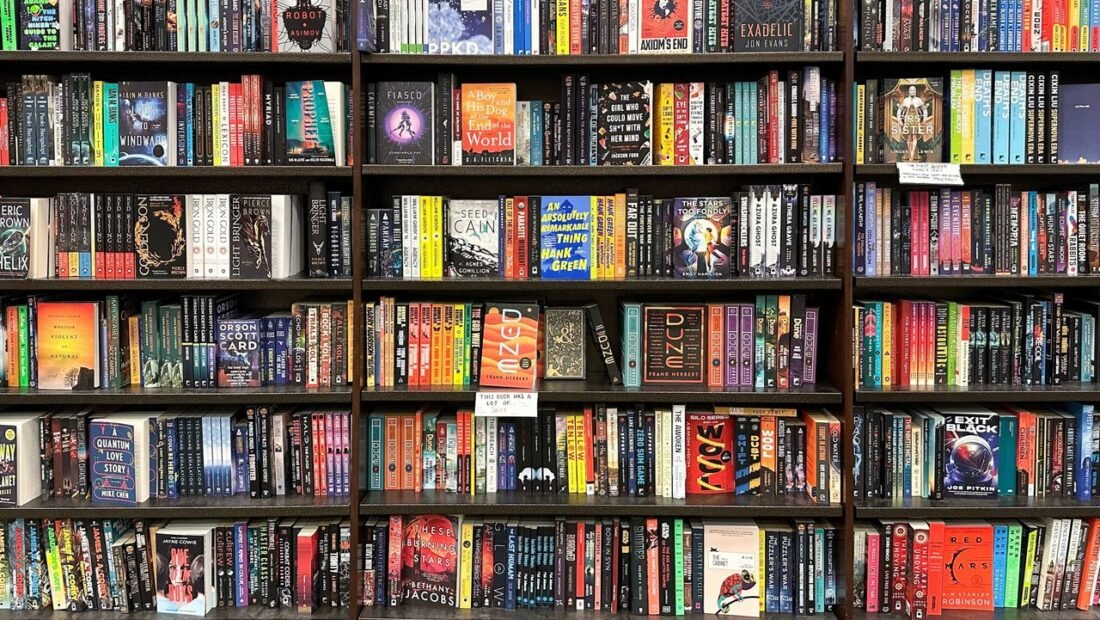
A century of science fiction runs roughly ten thousand novels deep, and the shelf that matters fits about fifteen of them. Fifteen is enough to cover the whole map — desert empires and robot detectives, first contact and time travel, jokes and dread — without turning reading into homework. Start with the fifteen below, in roughly the order listed, and every later science fiction novel will make more sense, because so many of them are answering one of these.
The Essential Shelf: 15 Novels Up Front
- Dune by Frank Herbert — a desert planet, a spice, and a fight for power that is really about ecology and belief.
- Foundation by Isaac Asimov — a falling galactic empire and a plan to shorten the dark age that follows.
- The Left Hand of Darkness by Ursula K. Le Guin — an envoy alone on an ice world where gender works by different rules.
- Ender’s Game by Orson Scott Card — children trained at a battle school for a war adults cannot face directly.
- The Hitchhiker’s Guide to the Galaxy by Douglas Adams — Earth demolished on a Thursday, and the survivor copes badly and hilariously.
- Neuromancer by William Gibson — a washed-up hacker hired for one impossible run through cyberspace.
- Kindred by Octavia E. Butler — a modern woman pulled back to a slaveholding Maryland plantation.
- Snow Crash by Neal Stephenson — a pizza driver and hacker facing a drug, a virus, and a language that all behave the same way.
- The Dispossessed by Ursula K. Le Guin — a physicist caught between a capitalist world and its anarchist moon.
- The Martian by Andy Weir — an astronaut stranded alone on Mars, solving one lethal problem at a time.
- The Three-Body Problem by Liu Cixin — a first-contact mystery that opens in the Cultural Revolution and widens to the fate of the universe.
- Project Hail Mary by Andy Weir — a lone teacher wakes on a spacecraft with no memory and the Sun going dim.
- All Systems Red by Martha Wells — a security android that hacked its own controls and would rather watch serials than guard humans.
- A Memory Called Empire by Arkady Martine — a young ambassador sent to a vast empire with her predecessor’s outdated memories in her head.
- Children of Time by Adrian Tchaikovsky — the last humans searching for a home find a planet remade for spiders.
The Foundations: Empire, Desert, and Ice
Dune earns first place by scale and staying power. Herbert builds Arrakis so completely — its water discipline, its sandworms, its feuding houses — that the planet itself becomes the strongest character, and Paul Atreides’ rise stays gripping even as the book warns against trusting heroes. Read it slowly through the first hundred pages, where names and customs arrive thick and fast. After that the politics click into place and the length stops mattering. It remains the best-selling science fiction novel ever, and rereads keep finding new layers about resources, religion, and propaganda.
Foundation shows the opposite method. Asimov writes plain, idea-first prose across huge spans of time, following Hari Seldon’s science of psychohistory as a galactic empire decays. Individual scenes can feel spare, but the sweep is the pleasure: centuries turning on whether a plan made by a dead man can still guide strangers. The Left Hand of Darkness then proves how literary the genre can be. Le Guin sends an envoy across the frozen country of Gethen, and the long trek across the ice — two people, a sled, dwindling food — carries questions about loyalty, gender, and otherness without ever pausing the journey to lecture. Finish these three and the genre’s range is already clear: spectacle, ideas, and style.
War, Laughter, and the Street-Level Future
Ender’s Game is the most propulsive book on the shelf. Ender Wiggin, recruited as a child to a space battle school, wins games that keep getting crueler, and the book keeps asking what victory costs the person ordered to achieve it. Short chapters and constant stakes make it the classic most often finished in two sittings. The Hitchhiker’s Guide to the Galaxy answers it with pure comedy — Arthur Dent in a dressing gown, a planet destroyed for a bypass, a depressed robot named Marvin. Beneath the jokes sits a sharp habit of looking at human importance from a very long way away, which is why lines from it get quoted decades later.
Neuromancer and Snow Crash map the future at street level. Gibson’s novel essentially invented cyberspace as fiction would picture it, and its lean, image-dense style made computers feel like neon cities long before the web looked like anything. It can feel dense for a first fifty pages; pushing through pays off as the run comes together. Snow Crash takes the same territory louder and funnier — a franchised America, a virtual Metaverse, and a plot that braids linguistics with computer viruses. It predicts and parodies digital life at once. Kindred stands apart from both, and hits hardest. Butler uses a single time-travel device with no machinery and no explanation tour: Dana is dragged to the past whenever a boy’s life is in danger, and survival there demands compromises that follow her home. It is short, clear, and unforgettable, and it shows what the genre can do with history that no realist novel can.
Two Le Guin Poles and the Problem-Solving Turn
The Dispossessed gives Le Guin a second, very different seat on the shelf. Shevex, a physicist from the dry anarchist moon Anarres, travels to the rich mother world his people fled, and finds both societies failing their promises in opposite ways. Few novels argue with themselves so fairly. Readers who finish it often argue back for days, which is the compliment political fiction wants most.
The Martian changes the temperature entirely. Mark Watney, left for dead on Mars, narrates his survival as a chain of practical problems — air, water, food, contact — each fix creating the next emergency. The voice is funny under pressure, and the science is presented plainly enough that a reader can follow the math of potatoes and rocket fuel without a background in either. Project Hail Mary repeats that problem-solving engine at interstellar scale, then adds the finest first-contact friendship in recent fiction: Rocky, an engineer from another star, met without shared language or biology. Talking about more would spoil the shelf’s happiest surprise.
The Newest Layer: Empires, Androids, and Spiders
The Three-Body Problem is the most demanding book here and the most argued about. It begins with a scientist haunted by loss, a strange countdown, and a game that hides a planetary secret, then expands until human history feels small. Its central dilemma — how to respond to a more advanced civilization that may not wish humanity well — has no clean answer, and the physics set pieces are unlike anything in older classics. Patience with the early chapters is repaid many times over.
All Systems Red is the shortest book on the shelf and often the first finished. Murderbot, a part-organic security unit that freed itself and kept doing the job out of habit, narrates with dry reluctance and fierce competence. It asks what a person owes a world that treats it as equipment, at novella speed. A Memory Called Empire slows down again for diplomacy: Mahit Dzmare arrives at the Teixcalaanli court carrying an implant of her predecessor that is fifteen years out of date, into a culture whose poetry is also its politics. Language lovers get the richest meal on the list here. Award lists kept by groups such as the Science Fiction & Fantasy Writers Association, whose Nebula Awards track the field year by year, are a reliable way to find what follows it.
Children of Time closes the fifteen with the biggest canvas. A terraforming project fails, a uplift virus finds spiders instead of monkeys, and the novel alternates between a human ark ship running out of time and a spider civilization inventing its world across generations. The spiders become fully realized characters without ever stopping being spiders, which is a harder trick than it sounds. Anyone who prefers detectives to starships can detour to the best mystery novels for beginners and return later — the shelf waits patiently.
How to Actually Read the Fifteen
Do not force a strict order beyond the first few. A workable path is Dune for immersion, Ender’s Game for pace, Hitchhiker’s Guide for relief, then Le Guin for depth, alternating one older book with one newer book so styles keep refreshing each other. Borrow the expensive hardcovers from a library, buy cheap used paperbacks of the ones already loved, and abandon any single title that stalls after eighty honest pages — taste differs, and another book on the shelf will catch. One warning applies to reading lists of every kind: do not buy all fifteen at once in matching editions. Earn them a few at a time. A shelf built book by book, each one argued with and ranked against the last, is the real prize here — fifteen novels that turn a century of what-if into a conversation a new reader can finally join.