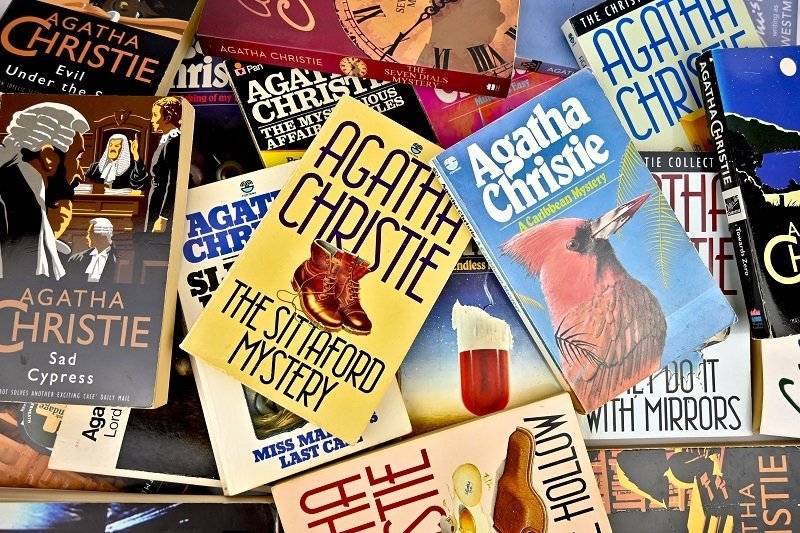
The best-selling mystery novel of all time was published in 1939, and it is still the right first mystery for a beginner today. That is the surprising part of this genre: the front door has been standing open for more than eighty years, and it still works. Below is a checklist of twelve books that cover every corner of mystery, from a locked island to a retirement village, followed by a closer look at each corner and a few habits that make any mystery more fun to read.
The Twelve-Pick Checklist
- And Then There Were None by Agatha Christie — ten strangers on an island, a killer among them, and a plot that runs like a machine.
- The Murder of Roger Ackroyd by Agatha Christie — a Poirot case with the twist that changed what a mystery could do.
- The Hound of the Baskervilles by Arthur Conan Doyle — the most approachable Holmes novel, part detective story and part gothic horror.
- The Big Sleep by Raymond Chandler — Philip Marlowe walks into noir, where style matters as much as the puzzle.
- Gone Girl by Gillian Flynn — two unreliable narrators and a midpoint turn that reshaped modern thrillers.
- In the Woods by Tana French — a literary police procedural with atmosphere to spare.
- The Thursday Murder Club by Richard Osman — four retirees solve crimes, warmly and wittily, with no grimness required.
- Killing Floor by Lee Child — the first Jack Reacher novel, built for one more chapter at midnight.
- Magpie Murders by Anthony Horowitz — a mystery inside a mystery, and a love letter to Christie.
- The 7½ Deaths of Evelyn Hardcastle by Stuart Turton — a time-loop murder mystery with real invention.
- The Silent Patient by Alex Michaelides — a tight psychological puzzle that saves its best move for the end.
- A Good Girl’s Guide to Murder by Holly Jackson — a young adult mystery that works perfectly for adult beginners.
Start With the Classics
Begin where the genre begins. And Then There Were None earns the first spot for a plain reason: it is the best-selling mystery of all time, and it reads like it was written yesterday. Ten strangers are lured to an island, accused by a recorded voice, and picked off one by one. There is no detective to hide behind and no wasted chapter. It is the perfect plot machine, and as a first mystery it sets a standard that makes the whole genre easy to judge afterward.
The Murder of Roger Ackroyd takes a different kind of risk. Hercule Poirot investigates a village murder, the telling seems straightforward, and then the twist arrives and redefines what readers thought a narrator could be trusted to do. Nearly a century later, first-time readers still gasp at it. The Hound of the Baskervilles is the friendliest way into Sherlock Holmes. A spectral hound on a foggy moor gives it the pull of a horror story, while Holmes and Watson keep it grounded as a puzzle. No long study of Victorian London is required, which is exactly why it converts so many new readers.
The Big Sleep points the other direction. Raymond Chandler’s Philip Marlowe is less interested in a tidy puzzle than in moving through a corrupt, glittering Los Angeles with a wisecrack and a code of honor. It is the birth of hardboiled noir in novel form. Readers who find classic whodunits too mannered often fall for Chandler first, because voice carries the book even when the plot tangles.
Reading order inside the classics is flexible, and that flexibility is part of their charm. Christie rewards almost any starting point, though beginning with the island and then the Ackroyd case shows two very different tricks back to back: the closed-circle suspect pool and the unreliable telling. Doyle can be sampled the same way, since the Holmes stories mostly stand alone and the Baskervilles novel gives the fullest taste in a single sitting. Chandler is best read slowly, a chapter or two at a time, because the sentences themselves are the attraction and rushing them wastes the best part. Beginners worried about older language usually find, within ten pages, that all three writers move far faster than their reputations suggest. These books survived a century of competition because they entertain first and impress second, in that order.
Modern Thrillers and Literary Mysteries
Gone Girl is the modern landmark on the list. Gillian Flynn splits the telling between two narrators, neither fully trustworthy, and then lands a midpoint twist that changed commercial fiction for a decade. Love the characters or loathe them, the pages turn. In the Woods slows the pace and deepens the water. Tana French pairs a present-day murder with a detective’s own unresolved childhood case, giving a police procedural real literary weight. The atmosphere does half the work, and the ending trusts readers to sit with uncertainty.
The Silent Patient belongs on the psychological shelf beside Flynn, but plays a cleaner game. A famous painter stops speaking after a shocking crime, a therapist tries to reach her, and the story builds to a stunning ending that sends many readers straight back to the opening chapters. Readers who enjoy arguing about books like these often end up gathering friends around them, and the habits behind how to start a book club with friends fit mystery readers especially well, since every twist gives a group something to debate.
Warm, Fast, and Wonderfully Strange
Not every good mystery is dark. The Thursday Murder Club proves it on every page. Four retirees in a retirement village meet weekly to study cold cases, then get a live one close to home. Richard Osman keeps the tone warm and witty while still delivering a real puzzle. It is the ideal pick for anyone who wants the game without the gore, and proof that mysteries need no grimness to grip.
Killing Floor offers the opposite pleasure: pure propulsion. It is the first Jack Reacher book, and Lee Child writes chapters that end exactly where a reader least wants to stop. For beginners who worry that classics will feel slow, this is the antidote. A Good Girl’s Guide to Murder closes the checklist from an unexpected direction. Holly Jackson wrote it as a young adult mystery, with a student reinvestigating a closed local case, yet adult beginners take to it just as readily. The telling mixes interviews, notes, and case files, which keeps the pace high and the clues visible.
Two picks stretch the form itself. Magpie Murders, by Anthony Horowitz, contains a full Christie-style whodunit inside a modern publishing mystery, so one book delivers two solutions. It is the natural choice for anyone who loved Knives Out. The 7½ Deaths of Evelyn Hardcastle goes further: Stuart Turton traps a manor-house murder inside a time loop, with the investigator waking in a different guest’s body each day. It is wildly inventive, and it rewards attention like few other books on the list. For ongoing coverage of books in this vein, CrimeReads’ mystery and crime fiction coverage is a useful shelf to browse between novels.
Choosing the next book after a favorite gets easier once taste has a name. Readers who loved the puzzle machinery of Christie and Horowitz will usually enjoy other fair-play and golden-age style stories, where the solution can be worked out from the page. Readers hooked by Flynn and Michaelides tend to want psychological pressure, domestic secrets, and narrators with something to hide. Readers who stayed for French’s atmosphere or Chandler’s voice should follow the writing itself, into literary crime where place and character carry as much weight as the case. Naming the pleasure — puzzle, pressure, or prose — turns a random next pick into a reliable one, and a librarian or bookseller given that single clue can aim with surprising accuracy.
Spoilers deserve one practical note. Famous twists, especially the Ackroyd and Gone Girl turns, live all over the internet in listicles, reviews, and casual references. Beginners protect the experience by reading the book before reading about the book, skipping review sections that promise ending discussions, and treating any headline that mentions a twist as a warning sign. The books on this checklist have waited patiently for decades, in most cases. They will survive a few more weeks at the top of a reading pile, unspoiled.
How to Read a Mystery Well
A few habits raise the fun of every book on the checklist. First, never peek at the ending. A mystery’s whole design points forward, and spoiling the answer is the only sure way to flatten it. Second, play along. The fair-play tradition behind most of these books means the clues are genuinely there, placed in the open and disguised by emphasis. Guessing is not a test. It is half the pleasure.
Third, keep a simple suspect-and-motive list, on paper or in a phone note. Add a line each time a character gains a reason, loses an alibi, or tells a story that does not quite match an earlier one. By the final third of a fair-play mystery, that little list often shows a pattern the narrative worked hard to bury, and spotting it a chapter before the detective announces it is one of the great small thrills in all of reading. Even when the list points the wrong way, it proves the book was read closely, which makes the true solution land harder. Writing down who wanted what, and who was where, sharpens attention and makes a well-planted clue feel electric when it clicks. Fourth, accept being wrong with good humor. A mystery that fools a careful reader has done its job well, and the surprise is the reward for playing fair. Finally, know that a great mystery rewards a reread once the solution is known. Scenes change meaning, throwaway lines turn into signposts, and the craft becomes visible. Start with the island. The rest of the genre opens from there.