
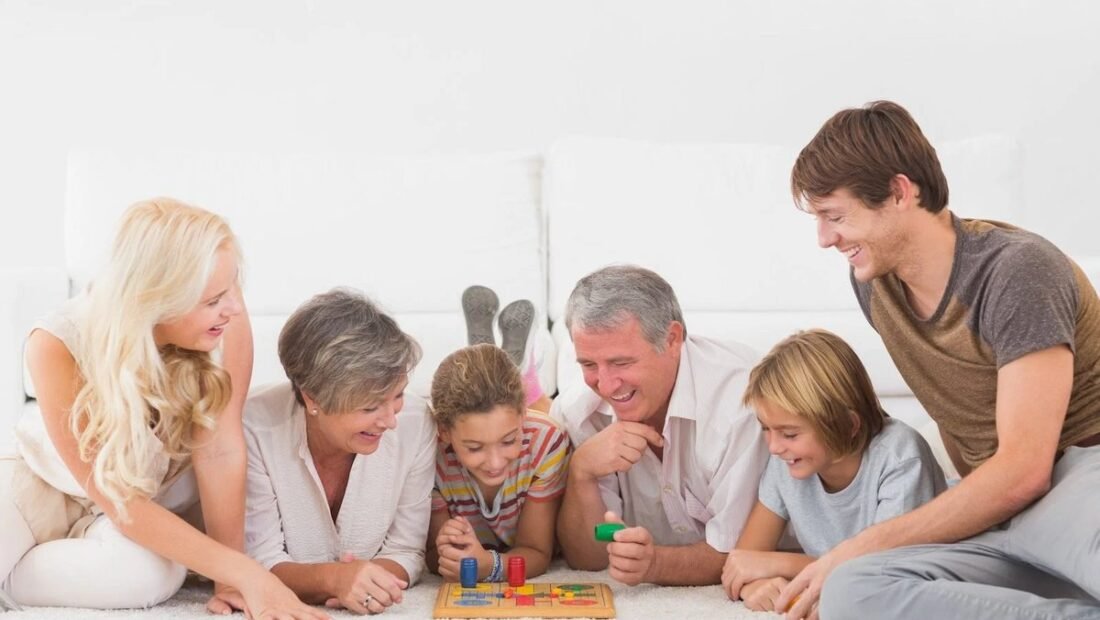
Why do some games get played twenty times while others gather dust after one outing? It is rarely the price, the artwork, or the theme. The games that return to the table share three properties: the rules can be taught in five minutes, nobody is eliminated and left watching, and the outcome stays undecided until late enough that everyone still cares. The short answer to “which board games should a family own?” is: a small shelf of games that pass those three tests for the ages you actually have — not one giant box that claims to suit everyone and suits nobody. The longer answer, by age group, is below, with the buying maths that makes a good shelf cheaper than it looks.
Ages 4–7: cooperation, pictures, and no reading
Little children need games with no reading, short turns, big chunky pieces their hands can manage, and either luck or cooperation doing the heavy lifting, because a five-year-old who loses a forty-minute strategy game experiences it as a verdict on them personally. They also need the session to end before the tiredness does the deciding — for this age, twenty good minutes is a complete and successful game night, and stopping there on a high is a strategy, not a surrender. Cooperative games — where the whole family plays against the game itself, like Hoot Owl Hoot!, where players work together to fly owls home before sunrise — are the revelation in this bracket: everybody wins or loses together, the teaching is one sentence, and the game ends in hugs rather than incidents. Candy Land remains the rite of passage (pure luck, zero decisions, which is exactly right at four), and simple matching and memory games earn their shelf space out of all proportion to their cost. Keep the session to the length of their attention, not the game’s potential: ending while they are still asking for one more round is how next month’s game night gets its audience.
Ages 8–12: the golden bracket — real decisions, short rules
This is where the famous names live, and one stands first for a reason: Ticket to Ride is the near-perfect gateway game — collect cards, claim railway routes across a map, finish your secret destination tickets. The rules teach in minutes, a game runs about forty-five minutes to an hour, decisions are real but gentle, and it quietly teaches the geography of wherever the map is set. Around it, the shelf for this age fills with games of one clean idea each: card games of set-collecting and mild sabotage, tile-laying games where a landscape grows turn by turn, and push-your-luck dice games that produce the table-wide groans and cheers that children remember for years. The industry has a name for this category — gateway games, the ones used to convert non-gamers — and BoardGameGeek’s wiki guide to gateway games is the reference list the hobby itself uses; anything on it was chosen because it teaches fast and stays interesting for the adults, which is the criterion that matters most: a game the adults are bored by will not survive the month, however much the children love it.
Teens and mixed ages: bring the room together
The mixed-age table is the hardest audience in the house — a fourteen-year-old, a parent, and a grandparent have almost nothing in common except this evening. The games that bridge it are the word-and-party games: team word-association games like Codenames, where two teams guess from one-word clues and the table erupts at every near miss; drawing-and-telephone games like Telestrations, where a phrase mutates around the table into comic disaster and nobody needs talent, only the willingness to be bad at drawing in public. Azul — a tile-drafting game of genuine beauty and almost no direct conflict — is the calmer bridge, and Carcassonne, the tile-laying classic, has onboarded more families than any other box in the hobby’s history. Notice what none of these require: no trivia knowledge (which excludes the youngest and the oldest at once), no elimination, no two-hour commitment. The mixed table is held together by laughter and light rivalry, and every pick above is engineered for both.
The maths: why a good game is the cheapest entertainment in the house
A forty-dollar game played twenty times costs two dollars a night — against a family cinema trip at eighty dollars that is forgotten by Tuesday — and the per-play cost of a beloved game keeps falling for years. That maths argues for a strategy most families get backwards: buy fewer, better games. One gateway classic that suits the table beats four novelty boxes bought on hope. And before buying at all, test-drive: many public libraries now lend board games, which lets a family learn in one free evening whether a fifty-dollar game is a twenty-play treasure or a one-play dust collector. Board-game cafés, where they exist, are the other cheap laboratory — the staff will teach the game, which removes the other hidden cost of this hobby, the rulebook evening.
Smaller households: two-player games and the grandparents’ visit
Not every table is a crowd. Couples and single-parent households need games designed for two, which is its own rich category — the two-player shelf (card duels, tile games built for a pair, cooperative puzzle games) is where some of the best design in the modern hobby lives, because a game for exactly two can be as tight and tense as chess or as gentle as a walk. The test for a pair is replayability above all: with only two players, a game repeats fast, so depth matters more than novelty. At the other extreme is the grandparents’ visit — the multi-generational table where the newest gamer is seventy years older than the youngest. There the winning properties are familiarity and visibility: games with a physical, readable board (tiles, dominoes, cards), no hidden information to track, and rules that can be taught by playing one open round together. A family shelf that holds one great two-player game and one great everyone game is insured against both evenings.
What to leave on the shop shelf
The dust-gatherers have tells. Licensed tie-in games — the film, the show, the football club — are usually a famous name wrapped around a thin game, bought by gift-givers rather than players. Giant deluxe editions with hundreds of pieces promise an epic and deliver a storage problem plus a forty-minute setup that eats the evening it was bought for. Games for one narrow age that your children will exit within the year are library loans, not purchases. And anything whose box brags about a playing time over two hours should be interrogated hard before it joins a family shelf: there are households where that is the dream, and they know who they are, because they are already playing them. Buy for the table you have, the evening you actually get, and the five-minute teach — the collection builds itself correctly from there.
Running game night so it survives
The shelf is half the system; the ritual is the other half. Keep a small scores notebook inside the most-played game box — running tallies across months turn single evenings into a family saga, and a saga is what brings everyone back to the table without being asked. Fix the night (Friday works, anchored to the week’s end), let the game choice rotate around the table so every member gets their game championed in turn, and keep first plays short — teach with a practice round, never by reading the rulebook aloud, which is where game nights go to die. Snacks away from the board, drinks in bottles not open cups, and a hard stop while everyone is still having fun rather than at the natural collapse: leaving the table wanting next week is the entire secret. When the children are grown, upgrade the shelf toward the two-player and strategy end of the hobby — how to plan the perfect game night for couples is that shelf’s next chapter.
Quick answers
How many games should we own? Five to eight that fit your ages and get played beats twenty that don’t. Rotate one new box in per season, chosen from a library trial or a café session.
What if my kids only want screens? Start with the party end of the shelf (the drawing game, the word game), play in short sessions, and let the laughter recruit them. Competing with a console on spectacle is hopeless; competing on family comedy is not.
Are the classics — Monopoly, Risk — really a problem? They are long, elimination-based, and famous for family arguments, which is three strikes by this article’s tests. If your family loves them, keep them; if game night keeps dying, they are the first suspects.
Is a more expensive game ever worth it? When it is a proven gateway classic your table will replay for years — the maths section explains why cost per play beats sticker price. It is not worth it for beautiful components on an untested game. Trial first, deluxe later, and let the library card carry the risk.




1 comment