
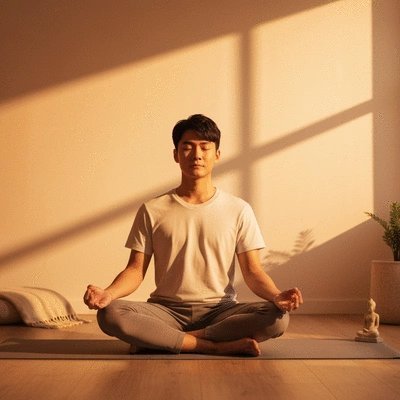
You don’t need a weekend retreat or an hour of yoga to lower your stress. Ten minutes — genuinely just ten — is enough to shift your nervous system out of fight-or-flight, if you use the minutes well. I’ve tested this during the most hectic months of my life, and the difference between ‘ten intentional minutes’ and ‘ten more minutes of scrolling’ is enormous. The promise to “reduce stress in ten minutes a day” sounds too good to be true — until you understand that your nervous system responds to brief, consistent signals.
The science is on your side here. Short bouts of slow breathing, brief movement, and even short nature exposure measurably lower cortisol. The catch: consistency beats intensity. Ten minutes daily outperforms a monthly spa day for baseline stress.
Here are 12 methods that actually fit in ten minutes. Pick one, do it daily for two weeks, and notice what changes.
Breathing Techniques That Work in Minutes
Slow breathing is the fastest lever you have on stress because it directly stimulates the vagus nerve — the brake pedal of your nervous system. The physiological sigh is my favorite: two short inhales through the nose, then one long exhale through the mouth. Repeat for five minutes. Researchers at Stanford found this pattern reduces stress faster than meditation in head-to-head tests.
Box breathing is the classic: inhale four counts, hold four, exhale four, hold four. Navy SEALs use it; you can use it before a tough meeting. Or try 4-7-8 breathing — inhale four, hold seven, exhale eight — which is basically a sedative you do with your lungs. Do any of these for five to ten minutes and your heart rate will drop measurably.
The key is the exhale being longer than the inhale — that’s what signals safety to your body. Set a timer so you’re not clock-watching, close the door, and breathe. The American Institute of Stress has free guided exercises if you want a voice to follow.
Move Your Body for Ten Minutes
Stress is physical — adrenaline and cortisol preparing you to fight or run. Ten minutes of movement burns off that chemistry. A brisk walk around the block is the gold standard: bilateral movement plus fresh air plus a change of scenery. It’s almost unfair how well it works.
No time to go outside? Do a ten-minute bodyweight circuit: 30 seconds each of jumping jacks, push-ups, squats, lunges, and planks, repeated twice. Or just shake it out — literally shaking your limbs for two minutes looks ridiculous and discharges tension remarkably well. Animals do this after a threat; we’re animals too.
Stretching counts as well. Ten minutes of neck, shoulder, and hip openers undoes a day of desk-hunching. Stress lives in the body — shoulders, jaw, hips — and addressing it physically is often faster than thinking your way calm.
Reset Your Mind and Environment
Sometimes stress is a thought loop, and you need to break the circuit. The 5-4-3-2-1 grounding technique: name five things you see, four you hear, three you can touch, two you smell, one you taste. It yanks your brain out of rumination and into the present in about two minutes. Therapists teach this for anxiety because it works.
Step outside for ten minutes of nature — even a parking lot tree counts. Studies show even brief nature exposure lowers cortisol and blood pressure. No nature nearby? Look at nature photos or listen to nature sounds; the effect is smaller but real. Our ideas for unwinding after work pair well with this as an evening routine.
Tidy one small space for ten minutes — a desk, a junk drawer, the kitchen counter. Visual clutter raises cortisol (researchers at UCLA documented this), and a quick reset gives you both order and a sense of control. Set a timer; the boundary is what makes it relaxing instead of another chore.
Reduce Stress in Ten Minutes a Day: Building the Habit
The reason ten minutes works is physiological, not motivational. Your autonomic nervous system doesn’t need an hour to shift states — it responds to signals within minutes. Slow exhales, gentle movement, and sensory grounding all tell your body ‘the emergency is over,’ and the body believes the body. This is why a ten-minute walk can do what an hour of worrying can’t: it speaks the nervous system’s language. Longer sessions are lovely, but they’re not required for the core benefit.
Stack your ten minutes onto an existing transition for maximum stickiness. The commute home, the lunch break, the gap between work and dinner — these are natural seams in the day where a reset fits without scheduling gymnastics. I do mine in the parked car before walking inside: engine off, five minutes of breathing, then in the door as a calmer person. My family can tell the difference on the days I skip it. Find your seam, protect it like an appointment, and let the ten minutes compound. For the full evening wind-down that builds on this, our bedroom-for-sleep guide handles the last hour of the day.
12 Ten-Minute Stress Reducers
- Physiological sigh breathing (2 inhales, long exhale) for 5 minutes
- Box breathing: 4-4-4-4 pattern
- 4-7-8 breathing before bed or big meetings
- Brisk 10-minute walk outside
- 2-minute full-body shake-out
- 10-minute bodyweight circuit
- Neck, shoulder, and hip stretching
- 5-4-3-2-1 sensory grounding
- 10 minutes of nature (or nature sounds)
- Tidy one small space with a timer
- Write a 5-minute brain dump of worries
- Cold water on face and wrists (vagal reset)
Make It Automatic
The method matters less than the habit. Anchor your ten minutes to something you already do: breathing after you park the car, a walk after lunch, stretching while the coffee brews. Habit researchers call this ‘stacking,’ and it’s how behaviors survive busy weeks.
Track it simply — an X on the calendar each day. After two weeks of X’s, you won’t want to break the chain, and by then you’ll have felt the difference: slightly calmer baseline, slightly shorter fuse recovery, slightly better sleep.
Ten minutes is 0.7 percent of your day. You spend more than that deciding what to watch. Spend it on your nervous system instead — it’s the highest-ROI ten minutes you’ll find.



