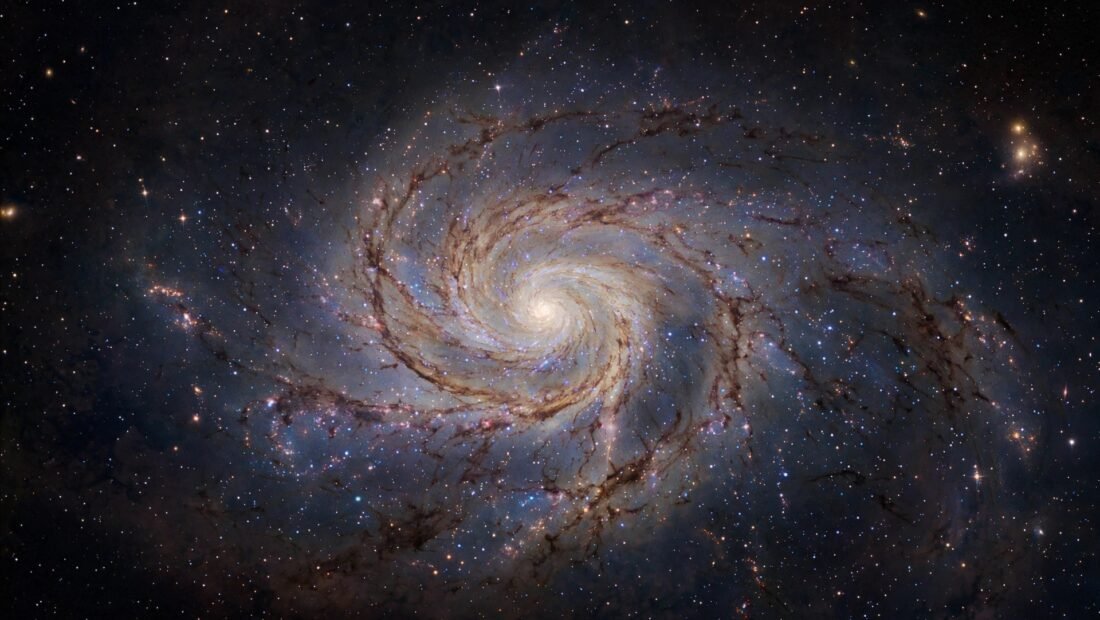
Everything you’ve ever seen — stars, planets, your own hand — is made of ordinary matter. And ordinary matter is only about 5% of the universe. The rest is dark matter (~27%) and dark energy (~68%), neither of which anyone has directly detected. Dark matter is the most embarrassing open problem in modern physics: we can map where it is, weigh it precisely, and watch it sculpt galaxies — but we don’t know what it is, and we can’t see it. Here’s the full story of the universe’s invisible majority.
The Evidence: How We Know It’s There
Galaxies spin too fast. In the 1970s, Vera Rubin measured stars orbiting in spiral galaxies and found the outer stars moving just as fast as inner ones — impossible if only visible matter’s gravity held them. Galaxies should fly apart; something invisible provides the extra gravitational glue. Every spiral galaxy shows the same anomaly.
Galaxy clusters bend light. Gravitational lensing — massive objects bending light from behind them — reveals far more mass in galaxy clusters than visible matter accounts for. The Bullet Cluster is the smoking gun: after two clusters collided, the lensing mass (dark matter, collisionless) separated from the hot gas (visible matter, which collided and slowed) — caught in the act of being two different things.
The cosmic microwave background agrees. The afterglow of the Big Bang carries imprints of the early universe’s composition, and its pattern demands ~27% dark matter to match observations. Three independent lines of evidence — galactic dynamics, lensing, and cosmology — converge on the same number. Dark matter isn’t a fudge factor; it’s one of the best-measured unknowns in science.
What Could It Be? The Suspects
WIMPs (Weakly Interacting Massive Particles): the longtime favorite — hypothetical particles that interact only through gravity and the weak force. Decades of exquisitely sensitive detectors (buried deep underground to shield from cosmic rays) have found nothing, progressively ruling out the most plausible WIMP territory. The silence is deafening and has pushed the field toward alternatives.
Axions: ultra-light hypothetical particles originally proposed to solve a different physics puzzle. They’re now a leading candidate — so light that they’d behave more like a wave than a particle, detectable through their faint conversion to photons in strong magnetic fields. Dedicated experiments are hunting them now.
Sterile neutrinos, primordial black holes, dark photons: the bench of candidates is deep. Primordial black holes (formed in the Big Bang’s first moments) could account for some dark matter, though lensing surveys limit how much. Each candidate predicts different detection signatures, which is why the search uses many approaches at once.
Or maybe it’s not matter at all: modified gravity theories (MOND and successors) propose that our theory of gravity itself breaks down at galactic scales — no invisible matter needed. These explain galaxy rotation beautifully but struggle with the Bullet Cluster and cosmic microwave background, where dark matter as actual stuff fits better. Most physicists bet on particles, but the door stays open.
Why Can’t We See It? The Nature of the Problem
“Seeing” means interacting with light — emitting, absorbing, or reflecting photons. Dark matter appears to do none of these; it interacts (as far as we can tell) only through gravity. A cloud of dark matter is perfectly transparent and intangible — it passes through you, the Earth, everything, constantly, without a trace. Billions of dark matter particles likely stream through your body every second, utterly undetectable to your senses.
This isn’t like searching for a hidden planet (which reflects light) or a distant star (which emits it). It’s searching for something whose only confirmed interaction is the weakest force in nature, at scales where that force is feeblest. Direct detection means catching a single dark matter particle bumping a single atomic nucleus in tons of ultra-pure detector material — an event expected maybe a few times per year, buried under background noise from cosmic rays and natural radioactivity. Hence detectors buried a mile underground in abandoned mines.
The search has three prongs: direct detection (catch a particle hitting a detector), indirect detection (spot the gamma rays or antimatter from dark matter particles annihilating in space), and production (create dark matter at particle colliders like the LHC and infer it from missing energy). All three have come up empty so far — which is informative (it rules things out) but increasingly uncomfortable.
What Dark Matter Does: The Universe’s Scaffolding
Here’s the profound part: without dark matter, you wouldn’t exist. In the early universe, dark matter’s gravity gathered ordinary matter into the first structures — its invisible scaffolding determined where galaxies formed. Computer simulations of cosmic evolution only produce the observed universe (galaxies, clusters, the cosmic web) when dark matter is included; without it, everything stays a smooth soup. Dark matter is the architect; visible matter is just the paint.
It also continues shaping galaxies today: the Milky Way sits inside a vast dark matter halo (~a trillion solar masses) whose gravity holds our galaxy together as it spins. Every star you see is embedded in invisible structure ten times more massive than everything visible.
Texas Connections: The Search Runs Through Here
The hunt for dark matter has Texas fingerprints: the state’s universities contribute to detector experiments and theoretical work, and Texas’s dark skies (Big Bend, Davis Mountains) host the observatories mapping dark matter through gravitational lensing. The Hobby-Eberly Telescope’s dark energy survey work at McDonald Observatory complements the dark matter quest — the two dark unknowns are deeply intertwined in cosmic history. For the astronomically curious, the best science fiction books of all time offer the imaginative complement to the real science.
What If We Never Find It?
Worth asking: what if dark matter is undetectable in principle — interacting only gravitationally, forever beyond our instruments? Then we’d have reached a genuine limit of empirical science: knowledge of something’s existence, distribution, and effects, without ever touching the thing itself. Some physicists are already preparing for this possibility, developing theories that work regardless. But history counsels patience: neutrinos were “undetectable” for 25 years after being proposed; gravitational waves took a century. The universe has a habit of yielding — eventually.
Conclusion
Dark matter is invisible because it shuns light entirely, interacting (seemingly) only through gravity — yet its gravitational fingerprints are everywhere: in spinning galaxies, bent starlight, and the Big Bang’s afterglow. We know it’s ~27% of everything, we know it’s the scaffolding the visible universe hangs on, and we have no idea what it is. That combination — precise knowledge of our ignorance — is what makes it the greatest detective story in modern science. The answer, when it comes, will likely rewrite physics.
To ponder dark matter under truly dark skies, consider the best scenic train rides in the U.S. — several cross West Texas dark-sky country near the observatories hunting it.
For the cosmic context, NASA’s universe exploration explains dark matter’s role in cosmic evolution.
And NSF physics research funds much of the U.S. dark matter search.
Frequently Asked Questions
What is dark matter made of?
Unknown — that’s the central mystery. Leading candidates include WIMPs, axions, and sterile neutrinos (hypothetical particles), or possibly primordial black holes. Decades of searches haven’t identified it yet.
Why can’t scientists see dark matter?
It doesn’t emit, absorb, or reflect light — it appears to interact only through gravity. “Seeing” requires light interaction, so dark matter is perfectly transparent and intangible to every telescope and sensor.
How do we know dark matter exists if we can’t see it?
Three independent lines of evidence: galaxies spin too fast for their visible mass, gravitational lensing reveals invisible mass in clusters, and the cosmic microwave background’s pattern requires ~27% dark matter. All converge on the same answer.
Could dark matter just be a mistake in our gravity theory?
Modified gravity theories exist and explain some observations, but struggle with the Bullet Cluster and cosmic background data where particle dark matter fits precisely. Most physicists favor unknown particles, but the debate continues.
Is dark matter dangerous? Does it pass through us?
Billions of dark matter particles likely pass through your body every second with zero effect — if it interacted meaningfully with ordinary matter, we’d have detected it long ago. It’s completely harmless.