
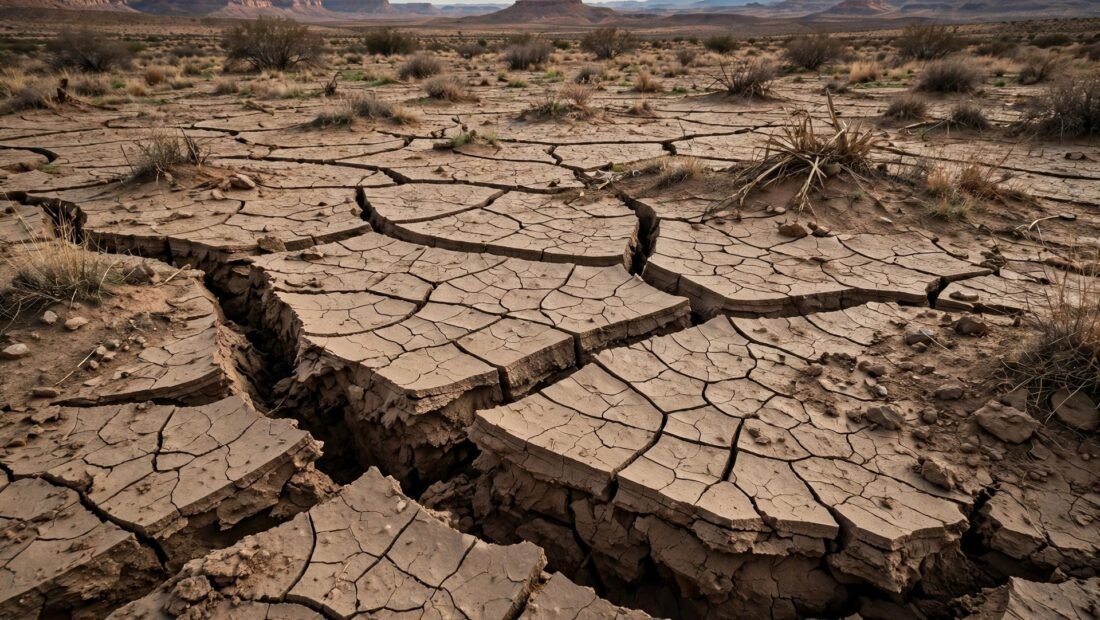
The ground under Texas moves more often than most Texans think. A rumble in West Texas, dishes rattling near Midland, a small shake outside Dallas that half the street sleeps through — these are no longer rare surprises. Some of that shaking comes from old faults doing what faults have always done. Some of it ties to the oil fields. Either way, the same questions come up, usually in this order: how does an earthquake start, why here, can anyone warn us, and what should a household actually do?
How does an earthquake actually start?
Earth’s outer layer is made of large rock plates that move very slowly, about as fast as fingernails grow. Where rock along a fault catches and locks, the movement does not stop. It bends and strains the rock instead, the way a rubber band stretches while you hold its ends in place. That strain can build for years or far longer, quietly, with no sign at the surface.
When the stress finally beats the friction holding the fault, the rock slips in seconds. The stored energy travels outward as waves, and that release is the earthquake. The spot underground where the slip begins is called the hypocenter. The place on the surface directly above it is the epicenter. In a large event the rupture can run for miles along the fault. The well-known 1906 San Francisco rupture ran for nearly 300 miles.
Magnitude and intensity are not the same thing, and mixing them up causes real confusion. Magnitude measures the energy released at the source, on a scale where each whole step up means roughly 32 times more energy. Intensity describes how strongly a particular place shook and what damage followed there. One quake has one magnitude, but many intensities, fading with distance and changing with local soil.
Why does Texas shake at all?
Texas is not on a plate boundary like California, but it has old fault systems, especially in West Texas, and rock that carries stress from far away. West Texas has produced natural quakes for as long as records exist. The Big Bend and Trans-Pecos country sit in a region where the crust has been stretched in the past, leaving faults that can still move.
On top of that natural background, Texas added a human driver. Oil and gas work produces huge volumes of salty wastewater. For years much of it was pumped deep underground through disposal wells. That added fluid raises pressure along old faults that were already close to slipping. Higher pressure pushes fault surfaces apart just enough to lower the grip between them. The fault does not need to be created. It only needs to be nudged.
That link explains the pattern people noticed around Dallas-Fort Worth in the late 2000s and 2010s, and later in the Permian Basin, where swarms of small to moderate quakes clustered near heavy disposal activity. It also explains why limits on injection volumes and pressures in the most active areas have been followed in some places by lower quake rates. Turn the pressure down and the nudging slows. For monitoring data and hazard maps, the U.S. Geological Survey’s earthquake information and monitoring is the national reference, alongside Texas’s own seismic network.
What was the biggest earthquake in Texas history?
The commonly reported largest quake in Texas history is the 1931 Valentine earthquake in West Texas, with an estimated magnitude of around 6.5. It struck near the town of Valentine, cracked walls and toppled chimneys across the region, and was felt over a wide area. The estimate deserves careful wording. Instruments in 1931 were sparse, so the figure is reconstructed from damage reports and the limited records of the time rather than measured the way a modern quake would be.
Later natural events, including a magnitude 5.7 quake near Alpine in 1995, confirm that West Texas faults can produce damaging shaking without any human help. More recent events in the magnitude 5 range in the Permian Basin area have drawn attention precisely because they occurred in the middle of the modern disposal era, where natural and induced causes are harder to separate for any single event. The honest summary is simple: the state’s largest known quake was natural, it happened long before modern oilfield injection, and it shows what Texas faults are capable of on their own.
Can scientists predict an earthquake?
No. Nobody can state the day, place, and size of a specific future earthquake, and anyone claiming they can is selling something. This is not a lack of effort. Decades of work have tested proposed warning signs — odd animal behavior, gas seeping from the ground, electrical signals, groundwater changes — and none has held up reliably. Signs appear without quakes. Quakes arrive without signs. A method that cries wolf most of the time and misses real events is not a prediction method.
The core problem is access. Weather forecasters watch the sky directly. Seismologists cannot watch a fault ten miles down, under immense pressure, as strain builds. They infer conditions from surface instruments, past behavior, and lab experiments on rock. That inference is good enough for some valuable work. It is not good enough for a date and time, and there is no clear path showing it will be soon.
What can scientists forecast, then?
Forecasting is different from prediction, and it is genuinely useful. Over periods of decades, scientists estimate how likely quakes of a given size are in a region, using fault history, measured slip rates, and records of past events. Forecasts in that style — a stated chance of a large quake in a broad area by a given year — guide building codes, insurance pricing, and infrastructure planning. They cannot tell you to leave town on a Tuesday. They can tell a city to bolt its schools and design its bridges for the shaking its faults can deliver.
Aftershock forecasting is the shorter-term success story. After a main quake, aftershocks follow fairly well-understood rules, and scientists can give useful odds for further shaking in the days and weeks that follow. That helps emergency crews decide where to work and helps residents judge risk while repairs begin. Research using machine learning on lab rock-fracture tests may sharpen these tools. Whether it ever grows into true prediction remains unproven.
Does Texas have an early warning system?
Texas has monitoring, but no public early warning system of the kind many people picture. The state is watched by TexNet, a seismic monitoring network run through the University of Texas system, which detects quakes, locates them, and publishes the results. Monitoring tells you what happened, where, and how big, usually within minutes. That is essential science and it feeds everything else, but it is not an alert on your phone before shaking starts.
A public early warning system, such as the ShakeAlert system operating on the West Coast, works differently. It uses the fact that the first waves from a quake travel faster and do less damage than the stronger waves behind them. Sensors near the epicenter catch those first waves and race an alert ahead of the shaking, buying seconds to tens of seconds — enough to drop and cover, slow a train, or pause a machine. Texas does not currently offer a public ShakeAlert-style service. Phrase it that way and you have it right: strong monitoring, no public early warning. Anyone planning around an alert that does not exist is planning around a gap.
What should you do during shaking?
Drop, cover, and hold on. Drop to hands and knees so the shaking does not throw you down. Cover your head and neck, ideally under a sturdy table, and hold on to that shelter as it moves. Stay away from windows, tall unsecured furniture, and heavy objects that can fall. If you are in bed, stay there, cover your head with a pillow, and keep shoes and a flashlight within reach for afterward — broken glass is a classic source of quake injuries, usually after the shaking stops, when people walk barefoot through a dark room.
Skip the old doorway advice. Modern doorways are no stronger than the rest of a house. Outdoors, move clear of buildings, power lines, and walls. In a car, pull over away from bridges and overpasses and stay inside until shaking ends. Most injuries in moderate quakes come from falling and flying objects, not from buildings collapsing, which is why cover matters more than running.
What should a Texas household prepare?
Keep 72 hours of water and supplies: a gallon of water per person per day as the standard planning figure, food that needs no cooking, medications, a flashlight, batteries, and a basic first aid kit. This is the same kit that serves through a hurricane, a freeze, or a long power outage, which in Texas makes it doubly worth having. Secure the obvious hazards at home. Strap the water heater, anchor tall bookcases to studs, and put latches on kitchen cabinets if you live in an active area. Know how to shut off gas and water, and keep the tool for it where you can find it in the dark.
Think about the car as well as the house, since a quake can catch you on the road or leave roads blocked afterward. The same planning behind what to include in an emergency kit for your car — water, light, a blanket, basic tools — covers the hours after a quake better than any prediction app. Check, too, what your insurance actually covers. Standard Texas homeowners policies generally do not cover earthquake damage. Separate cover or a rider may be available, and in the most active parts of West and North Texas it is at least worth pricing.
Will Texas quakes keep happening?
Yes, at some level, for both reasons covered above. Natural faults in West Texas will keep releasing strain on their own slow schedule, as they did in 1931 and 1995. Induced quakes will track human choices: how much wastewater goes down, how deep, how fast, and how close to stressed faults. Regulators adjusting disposal rules in response to shaking have already shown that this second category can be turned up or down.
That split is, in a strange way, the hopeful part of the story. The part of Texas seismic risk that people created is the part people can reduce. The natural part cannot be switched off, but it can be built for, monitored, and prepared for. No one will hand you a date for the next quake. A secured water heater, a stocked shelf, and a household that knows to drop, cover, and hold on are worth more than any forecast that pretends otherwise.


1 comment