Picture the morning honestly: a turkey roughly the size of a toddler, an oven you have never asked this much of, relatives arriving at noon, and you — hosting Thanksgiving for the first time — standing in the kitchen doing math about thawing that should have happened on Sunday. Here is the reassuring truth every experienced host knows: Thanksgiving dinner is about ninety percent planning and ten percent cooking, and the cooking itself is mostly one bird roasting undisturbed while you do other things. Nobody is born knowing the timeline. Every calm host you have ever seen was once a terrified first-timer reading instructions off a phone with flour on it. The difference between their dinner and a disaster is the schedule below, worked backward from the moment you sit down.
Two weeks out: decide everything decidable
This is the week of lists, not cooking. Fix the guest count and ask the dietary questions now — vegetarian cousin, nut allergy, the uncle who cannot do onions — while menus can still bend. Write the menu with discipline: the turkey, one stuffing, potatoes, one green vegetable, one orange vegetable, cranberry sauce, gravy, rolls, and one or two pies is a complete and honorable spread; every dish beyond that trades directly against your calm. Delegate deliberately: assign specific dishes to specific guests (“your green bean casserole, serves ten, arrives warm at 12:30”) rather than accepting “I’ll bring something,” which produces four desserts and no sides. Check your equipment against the menu — roasting pan, meat thermometer, carving knife, enough chairs, enough plates — and borrow or buy the gaps this week, while stores are calm. If a meat thermometer is not on that list, put it at the top: it is the single tool that separates confident hosts from anxious ones.
One week out: shop in two waves
Wave one is everything that cannot spoil: canned pumpkin, broth, flour, sugar, spices, drinks, ice, napkins, foil, and the storage containers you will need for leftovers. Wave two, a few days later, is the fresh food. Buy the turkey now if it is frozen — you want it in your fridge, not in a store’s last-week frenzy. Size it by the simple rule: one to one and a half pounds of whole bird per person, which sounds like a lot until you account for bones, shrinkage, and the leftovers that are frankly a major point of the holiday. Confirm contributions with your delegates, in writing, with arrival times. Lay the serving dishes out on the table with sticky notes naming their dish; this ten-minute exercise reveals, a week early, whether you own enough platters, and it makes Thursday’s plating a matter of matching labels.
Four days out: the thaw, the most important non-event
A frozen turkey thaws in the refrigerator at roughly twenty-four hours for every four to five pounds — so a sixteen-pound bird needs about four full days, and this arithmetic is the most common first-timer failure in the entire holiday. Put the bird on a rimmed tray on the bottom shelf (it will drip), and then leave it alone. If you are reading this with two days to go and a frozen turkey, the cold-water rescue works: keep the bird in its wrapper, submerge it in cold water, change the water every thirty minutes, and allow about thirty minutes per pound. Never thaw on the counter; the surface reaches unsafe temperatures while the center is still ice. While the bird thaws, use these days for the make-aheads that improve with rest: cranberry sauce (better on day three than day one), pie dough, compound butter, and turkey or chicken stock for the gravy if you are making your own.
The day before: everything that can be done, done
Wednesday is your real cooking day, and its goal is a Thursday that feels like assembly rather than battle. Assemble the stuffing ingredients (keep bread stuffing and bird separate until cooking time, or bake the stuffing entirely on its own — the safer and simpler route). Prep the sides to the point of “oven-ready”: potatoes peeled and held in water, green beans trimmed, casserole built and refrigerated. Make the pies. Set the table completely — plates, glasses, the serving dishes with their sticky notes finally removed. Chill the drinks. Lay out Thursday’s timeline on paper, on the counter, where a helper can read it without asking you anything. Then stop, eat a normal dinner you did not cook from the menu, and sleep; a rested host is a menu item too. For the bird itself, the roasting method that keeps it moist is covered step by step in how to make a juicy turkey for Thanksgiving — read it tonight, not at 9 a.m. tomorrow.
Thanksgiving morning: the bird goes in, the clock takes over
Work backward from serving time. A sixteen-pound turkey needs roughly four hours of roasting at 325°F, plus a rest of twenty to thirty minutes, plus carving time — so a 2 p.m. dinner means a bird in the oven by about 9:30 a.m. Keep the preparation genuinely simple: pat the skin dry, rub with oil or butter under and over the skin, salt and pepper generously, aromatics — an onion, an apple, herbs — in the cavity, and into the oven it goes. Resist elaborate brines and any frying experiment in your first year; simple and roasted beats ambitious and chaotic. The thermometer is the only doneness test that matters: 165°F in the thickest part of the thigh, not touching bone. Pop-up timers are famous for lying, in both directions. Butterball’s turkey calculators and cooking help will confirm times and temperatures for your exact bird size if you want a second opinion on the day — generations of first-timers have leaned on exactly that.
Two habits protect the roast. First, keep the oven door closed: every admiring peek drops the temperature and stretches the timeline, which is how birds end up late. The turkey does not need basting to be good — a dry skin at the start and butter under it do more for the result than a basting schedule does. Second, trust the thermometer over the clock in both directions. Turkeys finish early about as often as they finish late, and a bird resting under foil holds its heat graciously for the better part of an hour, which means an early turkey is a relaxed schedule and a late one is just information. Check the thigh temperature in the final stretch, not at the halfway panic point.
The final hour and the table
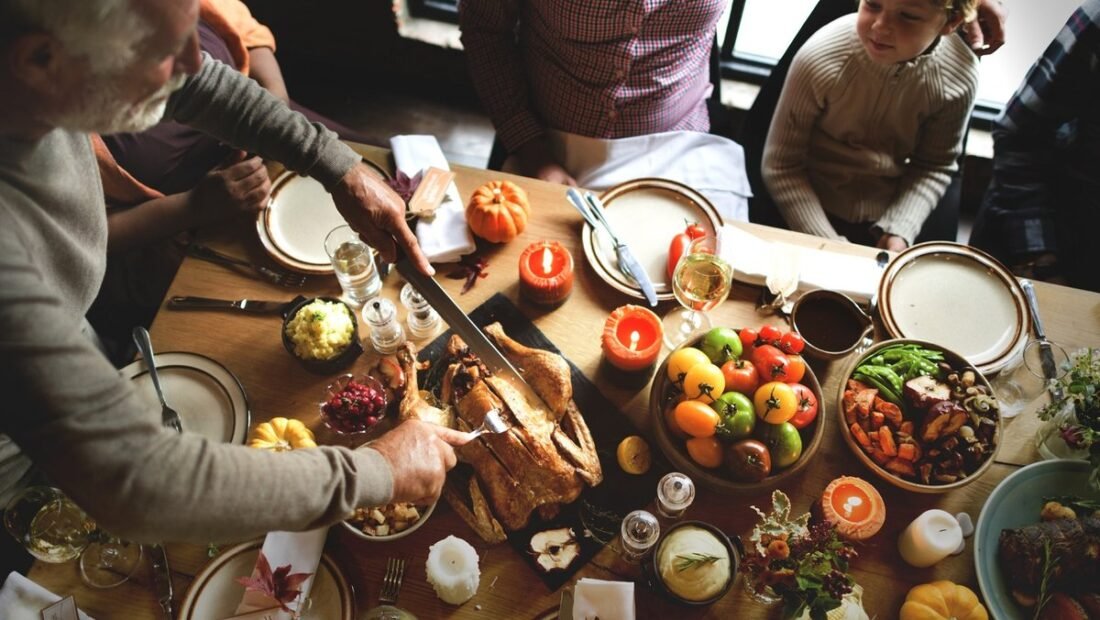
While the turkey rests under foil — resting is not optional; it finishes the cooking gently and lets the juices redistribute so the meat carves moist instead of flooding the board — the oven finally frees up for the sides’ last bake, the gravy gets built from the drippings, and the rolls warm. This is why the rest matters logistically as much as culinarily: it is the hinge the whole hour swings on. Put out simple appetizers early in the day — cheese, crackers, nuts, a vegetable plate — not as a course but as crowd management, keeping hungry arrivals happy and out of the cooking lane. Carve in the kitchen and carry a platter to the table; carving at the table is theater for people who have done this twenty times. Then sit down yourself, in a real seat, with a full plate, before anyone’s gravy congeals — the host who never sits has not finished hosting, and it is your dinner too.
Hosting: the part that is not cooking
While the turkey does its long, quiet work, your actual job is people. Set up a drinks station away from the kitchen — water, ice, glasses, a bottle opener — so guests hydrate themselves without crossing your cooking lanes. Have the appetizers out before the first arrival, because the first thirty minutes of any gathering are socially fragile and snacks are structural. Plan seating loosely rather than not at all: spread the talkative, seat the hard-of-hearing away from the kitchen noise, and give children a defined corner with something to do that is not a screen. Build one genuine pause before the meal — a toast, a round of thanks, thirty seconds of quiet — not as ceremony for its own sake but because a table that starts together eats together better. And schedule your own small mercy: fifteen minutes, somewhere in the late morning, when you leave the kitchen entirely, sit down with a drink, and let the timeline run without you. The dinner will survive it. So, more importantly, will you.
After: the hour that makes next year easy
Accept cleanup help specifically rather than waving it off, and send leftovers home in the containers you bought two weeks ago — being the house that sends people away with turkey is a reputation worth having. Get perishables into the fridge within a couple of hours. Then, on Friday, take ten unglamorous minutes to write down what actually happened: when the bird went in, when it was truly done, which dishes vanished and which one nobody touched, the thing you forgot (there is always a thing). That single page of notes is the difference between next year’s first-timer nerves and next year’s calm — because next year you will not be a first-timer. You will be a person with a timeline, a thermometer, and notes.