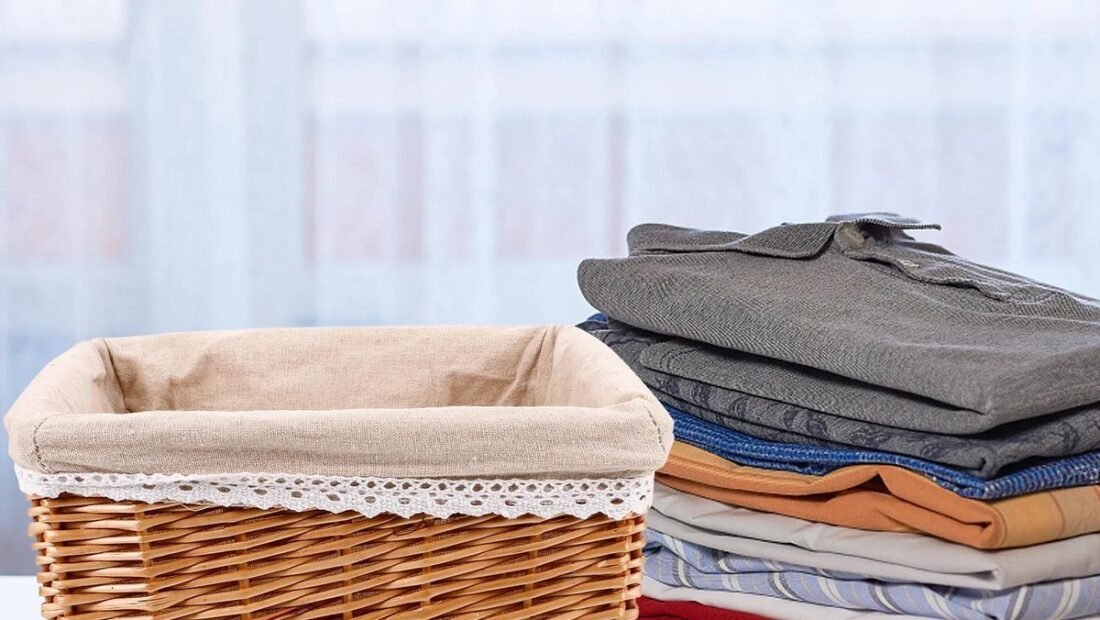
Every household has one: the laundry chair. Clean clothes go there to wait — for folding, for putting away, for a burst of energy that keeps not arriving — and within a week the chair is a geological formation of everyone’s wardrobe, mined each morning by people digging for socks. Laundry becomes a chore not because washing clothes is hard, but because the typical system saves it all up into one enormous weekly event with four unpleasant stages, each easy to abandon halfway. The fix is not motivation. It is replacing the weekly mountain with a set of small systems that keep laundry moving a little every day, so it never becomes an event at all. Fourteen of those systems follow, grouped by the stage they fix.
The core switch: smaller, daily, unfinished-proof
The foundation is the daily load. Instead of six or seven loads on Saturday — roughly six hours of elapsed chore, with folding saved for the moment you are most tired of it — run one load a day. A single load costs about fifteen minutes of actual hands-on time spread across the day: two minutes to start it, three to move it, ten to fold and carry. Because the load is small, it can survive interruption; because it happens daily, nothing ever piles into a crisis. Pair it with the second system, a strict same-day finish: a load is not done when it is dry, it is done when it is in drawers, and the ten-minute fold happens while it is still warm and small enough to be boring rather than daunting. The third system protects the first two: a hard rule that the machine never holds a wet load overnight, since the sour-smelling rewash is the tax procrastination charges.
Sorting systems: decisions made before wash day
Most sorting misery comes from making a hundred tiny decisions at the machine. Move the decisions upstream. A divided hamper — lights, darks, and a small third section for delicates or workout gear — sorts laundry at the moment clothes come off, which is when the information about them is free. A separate small basket or hanging bag for stained items keeps treatment from depending on memory. Per-person baskets are the fourth and fifth systems working together: each household member gets a basket, clean clothes are folded straight into the owner’s basket, and the basket’s owner completes the last meter of the journey. Children old enough to carry a basket are old enough to own this stage, which quietly removes the central laundry bottleneck in most homes: one adult as the sole distribution network. For the mechanics of sorting, water temperatures, and fabric care, Tide’s guide to sorting, washing and drying laundry is a solid reference to keep bookmarked.
Washing less: the load you never run
The cheapest load is the one that never happens. A household can reasonably cut its total laundry volume by around a quarter simply by not washing barely-worn clothes: jeans, sweaters, and jackets worn for a few indoor hours are not dirty, and a “wear again” hook or chair — a designated, respectable one, not the archaeology pile — gives them a home between wears. Towels and sheets get their own fixed cadence, say one set day a week, rather than joining the daily stream. The wardrobe itself is a system: fewer, more interchangeable clothes in similar colors means fewer specialty loads, faster sorting, and simpler folds; a household capsule wardrobe in two color families can collapse darks and lights into near-identical handling. And color-catcher sheets earn their place as a system of their own, because they let mixed loads run safely, which means the daily load never has to wait for a full load of one color to exist.
Folding, stains, and the last ten percent
Folding fails because it is a separate appointment; attach it to something that already happens. Fold during a podcast, a call, or the first ten minutes of a show, in the room where the watching happens, with baskets already there. Hang-don’t-fold is the companion system: anything that goes on a hanger should be hung at the dryer door, on hangers kept beside the machine, because a shirt hung in five seconds never becomes a wrinkled shirt ironed in five minutes. Stains get a station, not a scramble: a small caddy by the hamper with a stain stick and a soaking bucket, so treatment happens at undressing time, when it works, instead of at wash time, when it is archaeology. Finally, keep a simple “good enough” standard written into the system: towels folded in thirds by whoever is nearest, children’s clothes folded loosely, perfection reserved for the two categories anyone actually sees. Pair this with the same realistic thinking behind a realistic cleaning schedule for a working mom and the house’s two most resented chores both shrink to maintenance size.
The machine settings quietly doing damage
A system view of laundry includes the appliance itself, because the wrong defaults undo good habits. Overdosing detergent is the most common: excess soap does not rinse out fully, leaves fabric stiff and gray over time, and can leave the machine itself smelling — the dose lines on the cap exist because more is measurably worse past them. Load size is the twin error; a drum packed to the door cannot agitate or rinse properly, so the daily-load household wins twice, once on time and once on wash quality. Temperature discipline helps everything last longer: cold water for most everyday loads protects colors and fabrics and cuts energy use, with warm or hot reserved for towels, bedding, and illness weeks. And the machine needs its own small cadence — a monthly hot empty cycle or cleaning tablet, the door left ajar between runs — because a musty machine perfumes every clean load it touches, and no folding system can fix laundry that comes out smelling wrong.
Special cases: small spaces, big seasons
The systems bend for circumstances. In a small apartment with a compact washer or a shared laundry room, the daily load becomes the every-other-day load, and the divided hamper matters even more because sorting space is what you do not have; a hanging drying rack, folded away between uses, keeps air-drying from colonizing the living room. Households with athletes, tradespeople, or toddlers in a mud phase run a different problem: a genuinely filthy category that would poison a mixed load. Give that category its own small hamper and its own twice-weekly load with a pre-soak, and let the daily system stay gentle. Travel weeks and illness weeks break every system temporarily; the recovery move is not a heroic catch-up day but two loads a day for three days, which restores the rhythm without recreating the mountain. The system is the rhythm, not the streak — a rhythm can resume after an interruption, while a broken streak just feels like failure.
Starting this week without a shopping trip
No equipment is required to begin. Tonight, split whatever hamper you have with a spare bag for the second category, and start tomorrow’s first daily load before breakfast so it is ready to move at lunch and fold in the evening. Designate the wear-again spot — a hook behind a door works — and end the evening by carrying one basket to its room. On day three, add the stain stick by the hamper. On day five, hand one basket to its rightful owner permanently. By the following weekend, the moment the old system would have consumed arrives and passes almost unnoticed, which is the entire point: not a laundry triumph, not a before-and-after photograph, just the quiet absence of a problem that used to run the house’s schedule every single week without fail.
The 14 systems, listed
- One small load every day instead of a weekly mountain
- Same-day finish: no load counts as done until it is in drawers
- Never leave a wet load sitting in the machine
- Divided hamper that sorts at undressing time
- Separate stained-items bag so treatment needs no memory
- One basket per person, owned and carried by that person
- Children distribute and put away their own laundry
- A “wear again” spot for barely-worn clothes
- Fixed weekly cadence for towels and sheets
- A smaller, color-coordinated wardrobe that washes simply
- Color-catcher sheets so mixed loads are safe
- Folding attached to an existing habit, never its own appointment
- Hanging at the dryer door for anything that lives on a hanger
- A stain station at the hamper, used the moment clothes come off
Adopt them in the order that hurts least. Most households start with the daily load and the divided hamper, because those two change the shape of the problem immediately; the per-person baskets and the stain station follow once the daily rhythm holds. The goal state is unglamorous, quiet, and absolutely worth wanting: laundry as a background process of the house, noticed about as much as the dishwasher — a few minutes here and there, no mountain, no chair, no digging for socks at dawn in a panic, and no Saturday ever sacrificed to the washing machine again.