
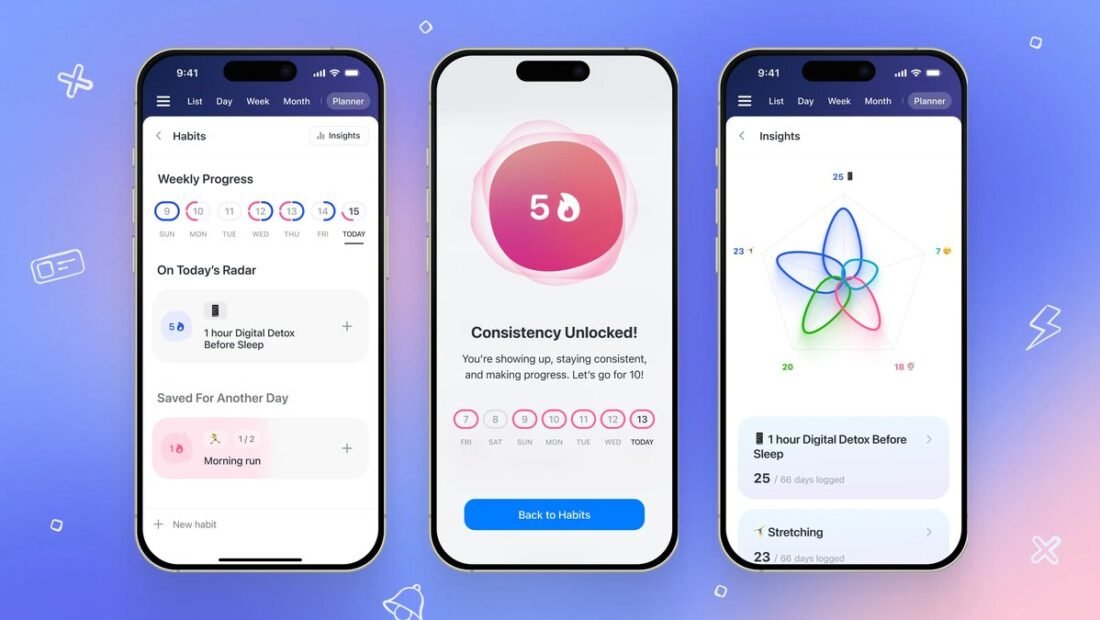
I’ve tracked habits on paper, in spreadsheets, and in roughly nine different apps. The app matters less than the psychology, but the right app removes enough friction that the habit actually survives February. The wrong one becomes another abandoned icon.
The best apps for tracking daily habits do four things: make check-ins take seconds, show your streak (the don’t-break-the-chain effect is real), remind you at the right time, and stay out of your way otherwise. Everything else — social features, AI coaching, elaborate analytics — is garnish.
Here are 12 worth your home screen, organized by what they do best.
Best Simple Streak Trackers
For pure ‘did I do it today’ tracking, simplicity wins. Streaks (iOS) is the gold standard — beautiful, fast, with smart reminders and Apple Health integration, and it nags you exactly the right amount. Habitica (iOS/Android, free) turns habits into an RPG: complete tasks, level up your avatar, join parties for accountability. It sounds silly; the gamification genuinely works for the game-brained.
Loop Habit Tracker (Android, free, open-source) is the minimalist’s choice — no account, no cloud, no nonsense, with excellent charts. For the paper-inclined, the Everyday Calendar concept (one wall calendar, one X per day) remains undefeated, and apps like Everyday (iOS/Android) digitize exactly that. Sometimes the best app is the one that does one thing.
The rule for simple trackers: if check-in takes more than five seconds, you’ll stop. Test the widget — the best habit apps live on your home screen as one-tap widgets, because opening an app, navigating, and tapping is three frictions too many.
Best for Building Systems (Reminders + Routines)
If your problem is remembering, not motivation, you need reminders done right. Productive (iOS/Android) excels at scheduled habits with location and time triggers — ‘meditate when I get home’ beats ‘meditate at 6.’ Routinery (iOS/Android) chains habits into timed routines: your whole morning sequence as one guided flow, which is perfect for busy parent mornings or evening wind-downs.
For the analytically minded, Exist (iOS/Android/web) correlates your habits with mood, sleep, and productivity data — it tells you which habits actually move your numbers. Way of Life (iOS/Android) uses the red/green daily journal format with trend charts and reminders; its nagging is legendary and effective.
Apple and Google’s built-in options deserve mention: Apple Reminders with recurring tasks and Google Tasks are free, sync everywhere, and sufficient for many people. Don’t buy complexity you won’t use — the fanciest app fails if you stop opening it.
How to Actually Stick With It
The app is 10 percent; the system is 90. Start with one to three habits maximum — the research on willpower and the graveyard of abandoned January resolutions agree: fewer is more. Stack new habits onto existing ones (‘after coffee, I meditate’) rather than scheduling them in isolation. Our journaling guide uses this exact anchoring principle.
Design for bad days: set the minimum viable version (one push-up, one page, one minute of meditation). The streak survives on minimums; minimums keep the identity (‘I’m someone who exercises’) alive through chaos. And use the ‘never miss twice’ rule — one miss is life, two misses is a new habit of not doing it.
Review weekly, not daily: a Sunday two-minute scan of the week’s check-ins shows patterns (you always skip Fridays — why?) without daily judgment. Adjust reminders, drop habits that aren’t serving you, and celebrate streaks monthly. The app is a tool; you’re the system. For cutting the phone habits that compete with good ones, see our guide to spending less time on your phone.
Best Apps for Tracking Daily Habits: The Analog Alternative
Here’s the contrarian option: skip the app entirely. A paper habit tracker — a notebook, a wall calendar, a printed grid — beats apps for many people, and the reasons are instructive. Paper is visible (the calendar on the fridge nags better than any notification), it’s instant (no passcode screen, no loading, one pen stroke), it never updates into uselessness, and the physical X has a satisfaction that tapping glass can’t match. Jerry Seinfeld’s famous ‘don’t break the chain’ method was a wall calendar and a marker — no app, no cloud, just psychology that works.
The deeper point comes from behavioral science: BJ Fogg’s Tiny Habits research shows that habits form through tiny actions anchored to existing routines and celebrated immediately — the tracker, digital or analog, is just the scoreboard. The game is won in the design: make the habit tiny (‘one push-up,’ ‘open the book’), anchor it (‘after I pour coffee’), and feel good about it instantly. Pick the tracking method you’ll actually look at daily — for some that’s a beautiful app, for others it’s a $2 calendar. The best system is the one that’s still in use in March.
12 Best Habit Tracking Apps
- Streaks (iOS, paid) — best simple streak tracker
- Habitica (iOS/Android, free) — RPG gamification
- Loop (Android, free) — minimalist, open-source
- Everyday (iOS/Android) — digital wall-calendar X’s
- Productive (iOS/Android) — smart scheduled reminders
- Routinery (iOS/Android) — timed habit chains/routines
- Exist (multi-platform) — habit correlation analytics
- Way of Life (iOS/Android) — red/green journal + trends
- Apple Reminders / Google Tasks (free) — simple and synced
- Done (iOS) — clean goal tracking with streaks
- HabitBull (Android/iOS) — detailed stats and forums
- Finch (iOS/Android) — self-care habits with a virtual pet
Pick One App, Three Habits, Start Today
Don’t download five apps and compare for a week — that’s procrastination wearing a productivity costume. Pick the one from this list that matched your style, add one to three habits, set the reminders, and check in tonight. The best habit-tracking app is the one you’ll open tomorrow.
Remember: the streak is a tool, not a tyrant. It serves the habit; the habit serves the life you want. A 200-day streak you resent is worse than a restarted streak you enjoy.
One app, three habits, today. Future consistent you is built one check-in at a time.



