
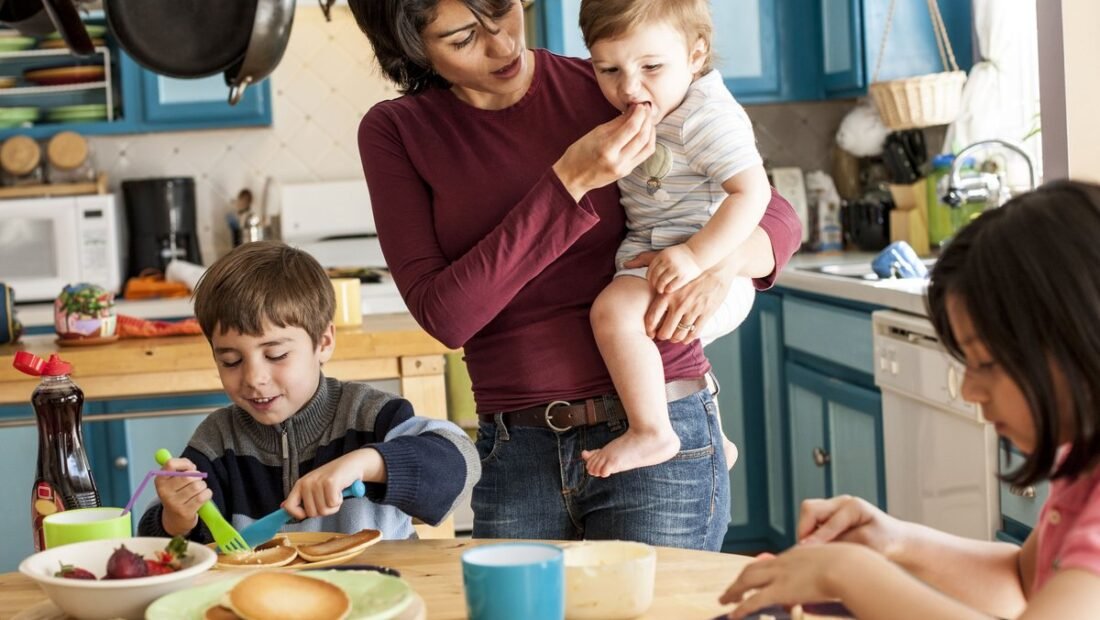
Picture a weekday morning in a house with two children under seven. It is 6:40 a.m. One shoe is missing. A form that needed signing is on the fridge, unsigned. Cereal has reached the floor, the dog is optimistic about the cereal, and somebody is crying about a sock. Nothing in this scene is a character flaw — it is what a morning looks like when it runs on luck, memory, and searching. Now picture the same house, same children, with a system underneath it: the shoes live in one basket by the door, the form was signed at 9 p.m., and the cereal is the kind that pours without drama. The children are identical. The morning is not. This is a walkthrough of the second version, hour by hour, and every piece of it is a decision made the night before or a habit that runs itself.
The night before: where the morning is actually decided
The walkthrough starts at about 9 p.m., because a calm morning is manufactured the evening before. In the kitchen, tomorrow’s breakfast is decided — not cooked, decided: bowls out, cereal or oats where a child-height hand (supervised) or a parent on autopilot can reach, fruit washed. By the door sits the launch pad: school bags packed and zipped, shoes in the basket in matched pairs, coats on hooks, and tomorrow’s out-the-door extras — the signed form, the library book, the show-and-tell object — inside the bags, not in a pile near them. Piles migrate; zipped bags don’t. The parents’ own clothes for tomorrow hang ready too, including the unglamorous details (belt, watch, the top that does not need ironing), because an adult choosing an outfit at 6:50 a.m. spends the exact minutes the children will need for an emergency about a sock. Ten to fifteen minutes of this, done while the house is calm, buys back half an hour of chaos at the hour when minutes are most expensive.
The head start: twenty minutes that change the weather
The parents in this house wake at 6:00; the children surfaces at 6:20 or after. Twenty minutes is not a heroic 5 a.m. routine — it is one coffee drunk hot, a face washed, clothes on, and a brain booted up before the first request arrives. The psychology matters more than the productivity: a parent who has had twenty minutes of being a person responds to the missing shoe as a logistics problem; a parent woken BY the missing shoe responds as a victim of it. Families building this habit should start smaller than twenty — start with ten, and move the alarm five minutes earlier each week until the margin feels real. The non-negotiable inside the head start: the phone stays out of it. Twenty minutes spent scrolling is not a margin; it is a debt, because it ends at the same time but with a mind already crowded by other people’s mornings.
The sequence: a routine children can run, not a timetable they must obey
From wake-up to door, this house runs a sequence instead of a schedule: get up, bathroom and get dressed, breakfast, teeth and hair, shoes and bags, out. The order never changes; the clock times float. That distinction is what makes it survive real life — a timetable shatters the first time a child is slow, and the shattering is what produces the shouting; a sequence just takes a little longer, in the same order, and arrives. The sequence lives on a picture chart at child height in the hallway: five drawings, no words needed, and the children check their own progress against it, which converts the parent’s job from announcing the next step forty times to pointing at the chart. Dressing comes before breakfast on purpose — a dressed child can eat slowly without consequence, while a fed child in pajamas at 7:40 is a second full operation waiting to happen. Shoes and bags are last because they are the exit, and because a child in shoes indoors at 7:15 will have removed one by 7:30.
Fuel: the parents’ breakfast is part of the system
In the lucky-morning version of this house, the adults ate standing up, if at all, and paid for it at 10 a.m. In the system version, parent fuel is planned with the same seriousness as the children’s: coffee made by a timer or in thirty seconds, something eaten — even toast eaten while supervising counts — because a hungry adult’s patience is measurably shorter and the morning spends patience like currency. The same applies to the children’s breakfast: boring, fast, and decided last night beats an ambitious cooked breakfast that produces washing-up and a negotiation. Weekday breakfast is logistics. Save pancakes for Saturday, when they are an event instead of a bottleneck.
When it goes wrong anyway — because it will
A system is not a spell. In this house the shoe still vanishes sometimes, because it lives where a four-year-old’s imagination put it. What the system changes is the margin: with bags packed and children dressed, a five-minute shoe hunt is an annoyance inside a forty-minute buffer, not the event that makes everyone late. Keep two pressure valves ready. The first is the grab box: a small basket by the door holding a spare hairbrush, hair ties, a travel pack of wipes, and a granola bar — the four things mornings ask for at the worst moment. The second is a pre-agreed drop list: on a genuinely bad morning, what gets skipped without debate — hair goes in a ponytail, the reading record gets signed at the gate, the fancy lunch becomes a simple one. Deciding the drop list on a calm Sunday is what stops it being an argument on a wet Tuesday. And when a morning collapses completely, let it: one late arrival, honestly explained, costs far less than a household that starts every day in a shouting match — the system exists to make collapses rare, not to make them shameful.
The same system, bent for other houses
The walkthrough above is one shape of family; the system flexes. With a baby in the house, the head start is not a fixed twenty minutes but whatever the first feed allows — which makes the night-before launch pad carry even more weight, and moves breakfast for the adults to “with the baby’s second feed,” planned rather than grabbed. In a shift-work house, the anchor is not the clock but the sequence: whoever is on mornings runs the same five steps in the same order, so the children meet an identical morning regardless of which parent is delivering it — predictability for the kids is the entire product. For a driven school run, add one line to the launch pad: car keys, fuel, and anything that must travel (the permission form, the PE kit) staged inside the bags by the door, because the car version of the missing shoe is the missing folder discovered at the school gates. And in a house with an older child and a younger one, recruit the older: a seven-year-old put in charge of the picture chart — checking off a younger sibling’s steps — turns the enforcer problem into a game, and frees the adult for the one job only adults can do, which is staying calm at 7:50.
Make it yours, and keep it boring
The last maintenance habit is a two-minute Sunday review: what jammed this week, and what is the smallest change that unjams it? A hook moved, a chart redrawn, the launch pad shifted to the other door. Systems that get reviewed in two minutes a week stay alive for years; systems that are never reviewed die silently, one friction at a time, until somebody concludes that “routines don’t work for us” — when in fact the routine just needed its hook moved.
Every family’s version differs in the details — shift work, a baby in the mix, a long commute, a child who needs medication at an exact time — and the sequence absorbs all of it, because you are designing an order of operations, not copying a timetable. Change one element at a time, starting with the night-before launch pad and the head start; those two alone transform most mornings, and adding everything at once is how routines get abandoned by Wednesday. Expect the system to feel effortful for about two weeks and invisible after a month — invisible is the goal. A morning routine has succeeded when nobody in the house can quite say why mornings are fine now. They are fine because the luck was replaced, piece by piece, the night before — and because the bigger balance behind it all, the one between the job and the family, is being guarded too: how to balance work and family time picks up where the school run ends. Pediatric guidance on family routines backs the same approach — the same case is made for predictable morning and school routines in the American Academy of Pediatrics’ back-to-school tips on HealthyChildren.org — because children, like their parents, are calmer when the next step is never a surprise.




3 Comments