
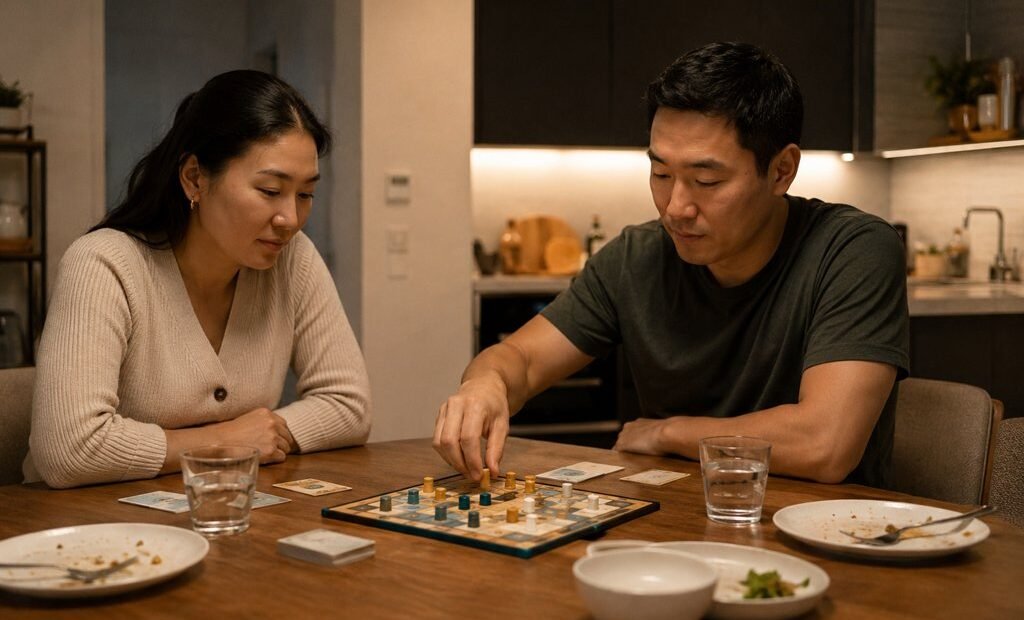
Three couples walk in at seven, coats still on, and one of them is already eyeing the game box like it might be homework. The host is smiling too hard. Somewhere in that first minute, a score is about to be tracked like a tax audit, a rules talk is about to run for forty-five minutes, and a perfectly good evening is about to go quiet. It does not have to. Picture the same night run a little differently, and the whole answer is right there in how the evening unfolds.
The door opens and nobody is led straight to a chair and a rulebook. The table is already set, and that matters more than it sounds. It is a dining table or a card table, big enough for a board, a pile of cards, and drinks that are not balanced on knees. A coffee table would have everyone hunched over, reaching past each other, knocking things over. On the proper table there is room to play and room to set a glass down without fear.
The light is bright enough to read small print on a card without squinting. Dim, romantic light is lovely for dinner and terrible for games. Music is on, but low, just enough to fill silences while people settle. Coats go on hooks, snacks are already out, and then the host says it with a grin, as a rule of the house rather than a scold: phones sleep in the kitchen tonight. Parked on the counter, face down, out of the game. Said cheerfully at the start, it feels like part of the fun. Said halfway through, after someone has scrolled through two turns, it feels like a complaint.
The First Game Has to Forgive Everyone
The guest who announced, while taking off a coat, that they are not really a game person is the real test of the night. Hand that person a dense strategy game and the evening is lost before it starts. So the opener asks almost nothing of anyone.
Just One is built for exactly this moment. It is cooperative. Each round, one person guesses a word while everyone else writes down a single clue, and any clue that matches another clue gets erased. There is no lecture to sit through. The idea lands in under a minute, the first round is funny, and the person who was worried about looking foolish is suddenly arguing, with real passion, about whether a clue was too clever. Nobody is eliminated. Nobody sits out. The room warms up because the game lets it.
Codenames in teams does the same job with a little more spark. Split into two teams, give cryptic one-word clues, and watch partners try to read each other’s minds across the table. Along with Wavelength, those three games form a kind of holy trinity for couples groups. Wavelength is the couples-perfect second act: a target is hidden along a spectrum, one partner gives a clue, and the other has to guess where that clue falls. Is a hot dog closer to a sandwich or not a sandwich at all? The debate that follows tells you more about how people think than any small talk would. Browsing BoardGameGeek’s rankings and player reviews before a night like this helps sort which of these will fit a particular group, because player counts and play times are listed plainly there.
Seating gets a quiet moment of attention too. Partners sit where they can see each other during team games, because half the fun of Wavelength and Codenames is watching a partner’s face while a clue lands. Chairs are close enough for talk across the table without shouting over the music. Anyone who needs reading glasses has them within reach before cards are dealt. The host also puts a small side table or counter spot within reach for rulebooks, score paper, and spare pieces, so the main surface stays clear for the game itself. None of this looks like hosting effort once guests arrive. It just feels like a room that was ready for them, which is exactly the feeling that lets people relax into the first round instead of spending it shifting glasses and hunting for space.
Food That Stays Out of the Game
By the second game, hands start wandering toward food, and this is where a lot of game nights quietly ruin a nice set of cards. The rule for the table is simple: one hand only, and nothing greasy. A charcuterie board works because people can graze between turns without utensils or plates piling up. Popcorn, pretzels, wrapped candies, and little veggie cups all pass the same test. They can be eaten with one hand, they leave fingers clean, and they do not demand a break in play.
Wings, ribs, and anything dusted in powder stay in the kitchen, far from the game. Nobody wants sauce on a card that cost real money, and nobody enjoys a game where every turn starts with a wet wipe. Drinks follow the same logic. Covered drinks and bottles sit safely at the edge of the table. Open wine glasses next to a spread of cards are an accident that has simply not happened yet. Once the food is set up this way, the host stops hovering. People help themselves, the game keeps moving, and the table still looks clean at nine o’clock.
When the Night Splits Into Smaller Games
Around eight thirty, one couple heads home early, and the evening changes shape. This is the other half of a couples game night: not the group around the big table, but two people staying in with a game built for two. The picks here are different, and tighter.
7 Wonders Duel is the headliner for two. It is a small civilization builder designed only for a pair, and it plays in about thirty minutes. Cards draft past quickly, choices bite, and a game can swing on science, military pressure, or gold. It feels substantial without taking over the night. Patchwork sits at the opposite mood and earns its place for that reason. On the surface it is a cozy game about stitching a quilt from odd-shaped pieces. Underneath, it is quietly cutthroat, because every patch costs buttons and time, and the piece a partner needs is always the one just taken. Jaipur is faster still, a trading game of camels, goods, and well-timed sales that wraps up in about twenty minutes and begs for an instant rematch.
Some nights, battling each other is the wrong note entirely. That is when a cooperative game saves the plan. The Crew sends a pair or a small group on quiet, tricky card missions where the puzzle is shared. Pandemic does the same on a larger scale, putting everyone on the same side against the board. Teaming up changes the talk at the table. Instead of blame after a loss, there is joint problem-solving and a shared groan when the game wins. Anyone still sorting out a shelf of options will find plenty of company in lists of the best board games for adults who hate Monopoly, which tend to favor exactly this kind of no-elimination, finish-on-time design.
The Guardrails Nobody Notices
Look back at the evening and the guardrails were there the whole time, just never announced as a list. No game knocked a player out early to watch everyone else have fun. No game ran past ninety minutes, which matters with a mixed group where stamina and interest vary. And no game needed a thirty-minute rules lecture. If a game cannot be taught in about five minutes, or with a quick practice round, it is the wrong game for this kind of night, however good it might be on another occasion. Learning the rules ahead of time, as the host, is what makes that five-minute teach possible.
Competition stayed friendly because the structure kept it that way. Teams rotated. Partners swapped for a round. When one person started running away with a score, the next game was shorter and sillier, which reset the mood. Winning was celebrated, good plays by anyone got a reaction, and bad luck got a laugh instead of a sigh. That tone is set by the host in the first game and held, gently, all night. The point was never who won Wavelength. The point was the argument about the hot dog.
One more pattern holds the night together: two or three short games beat one long one. Variety keeps energy fresh, gives everyone a game that suits them at some point in the evening, and means a single dud never defines the night. If the opener flops, the second game rescues it. If the main event runs long and tense, the closer can be chosen for pure silliness. Hosts who plan a loose order in advance, opener first and closer last with one flexible slot in the middle, can adjust to the room without ever looking indecisive. That flexibility is also what makes the monthly version sustainable, because no two groups and no two evenings need exactly the same mix.
Ending While It Still Feels Good
The best sign the night worked is that it does not drag until people are checking the time. After the main game, the host brings out one light closer, something quick and funny that needs no fresh rules energy, and dessert arrives alongside it. Sweet food after salty snacks marks a change of pace. Conversation loosens. People start retelling the best moments, which is how an ordinary Tuesday turns into a story the group will repeat next month.
That is also when the invitation lands, casually, before coats come out. Same time next month, different host house, someone else picks the opener. A standing date does the heavy lifting from there. Nobody has to organize from scratch, nobody has to be talked into a new thing, and the guest who arrived swearing they were not a game person is now asking what the game with the spectrum was called. The perfect couples game night was never about finding one perfect game. It was about a table that fit, food that stayed out of the cards, games that forgave beginners, and an ending that left people wanting the next one.




1 Comment