Your tuner app died mid-jam, the clip-on tuner is in your other gig bag, and the song starts in two minutes. Every guitarist faces this eventually — and the players who can tune by ear aren’t showing off, they’re just self-sufficient. Tuning a guitar by ear without a tuner is a learnable skill built on one reference note and a simple interval method that’s been used for centuries. It also trains your ear in ways a tuner never will, making you a better musician overall. Here’s the complete method, from your first attempt to reliable stage-ready tuning.
What You Need: One Reference Note
Relative tuning (tuning strings to each other) needs just one trustworthy pitch. Sources, best to worst:
- Another instrument: a piano, another guitar, or any tuned instrument — the gold standard.
- A tuning fork or pitch pipe: the classic A=440Hz fork costs $10 and never needs batteries.
- A song from memory: many players memorize a reference — the opening note of a well-known song in E, for instance. Less precise, but works in a pinch.
- Your own memory: experienced players can recall E approximately. Beginners shouldn’t trust this yet.
If you have no reference at all, you can still tune the strings relative to each other (the guitar will be in tune with itself but possibly sharp or flat of concert pitch) — fine for solo practice, not for playing with others. For more detail on a related topic, see our article on how to find concerts happening near me.
The 5th-Fret Method (Standard Tuning)
This is the core technique. Standard tuning is E-A-D-G-B-e (low to high). Each string is tuned to match a fretted note on the string below it:
- Tune the low E string to your reference pitch as best you can.
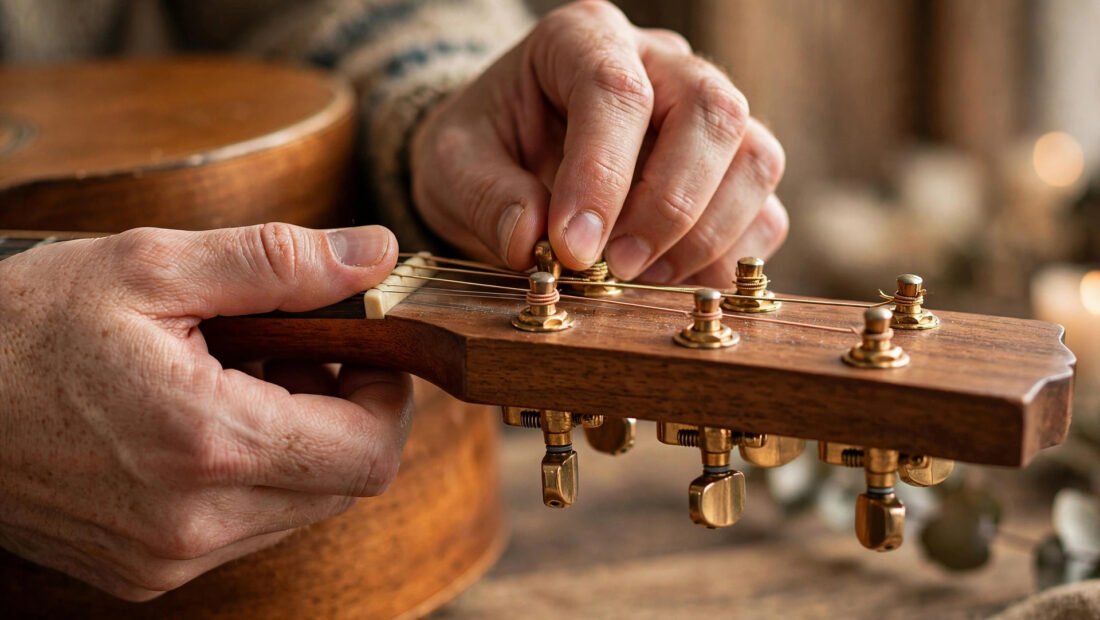
- A string: fret the low E string at the 5th fret — that note is A. Tune the open A string until it matches that pitch exactly. Listen for the “beats” (wah-wah-wah pulsation); when the beats slow to zero, the strings are in unison.
- D string: fret the A string at the 5th fret (that’s D). Match the open D string to it.
- G string: fret the D string at the 5th fret (that’s G). Match the open G string.
- B string: THE EXCEPTION — fret the G string at the 4th fret (that’s B). Match the open B string. (The G-to-B interval is a major third, not a fourth — this is the one everyone forgets.)
- High e string: fret the B string at the 5th fret (that’s E). Match the open high E string.
Listening for beats: when two pitches are close but not identical, you hear a pulsating wah-wah — the “beat frequency.” Faster wah = further apart. As you turn the tuning peg, the wah slows; when it disappears into a single pure tone, you’re in tune. This is the fundamental skill — practice hearing beats deliberately.
Checking Your Work: Harmonics and Chords
After the 5th-fret pass, verify:
- Harmonic method: play the 5th-fret harmonic on the lower string and the 7th-fret harmonic on the higher string — they should match (except G-B, which uses 4th-fret harmonic on G vs. open B… the standard check is 5th-fret harmonic on B against 7th-fret harmonic on high E, etc.). Harmonics ring clearer than fretted notes, making beats easier to hear.
- The chord test: strum open E, A, D, G, and C chords. If any chord sounds sour, one of its strings is off — retrace.
- Octave check: the low E and high E strings should be exactly two octaves apart. Play them together; any beating means something drifted.
- Always tune UP to pitch: if a string is sharp, loosen it below the target and tune up. Tuning down to pitch leaves slack in the gears and the string will drift flat within minutes.
Common Beginner Mistakes
- Turning the wrong peg: the eternal beginner error. Before turning, pluck the string and touch the peg — confirm which one vibrates sympathetically.
- Over-shooting: turn slowly. A quarter-turn changes pitch significantly on most guitars.
- Ignoring the G-B exception: using the 5th fret on the G string tunes the B string wrong — the single most common by-ear tuning error.
- Tuning with old strings: dead strings won’t intonate properly no matter what you do. If nothing sounds right, the strings (not your ear) may be the problem.
- Pressing too hard on frets: heavy fretting pressure sharpens notes. Fret lightly when matching pitches.
Training Your Ear Long-Term
- Daily 2-minute drill: deliberately detune one string slightly, then fix it by ear. This builds beat-detection faster than anything.
- Sing the intervals: the 5th-fret relationships are all perfect fourths (except G-B). Learning to hear and sing a perfect fourth makes tuning almost automatic.
- Use a tuner as a coach, not a crutch: tune by ear first, then check with the tuner. Note which strings you consistently get wrong — that’s your ear’s blind spot to work on.
- Learn songs by ear: figuring out riffs without tabs develops the same pitch-matching muscles. Expanding the music you listen to gives your ear more material to work with across genres.
Conclusion
Tuning by ear comes down to one reference note, the 5th-fret method (remembering the G-string’s 4th-fret exception), listening for beats, and always tuning up to pitch. It’ll feel clumsy the first dozen times — every guitarist’s first by-ear tuning takes 10 minutes and sounds questionable. But the skill compounds: within a month of daily practice you’ll tune in two minutes, within six months you’ll do it without thinking, and you’ll have developed an ear that improves every other aspect of your playing. The tuner app is convenient. The ear is permanent. For deeper music theory behind intervals, musictheory.net’s free lessons are excellent. Fender publishes free tuning and setup guides for players at every level.
Frequently Asked Questions
Can I tune a guitar with no reference note at all?
Yes — relatively. Use the 5th-fret method starting from any string; the guitar will be in tune with itself but may not match concert pitch (A=440Hz). Fine for solo practice, unusable for playing with other musicians or recordings.
Why does my guitar go out of tune so fast?
New strings stretch for 1–3 days (pre-stretch them by gently pulling). Old strings lose intonation. Temperature and humidity swings — common in Texas — affect tuning. And always tune UP to pitch to avoid gear slack.
What’s the 5th fret harmonic tuning method?
Lightly touch (don’t press) the string at the 5th fret and pluck to produce a harmonic. The 5th-fret harmonic of a lower string matches the 7th-fret harmonic of the next higher string (in standard tuning, except involving the B string). Harmonics make beat-listening easier because they’re purer tones.
How long does it take to learn to tune by ear?
Basic competence (getting close, verifying with a tuner) comes within 2–4 weeks of daily attempts. Reliable, stage-ready by-ear tuning typically takes 3–6 months. Daily 2-minute detune-and-fix drills accelerate it dramatically.
Is tuning by ear better than using a tuner?
Electronic tuners are more precise — no human beats a strobe tuner for accuracy. By-ear tuning’s value is self-sufficiency (no gear needed) and ear training that improves all your musicianship. Best practice: tune by ear, verify with tuner.