
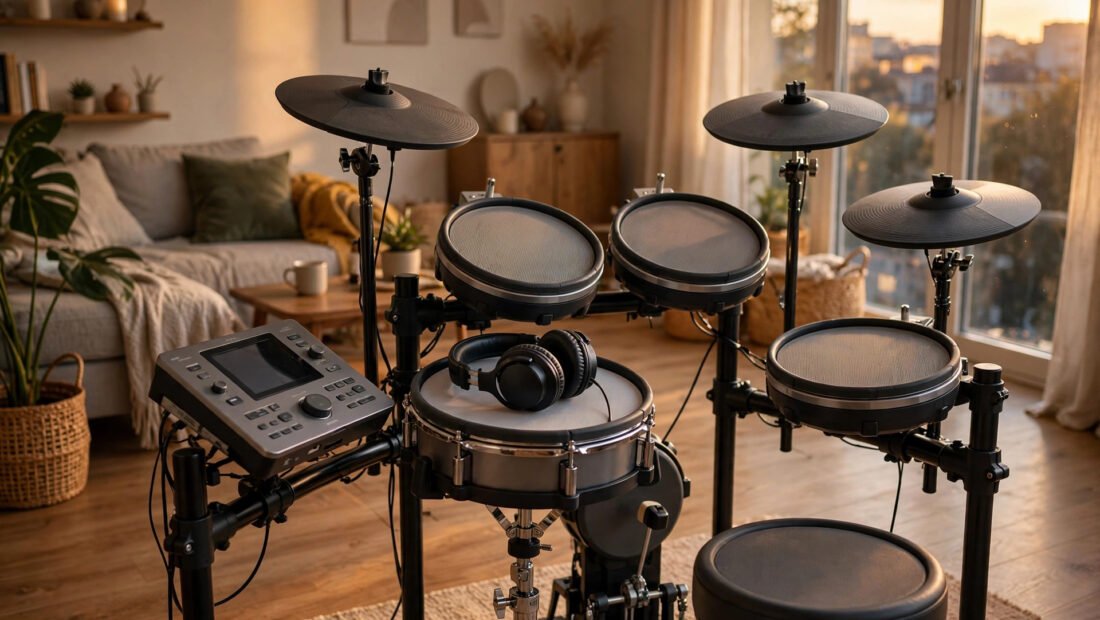
An acoustic drum kit in an apartment is not a hobby. It is a noise event your neighbors did not agree to attend. That is the honest starting point, and it is also why so many would-be drummers give up before they start. The good news is that volume is now a choice. Three very different routes let you learn real drumming at conversation level or below, and the right one depends on your home, your budget, and how far you plan to take it.
Route 1: An electronic kit through headphones
For most people in apartments, duplexes, and close-set Texas houses, this is the main answer. An electronic kit makes its sound in a module, not in the room. You hear the full kit through headphones at whatever volume you like. People around you hear tapping.
At the budget end, a kit like the Alesis Nitro Mesh runs around $300-$500. The mesh heads matter. They feel closer to real drum heads than hard rubber pads, and they are quieter to strike. A kit at this level is enough to learn timing, coordination, and basic beats, and to play along with songs for a year or two of steady progress.
Step up to roughly $700-$1,000 and you are in the range of kits such as the Roland TD-1DMK and the Yamaha DTX402K. The extra money buys better sounds, sturdier hardware, and pads that respond more evenly. It is worth it if you already know you will stick with drums and can afford the jump. It is not required to start. A cheaper kit played daily teaches more than a nicer kit you felt guilty buying and rarely touch.
Whatever kit you buy, look for mesh heads, a real kick pedal rather than a simple switch pedal, and a frame that fits your space without wobbling. Check the maker’s own range before you decide, since Roland’s electronic drum kits and practice gear show how the features and prices step up from entry level to the kits working players use.
How loud is an electronic kit, really?
Louder than the ads suggest, and quieter than any acoustic kit by a wide margin. The pads themselves make a soft thock that rarely travels through walls. The real noise is vibration. Each kick pedal strike sends a thump down through the stand and the floor, and a downstairs neighbor hears that as a steady knocking in their ceiling. Hi-hat and pedal work can add a faint clicking that carries in a quiet building at night.
The hidden noise fix: the floor, not the pads
This is the step new owners miss. A tennis-ball riser platform, built from a sheet of plywood resting on tennis balls, costs around $30 to make and breaks the path vibration takes into the floor. A purpose-built isolation pad under the kit does the same job with less effort. Add a rug under the platform, set the kit away from a shared wall where you can, and most floor complaints disappear. If you do only one thing beyond buying headphones, do this.
Route 2: An acoustic kit, quieted down
This route fits people who already own an acoustic kit, or who know they want the real feel of one and will play loud somewhere else now and then, such as a rehearsal space or a friend’s house.
The core move is a mesh head conversion, around $100-$150 for a full kit. You replace the normal batter heads with mesh ones. The drums still feel like drums under your sticks, with real rebound and real sizes, but the volume drops to something close to a firm knock. The shells stop booming because the mesh does not move air the way a normal head does.
Cymbals are the remaining problem, since a normal crash is loud no matter what the drums are doing. Low-volume cymbals, such as the Zildjian L80 and Sabian Quiet Tone lines, are drilled with patterns of holes that cut their volume by about 80%. They still shimmer and feel like metal cymbals, just at a level a house can absorb.
The cheapest option on this route is mute pads, roughly $30-$60 for a set. These are rubber pads that sit on top of drums and cymbals and cut volume by roughly 70-90%. They change the feel more than mesh does, and the cymbal pads in particular feel dead under the stick. Their big advantage is that they come off in a minute. Practice muted all week, then take the pads off for a rare loud session somewhere it is allowed.
Room setup helps any acoustic setup. Play in an interior room rather than one on a shared wall. Put a rug under the kit. Close the door. Soft furniture and curtains soak up more sound than bare walls and hard floors do.
Route 3: No kit at all, yet
The third route costs the least and makes the least noise of any option here: a practice pad and a metronome, around $30 together if your phone handles the metronome part for free.
This is not a sad substitute. The first 3-6 months of drumming are mostly pad work anyway, for everyone. Single strokes, double strokes, paradiddles, stick control, and playing in time are the base every later skill stands on, and all of them are learned on a pad. A beginner who spends those months on a pad arrives at a full kit with hands that already behave. A beginner who buys a kit on day one often spends the same months playing simple beats over untrained hands.
A pad also goes anywhere. Couch, kitchen table, balcony, a parked car on a lunch break. Low rebound pads and even a pillow add a useful twist, since a surface that gives nothing back forces your wrists to do the work, which builds control. The limit of this route is real, though. A pad cannot teach kick pedal work, hi-hat control, or moving around a full kit. Treat it as the right first stage, or as the quiet supplement to a kit you play less often, rather than a permanent replacement.
It pairs well with other quiet practice at home. Plenty of drummers keep a second instrument going at low volume, and if that is you, learning how to tune a guitar by ear without a tuner is another small skill that needs no volume at all.
The neighbor diplomacy playbook
Gear handles most of the noise. A short conversation handles the rest, and it is worth having before your first session, not after a complaint.
Talk first. Knock, introduce the plan in plain terms, and say what you have done about the sound. You are learning drums, you have an electronic kit with headphones, or a pad, and you want to know if they ever hear it. That visit does two things. It warns them, so a faint thump is not a mystery noise. And it gives them a friendly way to tell you if something carries, while it is still a small, easy fix.
Then agree on hours and keep them. A window in the early evening, such as after work and well before quiet hours, suits most buildings and most Texas leases, which commonly set quiet hours overnight. Predictability matters more than the exact times. A neighbor who knows the tapping stops by eight plans around it without resentment. A neighbor who hears random thumps at random hours feels ambushed by all of them. If a session ever needs to run louder or later, ask ahead. Permission turns the same noise from a nuisance into a favor returned.
A realistic learning path on any route
The first two months are pad territory whether you own a kit or not: basic strokes, simple rudiments, and steady time with a metronome, in short daily sessions of about 20-30 minutes. Months two to four bring the kit into it, basic rock and pop beats, and playing along with songs through headphones. From month four onward, add fills, dynamics, and playing with other people where you can. Progress feels slow week to week and obvious across a season. Short daily practice beats one long weekend session, for your hands and for your neighbors alike.
Record yourself now and then, even on a phone set across the room. Timing slips that feel fine while you play stand out at once on a recording, and catching them early is much easier than untraining them months later. Once your basic beats feel steady, a lesson every month or so is a good use of money on any route. A teacher spots grip and posture habits you cannot see yourself, and those habits matter more for quiet playing than people expect, because clean, relaxed strokes are also the quietest ones.
Verdict by living situation
In an apartment with neighbors below you, choose the electronic kit, add the riser platform from day one, and keep a pad for late practice. In a house with a little space and a kit already in the garage, quiet the acoustic kit with mesh heads and low-volume cymbals. If money is tight or you are still testing whether drums will stick, start with the pad and metronome and upgrade once the habit is real. Every route above leads to the same place: a drummer whose neighbors have no reason to know it.




1 comment