No, 30 is not too late to learn piano. The short answer is that an adult beginner who practices about 25 focused minutes a day can play simple songs with both hands in 3 to 6 months and reach a comfortable, satisfying level of playing in about 1 to 2 years. You will not become a concert pianist, and you do not need to. Playing songs you love, cleanly and for pleasure, is fully within reach at 30. Adults learn differently from children, not worse. You trade endless free time for focus, clear goals, and the discipline to show up daily.
Why Starting at 30 Works Better Than You Expect
Children often practice because a parent set a timer. Adults practice because they chose the instrument. That choice matters. When the song on the stand is one you picked because you love it, you protect the practice time. A person learning a wedding song or a favorite film theme will sit down on a tired evening when a child drilling assigned scales would not.
Focus is the second edge. A 30-year-old can spend 20 minutes on one hard bar, slow it down, fix the fingering, and repeat it with intent. That kind of deliberate practice is what builds skill. Young beginners noodle more and target less. You will have less total time than a school-age student, so efficiency has to carry you. Short, focused sessions do that job well.
Money helps, too. Most adults can budget for a decent instrument and occasional lessons, which removes obstacles that stall many childhood beginners. The honest limit is time, not talent or age.
The Instrument Decision: What to Buy First
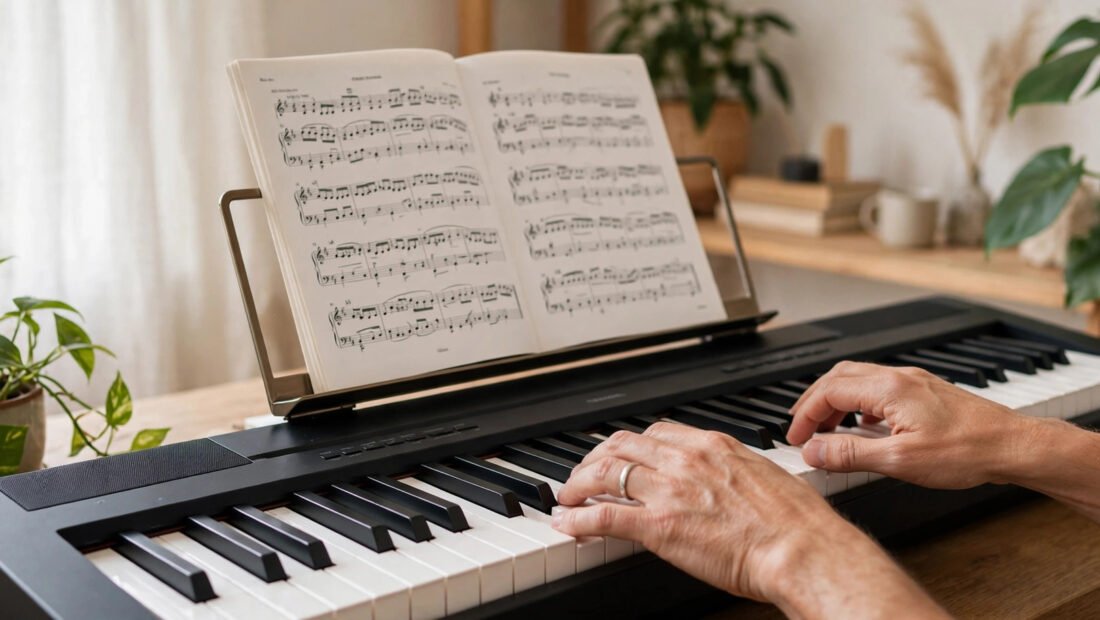
Buy an 88-key digital piano with weighted keys if you can. In the $400 to $800 range you can find solid models such as the Yamaha P-125, the Roland FP-30X, and the Casio PX-S1100. Weighted keys matter because they build finger strength and control over loud and soft playing. Skills learned on light, unweighted keys do not transfer cleanly to a real piano feel.
A digital piano also solves daily-life problems. A headphone jack lets you practice at night in an apartment, there are no tuning costs, and the volume knob ends the worry about neighbors.
Avoid starting on a 61-key unweighted keyboard if your goal is real piano playing. It is fine for a few weeks of curiosity. You will outgrow it in months, and your hands will learn habits you later have to undo. An acoustic piano is lovely if you have the space, the budget, and tolerant neighbors, but it is not required to begin. Many adults start digital and move to acoustic later, once the habit is solid.
The used market in Texas metros is worth checking. Digital pianos lose value fast, and good used instruments often sell at 40 to 60 percent of the retail price on resale listings. If you buy used, test every key and every pedal before you pay. Bring headphones, play high and low notes, and check that the sound is even across the keyboard. For model comparisons and learning material, Roland’s digital pianos and piano learning resources are a useful starting point alongside other makers.
How Adult Learning Actually Unfolds, Phase by Phase
In months 1 to 3, you build foundations. Posture and hand position come first: sit at the right height, keep wrists level, and curve your fingers as if holding a small ball. You learn to read the treble and bass clefs at a basic level, play simple five-finger pieces, and keep basic rhythms. A structured method book such as Alfred’s Adult All-in-One or Faber’s Adult Piano Adventures gives this phase its order. Aim for 15 to 20 minutes a day at the start. The goal by the end of this stretch is simple songs played with both hands, slowly and correctly.
Months 3 to 6 are about coordination, and they feel the hardest. Your hands must do different things at the same time, and at first that feels impossible. Then, with repetition, it clicks in small jumps. You add basic scales in C, G, and F major, and you start playing simple chord progressions. The goal here is easy pop songs played from chord charts, even if the tempo is modest. If this phase feels clumsy, that is normal. Clumsy is the stage right before independent.
From months 6 to 12, you build repertoire. Learn songs you actually want to hear yourself play. Simplified arrangements are fine and often smart. Add music theory only as it becomes useful: what a chord is, how a key works, why certain notes sound settled together. Theory learned to answer a real question sticks. Theory memorized in advance often does not. The goal for this stretch is a small set of pieces you can play for friends without apology.
In year two and beyond, fluency grows. Pieces that once took weeks take days. You try intermediate works, pick out melodies by ear, and add simple improvisation. The clearest milestone is the identity shift: you are now a person who plays piano.
Milestones That Tell You Progress Is Real
Adult beginners often ask whether they are improving, because daily change is too small to feel. Watch for these typical markers instead. Around week two, you stop hunting for notes. The layout of the keyboard starts to make sense under your hands. Around month two, hands-together playing stops feeling like a trick and starts feeling like a skill. Around month four, you can play a full song in a way others recognize, and someone at home comments on it without being asked.
Around month eight, new pieces come faster. Reading that once crawled now moves, because patterns repeat and your eyes and hands have seen them before. Around the one-year mark, most consistent beginners have a small repertoire, play for pleasure on ordinary days, and can learn a new easy piece without dread. Treat these as typical milestones, not deadlines. If you are behind one of them, the fix is almost always practice frequency. Add 10 steady minutes a day before you blame your hands or your age.
Lessons, Books, and Apps: Picking Your Mix
The best value for many adults is a lesson every two weeks or once a month, plus daily practice on your own. Lessons in Texas commonly run $30 to $60 per half hour. A teacher catches wrist and posture errors before they turn into sore, stubborn habits, and a standing lesson makes you practice more consistently. Accountability is not a small thing. It doubles follow-through for many beginners.
Self-teaching can work if you follow one structured method instead of jumping between random videos. Record yourself often, and book an occasional check-in lesson to catch technique problems early.
Apps have a place, as support. Programs such as Simply Piano, Flowkey, and Pianote are good for engagement, note reading drills, and keeping practice fun on low-energy days. They are weak on physical technique because they cannot see collapsed wrists or tense shoulders. If you want app ideas to test alongside a method book, start with the best free piano apps for beginners and treat any app as a supplement, not your only teacher.
Whichever mix you choose, daily practice is the non-negotiable part. Piano is a motor skill. It fades without repetition in a way that knowledge does not. Even 15 minutes on a busy day keeps the thread unbroken. Twenty-five focused minutes on a normal day moves you forward.
The Pitfalls That Stall Adult Beginners
Perfectionism stops more adults than difficulty does. Your month-one playing is supposed to sound rough. Every pianist you admire sounded rough at the start. If a rough sound embarrasses you into skipping practice, the rough stage lasts longer. Play through it, record it, and let later recordings prove the change.
Comparison is the second trap. Child prodigies are not your peer group. Measure yourself against your own recordings from last month.
Skipping foundations for a favorite hard song is the third trap. Jumping straight to a complex piece such as Bohemian Rhapsody without the steps beneath it builds frustration, not skill. Earn the big song through the method. You will reach it sooner and play it better than if you wrestle it from day one.
Inconsistent practice is the most common problem of all. Three hours on Sunday cannot replace short daily sessions, because your hands learn between sessions as much as during them. Anchor practice to a habit you already keep: after morning coffee, right after work, or before bed. Protect that slot the way you would protect a meeting. Small, daily, and attached to a routine beats large, rare, and left to motivation.
The last trap is ignoring theory completely. You do not need much. A basic grasp of chords and keys unlocks playing by ear and faster learning of new songs. Learn each idea when a song makes you ask for it.
Questions Adults Ask Before They Start
How long until I can play songs I recognize?
With daily practice, simple songs with both hands usually arrive in 3 to 6 months. A comfortable intermediate level, where you can learn and enjoy a wide range of pieces, commonly takes 1 to 2 years. Consistency decides the pace far more than age does.
Are my fingers too stiff or too old at 30?
No. Adults build the finger control piano needs through scales, exercises, and regular repertoire. The hands adapt readily at 30. An injury or a condition such as arthritis is a personal health question to raise with a clinician, not a normal age barrier.
Can videos alone teach me?
Videos help with song tutorials and motivation, but they make a poor main curriculum. There is no order, no check on your posture, and no one to correct a habit early. Pair videos with one method book and occasional teacher feedback for a much stronger result.
Too late for what is the question worth asking. Too late for a concert career, perhaps. Not too late to play the songs you love and feel the plain satisfaction of making music with your hands. At 30, with a proper weighted instrument, one clear method, and 25 minutes a day, that outcome is a plan with a timetable you can follow.