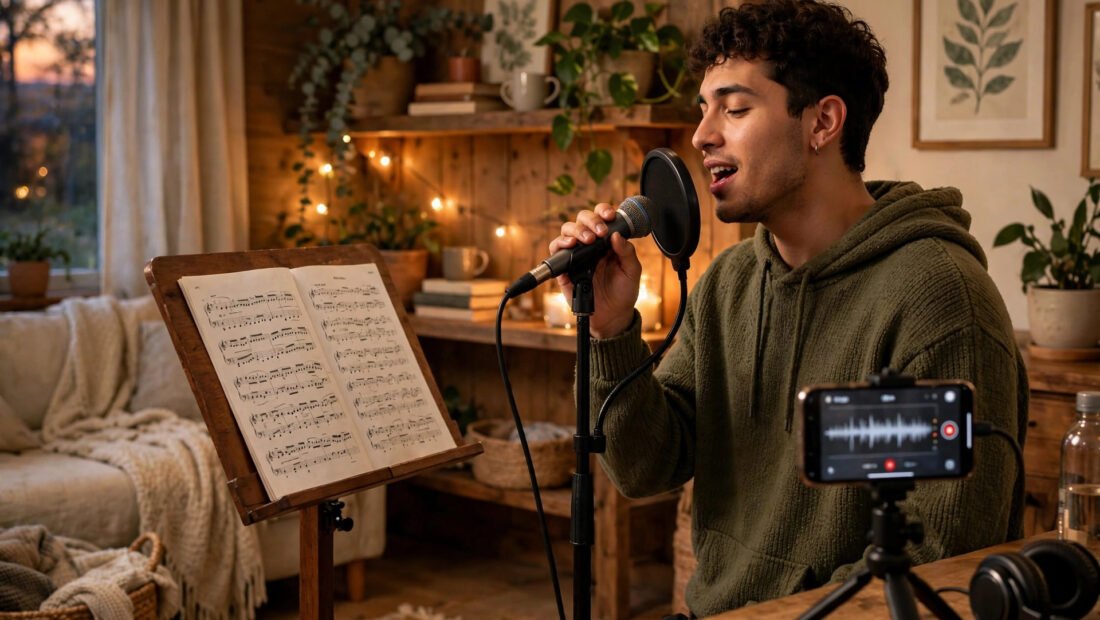
Private vocal coaches in Texas charge $40–$100 an hour — real money, especially when you’re not sure singing is “your thing” yet. Here’s the encouraging truth: you can dramatically improve your singing voice without a vocal coach, using structured self-study, free resources, and recording feedback. You’ll progress slower than with a great teacher’s ears on your technique, and you’ll need discipline to avoid ingraining bad habits — but the fundamentals of good singing (breath, pitch, resonance, consistency) are all trainable solo. This is the self-study system that actually works. For more detail on a related topic, see our article on how to find new music similar to your favorite bands.
Set Up Your Feedback Loop (The Coach Replacement)
A coach’s core value is ears you don’t have — you can’t hear your own tension, pitch drift, or tone quality accurately (bone conduction lies to you). Replace it:
- Record everything: your phone’s voice memo app is enough. Record every practice session and listen back with headphones — you’ll hear pitch problems, breathiness, and strain you’d never notice while singing.
- The one-week comparison: record the same song weekly. Progress is invisible day-to-day; weekly comparisons reveal it and keep motivation alive.
- Sing into a corner: facing a corner reflects sound back to your ears, giving a truer picture of your tone than singing into open space.
- Use a pitch app: free apps (Vocal Pitch Monitor, Tuner apps) show your pitch in real time — brutal, honest feedback on intonation.
- Video yourself: tension shows in the body — raised shoulders, clenched jaw, strained neck. Video reveals what audio can’t.
The Self-Study Curriculum: In Order
Phase 1: Breath and posture (weeks 1–3)
Everything builds on this. Practice diaphragmatic breathing daily: lie down with a book on your belly, breathe so the book rises (5 minutes). Then hissing exercises — exhale on a sustained “sss” as long as possible, keeping the airflow perfectly steady. Work up to 30+ seconds. Add lip trills on scales (YouTube: “lip trill vocal warmup”) — they coordinate breath and voice automatically. If you master nothing else, master this: most beginner singing problems are breath problems wearing costumes.
Phase 2: Pitch accuracy (weeks 3–8)
- Pitch matching drills: play a note on a piano app, sing it back, check with a tuner app. Start with single notes, then intervals, then short melodies.
- Sing along with recordings — then without: learn a song with the original, then sing it a cappella and record. The gap between the two reveals your pitch independence.
- Slow it down: practice difficult phrases at half speed. Pitch accuracy at tempo is built from accuracy in slow motion.
- The “one song” method: pick ONE song slightly above your comfort level and work it for a month. Depth beats breadth for beginners.
Phase 3: Tone and resonance (weeks 8–16)
- Humming scales: hum through your range daily — humming naturally places resonance forward and reduces throat tension.
- Vowel shaping: sing scales on pure vowels (ah, eh, ee, oh, oo), keeping the sound consistent. Wobbly vowels = inconsistent resonance.
- The yawn-sigh: yawn, then sigh from high to low on “ah.” This releases throat tension and finds your natural resonant space — do it before every session.
- Record and compare tone: aim for a clear, consistent tone without breathiness or nasality (unless stylistic). Small adjustments, recorded and reviewed, compound fast.
Phase 4: Range and expression (ongoing)
Extend range with sirens (smooth glides, never pushing), add dynamics (practice songs at 5 volume levels), and work on phrasing — where you breathe, which words you emphasize. Expression is what separates “accurate” from “moving,” and it’s free to develop.
The 20-Minute Daily Practice Template
Structure beats duration. Here’s a template that covers everything in 20 minutes:
- Minutes 0–5: Warmup. Lip trills up and down your range, then sirens. Never skip this — cold singing is how injuries happen.
- Minutes 5–12: Technique focus. One exercise targeting your current weakness: pitch-matching drills, humming scales for resonance, or straw phonation for breath balance. Rotate weekly.
- Minutes 12–18: Song work. Your “one song” — work the hardest 8 bars slowly, then at tempo. Record this section.
- Minutes 18–20: Cooldown. Gentle descending sirens and humming. Like athletes, singers need cooldowns — it prevents next-day stiffness.
Do this daily for a month and compare your week-one and week-four recordings of the same song. The difference is usually startling — and it’s the cheapest motivation there is.
Free Resources Worth Your Time
- YouTube teachers: channels like Justin Stoney (New York Vocal Coaching), Cheryl Porter, and Jacobs Vocal Academy offer structured beginner series rivaling paid courses. Follow ONE teacher’s beginner program start-to-finish rather than sampling randomly.
- Apps: Vanido and Sing Sharp provide guided daily exercises with pitch feedback — like Duolingo for singing.
- Community: r/singing offers feedback (post recordings for critique), and local choir participation — plus casual karaoke nights — gives you performance reps no app can.
- Books: “Set Your Voice Free” by Roger Love and “The Contemporary Singer” offer structured solo curricula for the price of lunch.
Avoiding Bad Habits Without a Coach
- The mirror rule: if you look strained, you sound strained. Practice in front of a mirror weekly checking for jaw clenching, neck veins, and shoulder lifting.
- The pain rule: singing should never hurt. Fatigue is normal; pain means stop. Hoarseness lasting over 2 weeks needs a doctor, not more practice.
- The volume trap: beginners equate loud with good. Practice at medium volume — control at moderate dynamics transfers to loud; the reverse doesn’t.
- Know when you’ve plateaued: if 3 months of disciplined self-study stalls, even 2–3 lessons with a teacher can unblock you. Think of it as a tune-up, not a commitment — many Texas teachers offer single sessions.
The American Academy of Otolaryngology’s voice health pages cover the medical side of keeping your instrument safe while training solo.
Conclusion
Improving your singing voice without a vocal coach is absolutely doable: build a recording-based feedback loop, work through breath → pitch → tone → expression in order, use one structured free program consistently, and police yourself with the mirror, pain, and volume rules. Expect real, audible improvement in 2–3 months of daily 20–30 minute practice. A coach accelerates the journey and catches what you can’t hear — but discipline plus feedback loops get you remarkably far alone. Your voice is already yours. Training just teaches you where it’s been hiding. The National Association of Teachers of Singing provides research on effective practice techniques for developing voices.
Frequently Asked Questions
Can you really learn to sing without lessons?
Yes — the fundamentals (breath support, pitch accuracy, resonance) respond well to structured self-study with recording feedback. A coach accelerates progress and prevents bad habits, but disciplined solo practice produces real, audible improvement.
How long should I practice singing each day?
20–30 minutes of focused daily practice beats occasional marathon sessions. Beginners should cap at 30 minutes to avoid vocal fatigue; consistency matters far more than duration.
What’s the best free app for learning to sing?
Vanido and Sing Sharp offer guided exercises with real-time pitch feedback. Pair any app with regular phone recordings of yourself — the recordings teach you what the app can’t.
How do I know if I’m a bad singer or just untrained?
Almost always untrained. True tone-deafness (amusia) affects ~4% of people. If you can tell when someone else sings off-key, your ear works — you just haven’t trained your voice to follow it yet.
When should I get a vocal coach despite self-studying?
When progress stalls for 2–3 months despite consistent practice, when you want to tackle advanced techniques (belting, mixed voice), or before any important performance. Even a handful of lessons can reset your trajectory.