The sticker on the windshield says 3,000 miles. The owner’s manual says 7,500. The oil-life monitor on the dash says 42 percent remaining. Three numbers, three different answers, and only one of them knows how you actually drive. So which one should you obey?
The short answer: for most drivers in 2026 using full synthetic oil, change it every 5,000 to 7,500 miles, or once a year, whichever comes first. Use 5,000 miles if your driving is mostly short trips, extreme heat, towing, or dusty roads. Use 7,500 miles if your driving is gentler and mostly highway. Follow the oil-life monitor when your car has one, and let the manual overrule the windshield sticker every time.
Why the Old 3,000-Mile Rule No Longer Fits
The 3,000-mile habit made sense in the 1970s. Engines were carbureted, tolerances were loose, and conventional oil broke down faster. Three changes ended that era. Full synthetic oil resists heat breakdown far longer than conventional oil because it is built for stability at the molecular level. Modern engines run tighter tolerances, better filtration, and precise fuel injection, so the oil gets contaminated more slowly. And oil-life monitors, common in cars built after about 2010, track real conditions such as temperature, engine speed, and trip length instead of guessing from mileage alone.
That is why most manufacturers now set intervals of 5,000 to 7,500 miles for normal driving on synthetic oil, and some set intervals as high as 10,000 to 15,000 miles, with many European brands in that higher group. Quick-lube shops still print 3,000-mile stickers because a shorter interval brings you back sooner. Your manual has no such reason to hurry you. When the sticker and the manual disagree, the manual wins.
What Actually Sets Your Interval
Oil type comes first. Full synthetic lasts roughly twice as long as conventional oil. If your manual calls for synthetic, putting conventional oil in and then stretching the interval is a reliable route to sludge. Use the oil type the engine was designed around, not the cheapest bottle on the shelf.
Driving pattern comes next, and it matters more than most owners expect. Short trips where the engine never fully warms up are hard on oil, because moisture and fuel collect instead of burning off. Highway cruising is gentle by comparison. A commuter making repeated 8-mile trips across Houston needs a shorter interval than a driver covering long highway miles, even if both cars show the same odometer reading at the end of the month.
Heat is the third factor, and Texas drivers cannot treat it as a footnote. Sustained summer heat above 100 degrees speeds up oil oxidation, especially in stop-and-go traffic with the air conditioning running hard. Engine age matters too. High-mileage engines burn oil and contaminate it faster. If you are adding a quart between changes, that is a signal to shorten the interval and to watch the level more closely, not to stretch things and hope. Finally, engine design counts. Turbocharged and direct-injection engines, now very common, are harder on oil, so the manual’s severe-service schedule deserves real respect if your driving already leans severe.
A Practical Schedule You Can Follow Without Guessing
- Full synthetic, normal driving: follow the oil-life monitor or 7,500 miles, whichever comes first.
- Full synthetic, severe driving: 5,000 miles. Severe means mostly short trips, extreme heat, towing, or dusty roads.
- Conventional or synthetic blend: 3,000 to 5,000 miles, though the price gap to full synthetic has shrunk so much that conventional rarely makes sense now.
- Time limit for everyone: at least once a year, even if the mileage is low, because oil degrades sitting in the pan and moisture builds up over time.
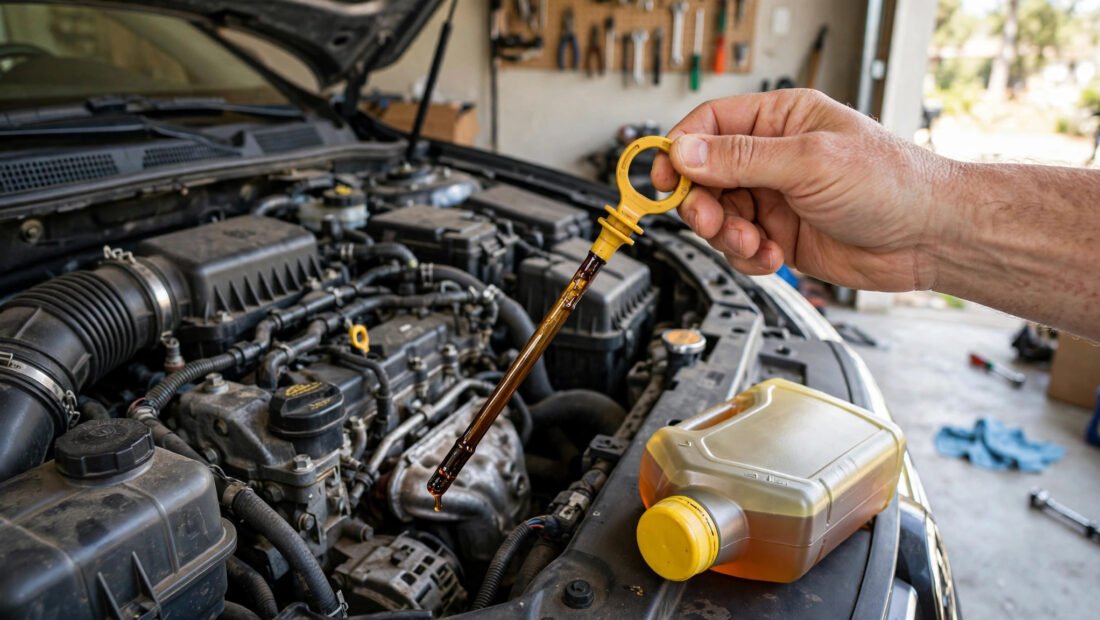
Then add one habit that costs nothing: check the dipstick once a month. It takes about 60 seconds. Look at the level, the color, and the smell. Amber to dark brown is normal. A milky look, visible metal flakes, or a strong gasoline smell means a visit to a mechanic, not a wait until the next scheduled change. The dipstick tells you things no calendar can, especially on an older engine that has started using oil between services.
The Numbers on the Bottle Are Not a Secret Code
A grade such as 5W-30 describes viscosity. The first number, 5W, covers flow when the oil is cold. The second number, 30, covers protection at operating temperature. Your manual names a grade because the engine’s oil passages and variable valve timing system were built around that flow. Use exactly that grade.
Texas heat tempts some owners to switch to a thicker oil on the theory that thicker must protect better in summer. It does not work that way. Thicker oil flows more slowly on cold starts, and cold starts are when a large share of engine wear happens. It can also starve tight-tolerance parts that expect the specified grade. The engineers who wrote the manual knew hot climates exist. Trust their grade, change on time, and you have covered the part that actually matters.
How Texas Driving Changes the Math
Summer heat waves hold oil temperatures high for months at a time. If your commute means crawling on I-35 or the Katy Freeway at 105 degrees, use the severe-service interval without guilt. That is not over-maintaining the car. That is matching the schedule to the conditions the car really faces.
Dust plays a quieter role. Rural roads and construction zones clog air filters faster, which puts extra stress on the engine over time. Check the air filter when you check the oil, so a cheap filter does not undermine the oil you just paid for. Long highway runs cut the other way. A drive from Dallas to El Paso is about the gentlest use you can give a lubricant: steady speed, full operating temperature, and moisture burned off rather than collected.
Keep one simple backup in the trunk. A quart of your car’s specified oil costs about $8 and can save a road trip when a high-mileage engine uses oil faster than expected between towns. Add a funnel and a rag and you can handle the most common roadside top-off without drama. Drivers weighing running costs across a whole car, not just its oil, will also find it useful to compare the real five-year cost of an electric car versus gas in Texas, where maintenance differences form part of the picture.
Doing It Yourself vs. Paying a Shop
The money is easy to compare. A do-it-yourself synthetic change runs about $30 to $45 in materials: five quarts of synthetic oil plus a quality filter. A shop charges about $70 to $120 for the same service. The home job takes about 30 minutes once you have done it twice, and it gives you one advantage no receipt can match: you know exactly what oil went into the engine.
If you would rather pay a shop, pay for the oil change itself and be polite but firm about the extras. Cabin air filters and engine flushes are among the highest-margin items on the counter. Flush services are unnecessary on a properly maintained vehicle, a point covered in AAA’s car care and repair guidance as well. What protects the engine is simple: the right oil, the right filter, and the right interval, repeated on schedule.
Questions Drivers Ask Most
Can you go 10,000 miles between changes?
Only if the manufacturer specifies that interval for your car and you use the required oil grade. Many Toyotas, Hondas, and European cars allow 10,000-mile intervals on full synthetic. Severe conditions still shorten that allowance. A long interval written for gentle highway use does not survive a summer of short trips and traffic unchanged.
Is synthetic oil worth the extra cost?
For nearly every driver, yes. It lasts roughly twice as long as conventional oil, protects better in extreme heat, and often costs less per mile once you count the fewer changes. Paying a little more per bottle to change oil half as often is rarely a bad trade.
What happens if you wait too long?
Oil loses its protective additives and gathers contaminants. Sludge builds up, wear increases, and engine damage follows if the habit continues. Skipping changes is the most expensive form of saving in car ownership, because the bill arrives later and much larger.
Should you change the oil before a long Texas road trip?
If you are within 1,000 miles of your interval, yes, do it before you leave. Fresh oil, a topped-off coolant reservoir, and a quick tire check are the three jobs that prevent the most road-trip trouble. None of them takes long, and all of them are harder to do well at the side of a highway.
Does the oil-life monitor replace mileage tracking?
For most drivers, yes. The monitor weighs temperature, engine speed, and trip length, which makes it smarter than any fixed number printed on a sticker. One rule still sits above it: change the oil at least once a year even if the monitor shows life remaining, because time alone degrades oil in a car that sits or makes only short runs.
So go back to those three numbers on your car. The sticker wants you back early. The monitor is measuring your real driving. The manual was written for your exact engine. Follow the manual, respect the monitor, shorten the interval when Texas summer and short trips demand it, and check the dipstick monthly. That routine, kept year after year, is what long engine life is actually built on.