The number you need for your tires is not printed on the tire. It is on a sticker in the driver’s door jamb. The number molded into the sidewall of the tire is a maximum the tire can handle, not the target your car was designed for. Fill to the sidewall number and you are overfilling for daily driving. Fill to the door jamb number and the car rides, grips, and wears its tires the way the maker planned. That one mix-up explains a lot of harsh rides, odd wear, and wasted fuel.
Step 1: Find the Placard Pressure for Your Car
Open the driver’s door and look at the jamb. You will find a sticker, often called the tire placard, that lists the recommended cold pressure for the front and rear tires. It also lists the spare in many models. Most sedans call for 30 to 35 PSI. Trucks and SUVs often call for more, and front and rear numbers sometimes differ, especially on trucks set up to carry loads.
Write the numbers down or take a clear photo of the sticker. Note the spare separately, because spares often take a much higher pressure than the road tires, and a spare that sat low for two years will be soft on the one night you need it on a dark shoulder. If the sticker is missing or unreadable, the owner’s manual carries the same figures. Do not use the sidewall maximum as a stand-in. That number tells you the ceiling for the tire itself, across many different vehicles. The placard tells you the right pressure for your vehicle, your weight, and your suspension.
Step 2: Get a Gauge You Can Trust
Buy a digital gauge for $10 to $15. Digital gauges read clearly in bright sun, hold the number long enough to compare tires, and tend to be more accurate than the thin pencil style gauges that rattle around in glove boxes for a decade. A good dial gauge also works well. What matters is that you own one and keep it in the car, not in a garage drawer you will forget.
Step 3: Check Cold, Before the Tires Warm Up
Step 3 is where most readings go wrong. Cold does not mean winter. It means the car has sat for at least three hours, or has been driven less than a mile at low speed. Driving heats the air inside the tire. Heat raises pressure, often by 3 to 5 PSI on a normal drive and more on a hot highway run. A tire that reads fine after a commute may in fact be low once it cools.
Morning, before the first drive of the day, is the best time to check. In a Texas summer that timing matters even more, because a car that sat in afternoon sun can give uneven readings from the sunny side to the shaded side. If you must check after driving, note that the reading runs high and recheck the next morning for the true number. Never bleed air out of a warm tire to hit the placard figure. You will end up underinflated once it cools.
Step 4: Measure All Four Tires, Plus the Spare
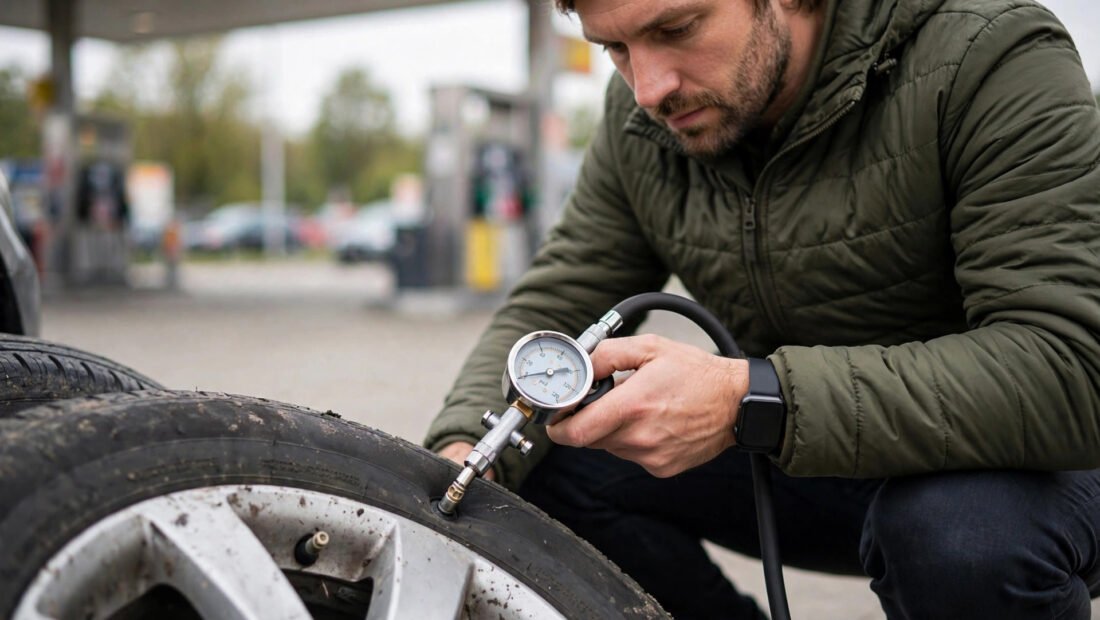
Work around the car in a fixed order so none gets skipped. Pull the valve cap and keep it in a pocket, not on the ground where it rolls away. Press the gauge straight and firm onto the valve stem. A brief hiss as it seats is normal. A steady hiss means the gauge is crooked, so reseat it. Read the number and compare it to the placard figure for that axle.
Expect small differences. Tires lose about 1 to 2 PSI a month through the rubber itself, and one side of the car may sit in more sun than the other. What should catch your eye is one tire notably lower than its mates. A single tire down 5 PSI or more while the others sit near target often means a slow leak: a nail in the tread, a tired valve stem, corrosion where the tire meets the rim, or a small crack in the wheel. Note that tire and watch it over the next few days. If it keeps falling, it needs a shop visit, not another top-up.
Step 5: Fill or Bleed to the Placard Number
Add air in short bursts, then recheck. Gauges and hoses overshoot easily, so sneaking up on the target beats blowing past it and guessing on the way down. If you go a pound or two over, press the small pin in the center of the valve stem briefly with the back of the gauge to let a little air out, then measure again.
Step 6: Recheck, Then Set a Monthly Rhythm
Do a final pass with the gauge after adjusting. Confirm each tire sits at its placard number while cold. Then set a rhythm you will actually keep: once a month, on the same weekend day, plus a check before any long trip and whenever the weather swings hard. Put it next to a habit you already have, such as the first fuel fill of the month. Like how often you should really change your oil, tire pressure rewards a boring schedule far more than occasional bursts of attention.
Why Texas Heat and Cold Swings Change the Math
Air pressure moves with temperature at a steady rate: about 1 PSI for every 10 degrees Fahrenheit. Set a tire correctly on a 95-degree afternoon in San Antonio, then drive to a 40-degree morning in the Panhandle, and that tire can read 4 to 6 PSI low with no leak at all. The fall cold snap that sweeps the state each year turns on dashboard warning lights by the thousands for exactly this reason. The tires did not suddenly fail. The air inside them contracted.
Summer pushes from the other side. Asphalt in Texas sun can pass 150 degrees. A tire rolling on that surface at highway speed builds heat fast, and an underinflated tire builds the most heat of all because its sidewalls flex more with every turn. Flexing is work, and work becomes heat inside the tire’s structure. Heat breaks down the bonds that hold the tire together. That is the path from a soft tire to a sudden blowout at 75 miles per hour, often with little warning. A tire running 25 percent under its placard pressure is not just a bit soft. It is flexing itself toward failure on every mile of hot road.
What Correct Pressure Saves You
The savings are modest per trip and real per year. Proper inflation can improve fuel economy by up to about 3 percent compared with notably low tires, a figure echoed in the official U.S. fuel economy guidance at FuelEconomy.gov, including tire inflation and gas mileage. For a Texas driver covering 15,000 miles a year, wasted fuel from low tires can run roughly $70 to $100 a year. That alone pays for a good gauge many times over.
Tread life is the larger bill. A tire run low wears its outer shoulders fast and can lose about a quarter of its useful life. On a set of tires that costs several hundred dollars, a quarter of the life is real money thrown away for want of five minutes a month. Overfilled tires waste money too, wearing the center of the tread first and shrinking the patch of rubber that grips wet pavement. Correct pressure spreads wear evenly and keeps the full tread working, which shortens stopping distances when a Gulf storm soaks the road.
The Dashboard Light Is a Backup, Not a Gauge
Most cars now carry a tire pressure monitoring system, or TPMS, that lights a symbol on the dash when a tire falls badly low. Treat that light as a safety net, not a measuring tool. By law the system warns when a tire drops to about 25 percent below the placard figure. Fuel waste, shoulder wear, and extra blowout risk all build up well before that point. A driver who waits for the light is a driver who has already been running low for weeks.
When the light does come on, check all four tires with your gauge that day, fill to the placard numbers while cold, and see if the light clears after a short drive. If it returns within days, you likely have a leak or a sensor problem. TPMS sensor batteries last about 5 to 7 years and cannot be swapped on most units, so an aging car may need new sensors at tire replacement time. A shop can tell you which wheel is reporting the fault.
Nitrogen Fills, Judged Honestly
Shops sell nitrogen fills for $30 to $100 with claims of slower pressure loss and cooler running. There is a kernel of truth in the claim. Nitrogen molecules are slightly larger than oxygen molecules, so a nitrogen-filled tire loses pressure a touch more slowly. The catch is scale. Air is already 78 percent nitrogen. The real-world difference works out to about 1 PSI over months, which a monthly check erases for free.
Nitrogen makes sense for race teams and aircraft, where tiny margins and extreme loads justify the cost and the gear. For a daily driver in Dallas or El Paso, a $12 gauge and a monthly habit beat an expensive fill paired with neglect every time. If your tires already hold nitrogen at no extra cost, there is no harm in it. Just check them on the same schedule, because nitrogen tires still lose pressure and still respond to temperature swings.
Warning Signs That Mean More Than Weather
Some patterns point past routine checks. One tire losing pressure much faster than the rest means a leak until proven otherwise. A tire that will not hold pressure overnight should not be trusted on the highway. A valve stem that hisses when you wiggle it is failing. Rust or white corrosion building where the tire meets an alloy rim can break the seal in slow motion. And a TPMS light that stays on at correct pressures points to a dead sensor battery or a system fault, not to the air itself.
Get those checked promptly. A slow leak found early is often a cheap plug or a new valve stem. The same leak ignored through a summer of highway miles can end as a shredded tire, a damaged rim, and a tow bill on a stretch of road with no shade. Five minutes with a gauge each month is how you catch the cheap version of the problem.