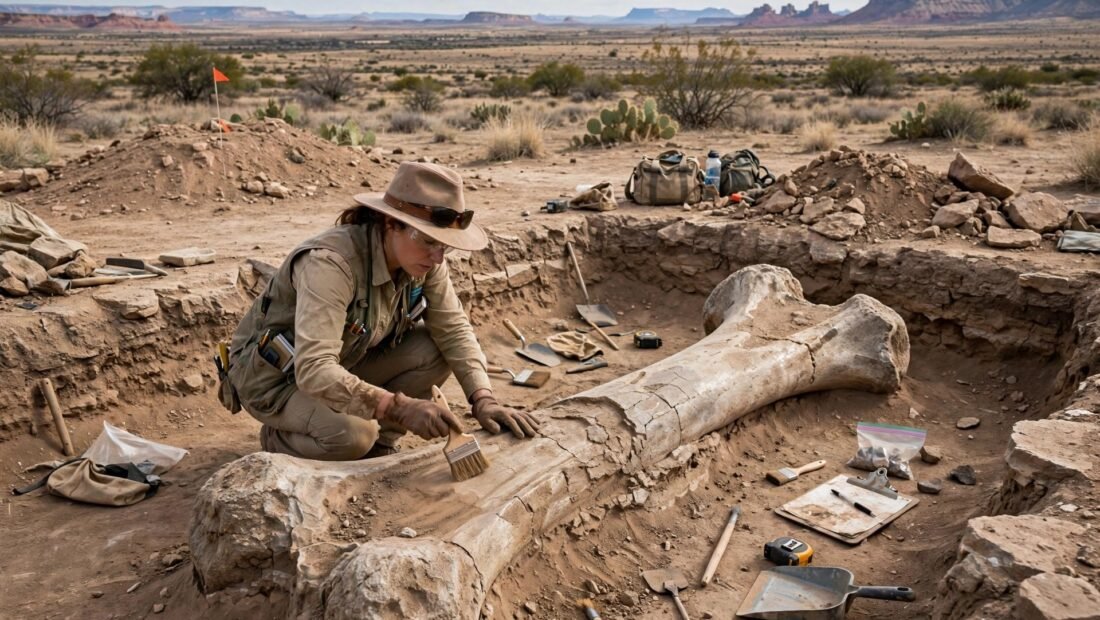
No single clock can date the whole past. A bone from a campfire, a layer of volcanic ash, and a slab of cave limestone each hold time in a different way, and each clock runs out at a different depth. So scientists run four clocks, in the order of the ages they can reach. Annual bands come first, for the recent past. Radiocarbon takes the middle stretch that covers most human prehistory. Uranium-series handles the deeper middle. Potassium-argon and argon-argon reach the millions of years where fossils of early life and dinosaurs sit. Understanding which clock fits which material is the whole secret behind a headline like 68 million years old.
First Clock: Counting Years One Band at a Time
The most direct way to date anything is to count. Trees lay down one growth ring per year, wide in a wet year and narrow in a dry one. That pattern of wide and narrow rings works like a barcode for a stretch of years. By overlapping barcodes from living trees, dead trunks, and beams in old buildings, researchers build unbroken ring sequences that reach back roughly 14,000 years in the best chronologies. If a wooden artifact matches a place in that sequence, its age is known to the exact year it was cut. No other method gives that kind of precision.
Ice does the same thing on a far larger scale. Snow falls each year on Greenland and Antarctica, packs into a layer, and traps dust and air from that year inside it. Drill deep enough and you pull up a core that reads like a stack of annual pages. In Antarctic ice those pages run back about 800,000 years. Volcanic ash layers inside the ice, matched to known eruptions, help confirm the count at depth where annual layers squeeze thin and grow hard to tell apart.
Second Clock: Radiocarbon and the Last 50,000 Years
Radiocarbon is the famous one, and its logic is clean. High in the atmosphere, cosmic rays create a rare form of carbon called carbon-14. Living things take it in at a steady rate while they live — plants from the air, animals from the plants and prey they eat. The moment an organism dies, intake stops. The carbon-14 already inside then decays at a known rate, with a half-life of 5,730 years. Half is gone after 5,730 years, half of what remains after another 5,730, and so on. Measure how much is left compared with stable carbon, run the decay math backward, and you get the time since death.
The limits matter as much as the logic. After about 50,000 years, so little carbon-14 remains that even sensitive instruments cannot measure it reliably. That single fact explains why radiocarbon cannot date a dinosaur. Dinosaurs died out about 66 million years ago, more than a thousand times beyond the method’s reach. Anyone claiming a radiocarbon date for dinosaur bone has misunderstood the clock, or has measured contamination rather than the bone itself.
Radiocarbon also needs organic material. Bone, wood, charcoal, shell, cloth, and leather can all be dated. Stone cannot, because stone was never alive and never traded carbon with the air. That point returns at the end, because it shapes how stone tools are dated at all. One more wrinkle needs care: the amount of carbon-14 in the air has not stayed perfectly steady over time. Sun activity, ocean shifts, and more recently fossil fuel burning and nuclear tests have all nudged it. Scientists fix this by calibrating. They date tree rings of known age with radiocarbon, compare the two answers, and build correction curves that turn a raw radiocarbon age into a true calendar age. A reported date that skips calibration is unfinished work.
Texas gives this clock a famous job. Charcoal from hearths at Clovis sites, including the rich Gault site near Austin, dates to about 13,000 years ago. Those hearths anchor early human presence in the Americas. Because the charcoal sat with stone tools in sealed layers, the radiocarbon age of the charcoal dates the human activity around it — a pattern of dating by association that runs through all of archaeology.
Third Clock: Uranium-Series for the Deep Middle
Between radiocarbon’s limit and the volcanic clocks lies a long stretch, roughly 1,000 to 500,000 years, where many key chapters sit: cave art, early human spread, mammoth hunts, and shifting ice age climates. Uranium-series dating covers that stretch. It works in materials where water has carried uranium in and left it trapped, above all the calcite crusts that grow on cave walls and floors, plus coral and some shells and bones.
Inside that trapped mineral, uranium decays through a chain of elements at known rates. A fresh calcite layer starts with uranium but almost none of one decay product, thorium-230, because thorium does not travel in water the way uranium does. As years pass, thorium-230 grows in at a pace set by physics. Measure the ratio between them and you can read off how long the layer has been sealed. A painting covered by a thin calcite skin must be older than the skin. A painting on top of a dated crust must be younger. Bracket by bracket, cave art around the world has gained firm minimum and maximum ages this way.
Texas caves and rock shelters hold the same kind of crusts, and Central Texas sites with burned-rock middens and layered deposits give uranium-series and its partner methods real work to do. Luminescence dating often works alongside it here. That method reads how long quartz or feldspar grains have been buried since last seeing sunlight, by measuring stored energy released as light in the lab. It dates the sediment itself, which makes it a strong partner where no charcoal survived. Readers who want a broad reference can compare methods in Encyclopaedia Britannica’s explainers on radiometric and archaeological dating, which lay the major clocks side by side.
Fourth Clock: Potassium-Argon and the Millions
For volcanic layers millions of years deep, the clock needs a much slower tick. Potassium-argon dating uses potassium-40, which decays to argon-40 with a half-life of about 1.25 billion years. The trick lies in how argon behaves. When rock is molten, argon gas escapes freely, so fresh volcanic rock starts with essentially no trapped argon. Once the rock cools and hardens, argon from decaying potassium builds up inside the crystals and stays put. Measure how much argon has gathered against how much potassium remains, and the ratio tells you how long ago the rock solidified.
A refined version, argon-argon dating, heats the sample in steps and measures gases with great care, yielding tighter dates from smaller samples. This is the family of methods that pinned the dinosaur extinction layer to about 66 million years ago and that dates the ash beds bracketing early human fossils in East Africa. The catch is the same one seen with radiocarbon, only larger. These methods date the volcanic rock, not the fossil nestled near it. If a fossil lies between an ash layer dated to 2.1 million years below and one dated to 1.9 million years above, the fossil’s age sits between those bounds. Geology calls this bracketing, and honest reporting keeps the brackets visible.
Other long clocks support this deep work. Uranium-lead dating, with half-lives in the billions of years, dates the oldest minerals on Earth, including zircon crystals over 4 billion years old, and sets the age of the planet itself. Paleomagnetism adds a check that needs no decay at all. Earth’s magnetic field has flipped many times, and iron minerals in cooling lava or settling sediment lock in the field’s direction as they form. Match that frozen compass direction to the known flip timeline and you gain an age range that either confirms a radiometric date or flags a problem. For background on how shifting ground itself gets studied, see how earthquakes happen and whether science can predict them — a different puzzle, but one that leans on the same layered reading of rock.
Why Trust Any of This: The Clocks Check Each Other
A single date from a single lab should never carry a big claim on its own, and in good practice it does not. The strength of modern dating is overlap. The four clocks were built on different physics. Tree rings count seasons. Radiocarbon counts a decaying isotope in once-living tissue. Uranium-series counts a decay chain growing inside cave stone. Argon methods count gas trapped in volcanic crystal. There is no shared flaw that would push all four toward the same wrong answer by chance. When they agree on a site’s age, that agreement is the evidence.
The Clovis example shows the habit at work. Charcoal gives a radiocarbon age. Sediment around the tools gives a luminescence age. Stratigraphy — the rule that deeper layers in undisturbed ground are older than the layers above them — checks that the order makes sense. If a date breaks the order, scientists look for a cause: burrowing animals mixing layers, groundwater moving carbon, an old piece of wood reused in a younger fire. Disagreement triggers investigation, not cherry-picking. Methods also get tested against ages history already knows, such as material from the eruption of Vesuvius in 79 CE, where the correct answer is written in Roman records. Clocks that pass those blind checks earn the trust placed in them at 13,000 or 66 million years.
The Stone-Tool Answer
So how do you date a stone tool, if stone itself holds no radiocarbon and no trapped argon clock from the day a person shaped it? You date everything around the tool. Charcoal from the hearth where it was dropped. Sediment that buried it. A calcite crust that sealed the layer. Ash beds above and below. The tool inherits the age of its context, which is why excavation records the exact layer of every find before anything moves.
That is also why looting and careless digging destroy knowledge that no lab can rebuild. A point ripped from the ground with no record of its layer is a beautiful object with its date torn off. Left in place and recorded, the same point becomes evidence. The four clocks, run in order from annual bands to volcanic argon, turn soil, ash, bone, and stone crust into a timeline. No one clock does the job. Together, cross-checked at every step they can reach, they make the deep past legible.