
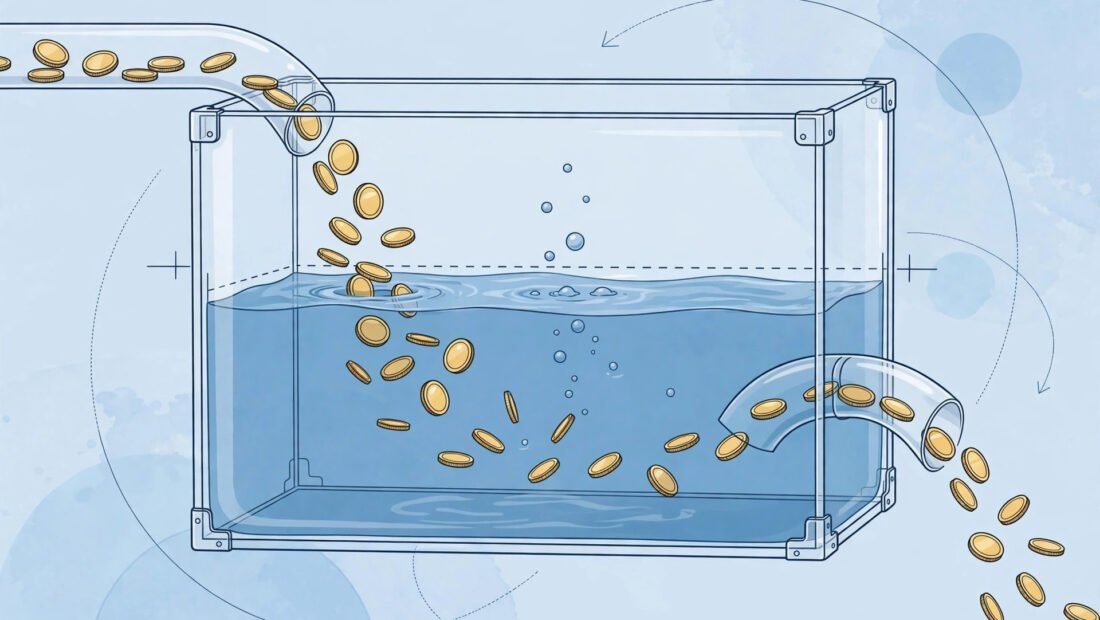
Payday lands on Friday and the balance looks healthy. Rent leaves on Monday. The card autopay lands on Wednesday, two days before the next paycheck, and a $40 timing gap that nobody noticed quietly turns into a $35 overdraft fee. Nothing was overspent. The money existed. It was just in the wrong account on the wrong day, and the bank charged for the gap.
Follow a household through a month like that and the right checking balance stops being a mystery number. It becomes a piece of timing equipment: enough cash sitting where bills are paid from to absorb every mismatch between when money arrives and when money leaves, and not a dollar more than that job requires.
Week One: The Rent Leaves Before the Month Settles
Take a household with regular monthly outflows of about $3,000: housing, utilities, insurance, loan payments, and normal variable spending on food, fuel, and household needs. The paycheck arrives every two weeks. The rent or mortgage goes out on the 1st. Insurance auto-drafts on the 22nd. Pay arrives on the 15th. On paper the income covers the bills. On a calendar, the bills keep arriving at moments when the balance is at its lowest.
That calendar problem is the whole reason for a buffer. Keep one month of essential expenses in checking, plus enough to cover the bills due before the next payday, and the timing stops mattering. The rent can leave on Monday without anyone checking whether Friday’s pay has cleared. For most people that target produces a checking balance that moves between about $2,000 and $6,000, depending on spending. The balance is supposed to move. A checking account that never dips and never rises is either carrying too much idle cash or running too close to empty.
Work out the household floor in one sitting. Add up one month of regular outflows. That total is the floor, the level the balance should rarely fall below. Anything that stays above the floor plus the next two weeks of bills, month after month, is not safety. It is idle cash that belongs somewhere it can earn a return.
Week Two: The Autopay That Tests the System
The Wednesday card payment in the opening days of the month is where thin buffers fail. A single overdraft fee runs $30 to $35 at most banks, and one mistimed bill can trigger several fees in a row if other payments follow it into an empty account. The household that keeps a $40 cushion has not saved money by keeping the rest elsewhere. It has bought a fee with its own timing.
Now run the cost of the safer setup honestly. Holding a $3,000 buffer means giving up the interest that $3,000 could earn elsewhere, roughly $135 a year at 4.5 percent. Two overdrafts cost about $70. On fees alone the trade looks close, until you count what the simple comparison leaves out: the time spent disputing charges, the risk of a missed payment being reported, the stress of watching an account daily, and the third or fourth fee in a bad month. The buffer wins for a household that overdrafts only rarely. If overdrafts happen constantly even with a buffer in place, the problem is no longer buffer size. It is cash-flow timing itself, and that calls for moving due dates or rebuilding the payment calendar, not just adding more cash.
Add one more layer of protection. Link checking to savings for overdraft cover, which is usually free or carries a small transfer fee instead of a full overdraft charge. Buffer plus link makes an actual overdraft hard to reach. That is the point of both pieces: the buffer handles normal timing, and the link catches the rare mistake.
Week Three: The Sweep That Stops Idle Cash Piling Up
By the third week the opposite problem appears. Two paychecks have landed, the big bills have cleared, and the balance sits well above what the household needs. Left alone, it will still be sitting there next month, earning essentially nothing, feeling safe and doing nothing.
The sweep system fixes that drift with two numbers. The floor is the one-month buffer, say $3,000. The ceiling is the floor plus a comfort margin, say $5,000. Once a month, on a fixed date, everything above the ceiling moves into high-yield savings or investments. Pick the sweep date for just after the last monthly bill clears, so the transfer never pulls money that a pending payment needs. Most banks allow automatic transfers on a schedule, so the habit does not depend on remembering.
Windfalls follow a separate rule. A bonus, a tax refund, or side income should bypass checking’s orbit and go straight to savings or investments. If a refund lands in checking and waits for the monthly sweep, it inflates the balance for weeks and tends to get absorbed into ordinary spending. Routing it out on arrival keeps it intact. Households building longer-term savings alongside the buffer often pair that habit with a clear target for how much retirement savings is enough in your 30s, so swept money has a job waiting for it instead of drifting between accounts.
Week Four: What Too Much Cash in Checking Really Costs
At the end of the month, add up what an oversized balance charges you. Every $10,000 sitting in checking instead of a high-yield savings account costs roughly $450 a year at current rates. A $20,000 balance kept in checking for safety gives up about $900 a year. Over a decade that is more than $9,000 of lost interest, before compounding. That is not a rounding error. That is a bill the household pays annually for a feeling.
The feeling deserves a fair hearing, because safety is a real need. But safety comes from the buffer plus the linked savings behind it, not from the size of the checking balance itself. Money in high-yield savings is nearly as reachable, with transfers usually taking one to two days, and it grows while it waits. A genuine emergency that cannot wait one or two days is rare, and the buffer already covers the urgent first wave of almost any surprise. For the rules that protect deposits wherever you hold them, the FDIC’s consumer banking resources explain deposit insurance coverage in plain terms, which is worth checking if combined balances across accounts grow large.
Run a quick test on your own account. Look at the average balance over the last six months. If it sits consistently at double your monthly outflows, the account is overfunded. Sweep the excess this week. The transfer takes about five minutes, and the only thing that changes is that the same money starts earning something.
When the Household Math Changes
Irregular income rewrites the floor. Freelancers and commission workers should keep six to eight weeks of expenses in checking rather than four, because the next payment’s arrival date is genuinely uncertain. The ceiling rises with the floor, and the sweep still applies above it. The principle does not change: cap the account, move the rest.
Known large bills rewrite it temporarily. Property tax due next month, or an insurance premium arriving in six weeks, justifies raising the floor until that payment clears, then dropping it back. The buffer should flex for a named, dated expense. It should not creep upward for a vague sense that a bigger number feels better.
Separate accounts need separate treatment. A household running one checking account for bills and another for spending should apply the buffer to the bills account. The spending account holds only discretionary money and can run leaner. Business owners should keep business and personal checking strictly separate and apply the buffer rule to each one on its own. Business checking usually needs the larger buffer of the two, because money owed to the business arrives on other people’s schedules.
Fees set a floor of their own. Many banks waive monthly fees at a minimum balance, with $1,500 a common threshold, or with direct deposit. Know your bank’s rule and count it when you set the floor. If a bank charges fees you cannot reasonably avoid, switch. Free checking is widely available, and there is no prize for paying a bank to hold your own money.
The Five-Minute Review That Keeps the Month Honest
Close the month the way the household opened it: on the calendar. Once a month, spend five minutes on three numbers. First, the lowest balance the account reached. Was the buffer ever threatened? Second, the average balance. Is idle cash building up above the ceiling? Third, any fees. Are you paying for avoidable mistakes?
Act on what those numbers say. An average that keeps creeping above the ceiling means the sweep amount should rise or the ceiling should fall. A low point that keeps dipping near zero means the floor is too small for the household’s real payment pattern, and it should go up. Recalibrate twice a year, and again after any major change in income or regular expenses.
By the next payday Friday, the household from the opening week is running a different month. Rent still leaves on Monday. The card autopay still lands on Wednesday. The difference is that a one-month buffer sits under both dates, a linked savings account stands behind the buffer, and everything above the ceiling has already been swept out to earn its keep. Checking has gone back to its proper job. It is a transit hub for money on its way somewhere, not a parking lot for money going nowhere.



1 Comment