
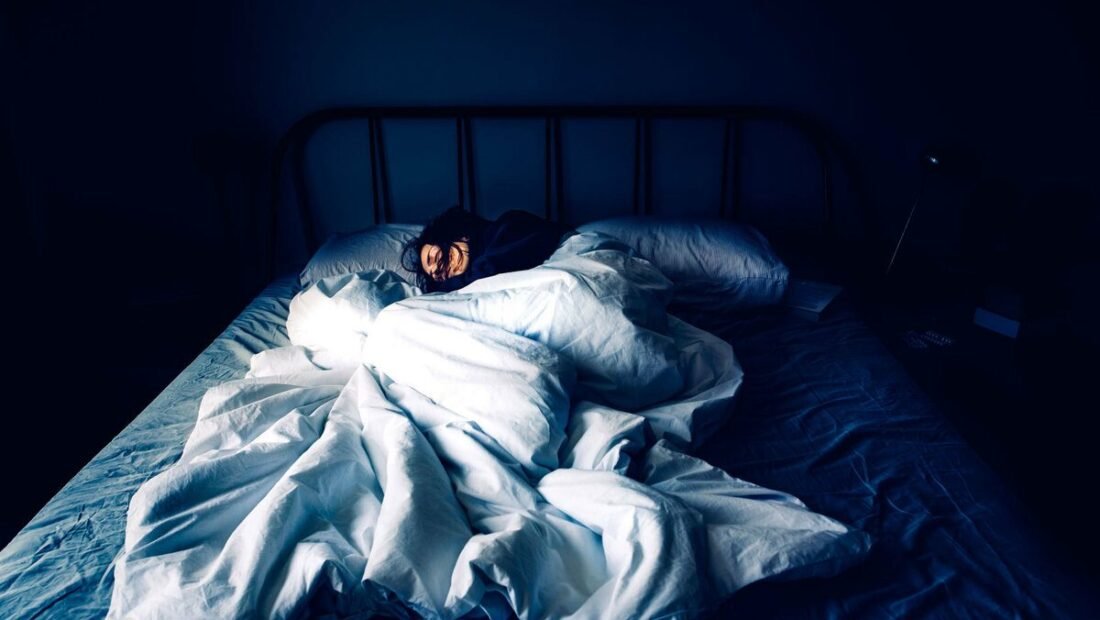
11:40 p.m. You are exhausted — the honest, whole-body kind of tired that should end the day on contact with the pillow. The room is dark, the phone is (mostly) away, and instead of sleeping you are now reviewing, in high definition, every awkward sentence you produced this week, plus one from 2019. If this scene is your nightly ritual, nothing is wrong with your character and very likely nothing is wrong with your body. What is wrong is the run-up: falling asleep is a landing, and most struggling sleepers are trying to land a plane that never descended. Walk the evening through hour by hour — the way sleep specialists actually build it — and watch where the descent gets built.
6 p.m. to 8 p.m.: the decisions that look unrelated
The descent begins before dinner. Caffeine is the first line item: it has a half-life of roughly six hours, which means half of your 4 p.m. coffee is still on duty at 10 p.m. — people vary, and slow metabolizers carry it longer. A noon cutoff is the conservative standard that works for almost everyone; if you are reading this at midnight, wide awake, move your last caffeine earlier before you try anything else. Exercise belongs in this window too: regular daytime exercise deepens sleep measurably, but a hard session ending within an hour or two of bed can leave some people wired — earlier is safer if you are sensitive. And write the first descent note now, not later: the two or three things circling your mind get captured on paper tonight, because the plan for 10 p.m. depends on it.
9 p.m.: dim the world
Light is the strongest signal your body clock takes, and the evening mistake is living under daylight-bright lighting until the moment you ask for darkness. An hour before bed, drop the house to evening levels — lamps instead of overheads, screens dimmed or done. This is when the shower trick belongs: a warm shower or bath about 90 minutes before bed seems backwards but works forward, because the steep drop in body temperature afterward is one of the body’s natural “sleep is coming” signals. Sleep researchers call body temperature decline a core part of sleep onset; the shower simply schedules it. While you are there, set the bedroom itself to cool — around 65°F (18°C) suits most sleepers, and a room that feels almost chilly with a warm blanket beats a warm room for nearly everyone.
10 p.m.: the worry appointment and the phone exile
Remember the list from earlier? This is its moment. Take five minutes with the notepad: tomorrow’s tasks written down, today’s open loops named, anything unresolved given a written home. The technique sounds too small to matter, but the racing mind at 11:40 is usually not anxious about mysteries — it is doing inventory, afraid of forgetting. Paper remembers so the brain can stop volunteering. Then the phone leaves the bedroom. An old-school alarm clock costs about $10 and removes the single largest source of “just one more scroll” bedtime delays, the glowing clock-checks at 2 a.m., and the news alert that restarts your heart rate at midnight. If the phone must stay for emergencies, it stays face-down, across the room, on do-not-disturb — a landline’s manners, not a slot machine’s.
11 p.m.: the twenty-minute rule
Lights out. And now the most counterintuitive instruction in sleep medicine, called stimulus control: if you are not asleep in roughly 20 minutes, get up. Lying awake for hours trains your brain to pair the bed with frustration and effort, and that pairing is precisely what keeps people awake at 11:40 reviewing 2019. Instead: go to a dim room, do something genuinely boring — a dull book, quiet music, nothing with a feed — and return to bed only when sleepiness actually arrives. Repeat as needed. It feels wrong the first nights and re-teaches the bed its job within a week or two for many people. While lying there, turn the clock away. Clock-watching converts normal wakefulness into arithmetic anxiety (“if I fall asleep now I get five hours and forty minutes”) and the arithmetic is itself a stimulant.
For the mind that still will not stop: give it a low-effort anchor. Slow breathing with a longer exhale than inhale. A body scan, toe to scalp, conducted in a deliberately bored tone. A familiar, mildly interesting audiobook or podcast you have heard before — engaging enough to occupy the narrator in your head, known enough to hold no cliffhangers. The NHLBI’s pages on insomnia describe the same behavioral toolkit and the point at which insomnia deserves a medical conversation — roughly, when it persists most nights for three months despite a repaired routine, or arrives with loud snoring, witnessed breathing pauses, or serious daytime impairment.
Shared beds, small children, and other real-world weather
Protocols pretend people sleep in laboratories. Real descents happen in houses with snoring partners, shift-working spouses, and toddlers who treat 3 a.m. as a social hour. A few adaptations keep the system intact. Earplugs and a white-noise machine are not failures of the method; they are how the method survives a snoring partner, and couples do better negotiating them cheerfully than conducting a nightly referendum on whose sleep matters. If your partner’s schedule differs from yours, negotiate the overlap items — light, noise, the alarm — once, in daylight, rather than nightly at midnight. For parents of small children: the goal is not a perfect descent but a fast return to sleep after interruptions, which is exactly what the twenty-minute rule and the anchored morning train. Keep wake time steady even after broken nights — counterintuitive, exhausting for a day, and the thing that rebuilds sleep pressure for the next night. Nap if you must, before mid-afternoon and under an hour, so the nap borrows from the day instead of from tonight.
What about the non-pill shelf?
Because the question always comes: the sleep aids that are not sleeping pills deserve an honest sorting. Magnesium is reasonable if your diet is low in it, and harmless for most people, but it is a modest player. Herbal teas — chamomile, valerian — are mild, pleasant rituals whose ritual value may exceed their chemistry, which is fine; ritual is half of this article. Weighted blankets genuinely help some anxious sleepers feel settled and do nothing for others; borrow before you buy. Glycine and tart cherry juice have small, preliminary findings and low risk. What none of them do is replace the descent: a supplement taken at 11:55 in a bright room with a phone in hand is a candle on a windy porch. Build the pattern first. Then, if you still want a supporting player, the ones above are the sensible bench — and anything stronger, or any nightly dependence forming, belongs in the doctor conversation rather than the supplement aisle.
The next morning: the anchor nobody suspects
The descent that failed last night usually started the previous morning. Wake time is the anchor of the entire system: a consistent waking hour — weekends included, within an hour — plus daylight exposure soon after waking sets tonight’s sleep pressure and timing more powerfully than any evening ritual. This is also why the cruelest trap is the weekend lie-in after a bad week: sleeping until 10 on Saturday feels like recovery and functions like jet lag, which is why Monday nights are the worst sleep of the week for so many people. If your nights are broken, our analysis of why you’re still tired after 8 hours of sleep covers the other half of the problem — sleep that happens but does not restore.
Two refinements for stubborn cases before you conclude the system is not for you. First, check the substances honestly: nicotine is a stimulant that fragments sleep even in people who swear it relaxes them, alcohol sedates the first half of the night and shatters the second — many “insomnias” are actually a nightcap with good PR — and some prescription and over-the-counter medicines quietly list insomnia among their effects, which is a question for your pharmacist. Second, if you do everything here and still lie awake most nights for a month, that is not a character verdict either; it is the entry criteria for cognitive behavioral therapy for insomnia, the structured program sleep specialists consider the first-line treatment — more durable than any pill, and increasingly available by referral and even by app. Not sleeping is a solvable problem at every level of stubbornness. It just solves in order.
Give the full sequence two weeks of honest repetition. Falling asleep is not a talent; it is a landing pattern — caffeine timed out, lights lowered, temperature dropped, worries filed, bed reserved for sleep, morning anchored. Run the pattern nightly and most planes, even the ones that have circled for years, come down. And on the nights they still circle, you will at least know which part of the pattern the weather disrupted — which turns a mystery that breeds dread into a checklist that breeds sleep.




1 Comment