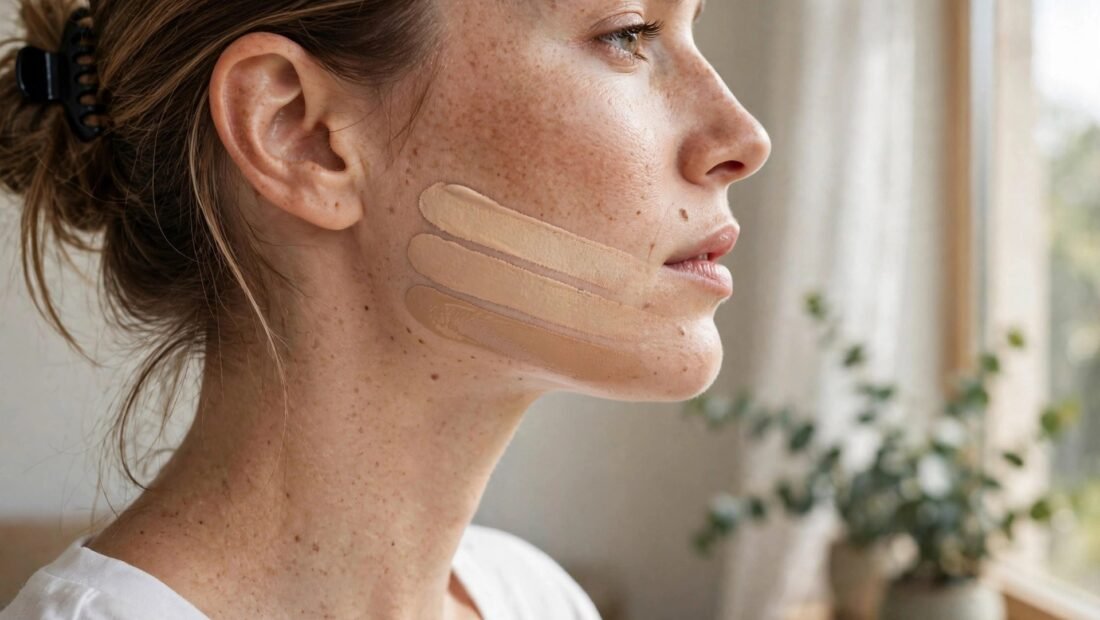
You’ve done it in a drugstore aisle: swatched three “your shade” foundations on your hand, picked the closest, and gotten home to discover your face is orange and your neck is a different person. Foundation matching is the highest-stakes decision in makeup — the wrong shade is visible from across the room, while the right one is invisible. And Texas adds complications: year-round sun shifts your shade seasonally, humidity changes how formulas wear, and harsh overhead lighting in stores lies to you. Here’s the systematic method for finding your actual match.
Step 1: Know Your Undertone (Not Your Surface Tone)
The #1 foundation mistake is matching surface tone while ignoring undertone — the subtle hue beneath the skin that determines whether a foundation looks natural or mask-like. Three categories:
- Warm: golden, peachy, yellow hints. Veins on the inner wrist look green; gold jewelry flatters; you tan relatively easily.
- Cool: pink, red, blue hints. Veins look blue/purple; silver jewelry flatters; you burn before tanning.
- Neutral: a mix — veins look blue-green, both metals work, neither test is decisive.
The vein test is a starting point, not gospel — confirm with the white-paper test (hold white paper to your face in natural light: does skin look yellowish = warm, pinkish = cool, grayish = neutral-olive?) and the jewelry test. Most mismatches come from warm-undertoned people wearing cool/pink foundations (the classic “my foundation looks pink on me”) or vice versa. Once you know your undertone, you’ve eliminated two-thirds of wrong options — filter by it first, always. Our guide to colors that flatter warm skin tones extends the same undertone logic to your whole wardrobe.
Step 2: Find Your Depth (Light to Deep)
Depth is the light-to-deep scale — fair, light, medium, tan, deep. Match depth after undertone: a medium-warm and a medium-cool look entirely different on skin despite sharing “medium.” Texas consideration: most people run one shade deeper in summer than winter, even with sunscreen — incidental sun exposure accumulates. Serious foundation users keep two shades (summer and winter) and mix in the shoulder seasons, or use a slightly deeper shade year-round with bronzer to adjust. If you’re between depths, go with the deeper option — too-light foundation reads ashen and mask-like, while slightly-deep blends more forgivingly.
Step 3: Swatch Correctly (The Jawline Protocol)
Where and how you swatch determines everything:
- Swatch on the jawline — not the hand, not the wrist. The jaw is where face meets neck, and the goal is making that transition invisible. Stripe three candidate shades vertically along the jaw.
- Check in natural daylight. Store lighting — especially Texas drugstores’ harsh fluorescents — distorts color. Walk outside or to a window. The shade that disappears into your skin is the match; if you can see the stripe’s edges, it’s wrong.
- Wait 10 minutes. Foundations oxidize — they darken as they react with skin oils and air. A perfect in-store match that’s orange by lunch was tested too fast. Ask for samples and wear-test at home when possible.
- Check the neck, not just the face. Faces are often redder/darker than necks. The right foundation bridges the two — if your face shade and neck shade differ significantly, match between them or use the neck as the deciding vote (a slightly lighter face looks natural; a darker face with a pale neck looks like a mask).
Step 4: Match Formula to Texas Skin Reality
Shade is only half the equation — the wrong formula in the right shade still fails:
- Oily/combination skin + Texas humidity: oil-free, matte or natural-matte liquid foundations; avoid dewy/radiant finishes (humidity provides enough glow). Set with powder in the T-zone.
- Dry skin: hydrating, satin-finish formulas; matte foundations cling to dry patches and age you. In Texas winter (yes, the dry cold fronts), switch richer.
- Mature skin: lightweight, medium-coverage formulas — full-coverage matte settles into every line. Less is more after 40.
- Acne-prone: non-comedogenic, fragrance-free; mineral formulas are often gentlest. Coverage needs don’t require heavy formulas — layer a medium foundation with targeted concealer instead.
Finish matters as much as coverage: in Texas summer, a matte foundation that looked perfect at 8 a.m. can separate by 2 p.m. Primer (mattifying for oily, hydrating for dry) is the difference between all-day wear and midday meltdown. And remember that foundation with SPF is not a sunscreen substitute — the American Academy of Dermatology is explicit that you’d need far more product than anyone applies to reach the labeled SPF, so layer real sunscreen underneath regardless of what the foundation claims. Dermatologists at Cleveland Clinic similarly advise treating makeup SPF as a bonus, never the plan.
The Undertone Traps Specific to Foundation Lines
- “Neutral” isn’t universal: many lines’ “neutral” shades lean pink or yellow. Test, don’t trust the label.
- Olive undertones are underserved: greenish-olive undertones (common in Mediterranean, Middle Eastern, Latin American, and many South Asian skin tones — all well-represented in Texas) often find nothing in mainstream ranges. Look for lines explicitly offering olive shades, or mix yellow + a touch of green corrector.
- Depth ranges lie: “medium” in one line is “tan” in another. Always swatch; never buy by name across brands.
- Drugstore vs. prestige shade ranges: prestige lines typically offer 40+ shades with real undertone variety; drugstore lines have improved dramatically but still skew narrow in the deep and olive ranges. The budget polished look is absolutely achievable — it just takes more swatching at the drugstore.
Conclusion
Finding your foundation shade is a four-step system: determine undertone (warm/cool/neutral) first, then depth, then swatch on the jawline in natural light with a 10-minute oxidation wait, then match the formula to your skin type and Texas climate reality. Keep two shades if your skin shifts seasonally, distrust labels, and remember the goal — the perfect foundation is the one nobody notices. Get the undertone right and everything else gets easier; get it wrong and no amount of blending saves you.
Frequently Asked Questions
How do I choose the right foundation shade for my skin tone?
Determine your undertone first (warm, cool, or neutral via vein, white-paper, and jewelry tests), then your depth. Swatch 3 candidates on your jawline, check in natural daylight, wait 10 minutes for oxidation, and pick the shade that disappears into your skin.
Should I match foundation to my face or neck?
Match the transition — swatch on the jawline where face meets neck. If they differ, split the difference or favor the neck; a face slightly lighter than expected looks natural, while a darker face over a pale neck looks mask-like.
Why does my foundation look orange after a few hours?
Oxidation — the formula darkens reacting with your skin’s oils and air. Test shades with a 10-minute wait before buying, choose a shade slightly lighter than your initial instinct, and use primer to create a barrier.
Do I need different foundation shades for summer and winter?
In Texas, usually yes — incidental sun deepens most people’s skin a shade in summer. Keep summer and winter shades and mix during transitions, or use bronzer to warm up a winter shade.
How do I find foundation for olive undertones?
Look for lines with explicit olive shade offerings, or mix a yellow-based foundation with a small amount of green color corrector. Test in natural light — olive is the undertone most distorted by store lighting.