Here is the whole secret, priced out loud: a $15 steamer, $30 to $50 of tailoring on clothes you already own, and shoe polish you probably have in a drawer — under $75 total — will make you look more put together than a $300 shopping spree will. Looking polished is almost never a buying problem at all. It is a finishing problem, and most people get it backwards in six specific ways. The mistakes come first, because each one you stop making is worth more than the next purchase you were planning.
Mistake 1: Buying more clothes to fix a presentation problem
The instinct, when you feel scruffy, is to shop. But new clothes worn wrinkled, unaltered, and with unpolished shoes reproduce exactly the same impression at a higher budget — the fashion industry is delighted to sell you this lesson repeatedly. A $500 outfit on an ungroomed person genuinely loses to a $50 outfit on a polished one, because observers read grooming, fit, and finish before they ever register labels or price. The audit to run before any shopping: of the clothes you already own, how many are clean, unwrinkled, properly fitted, and in good repair right now? For most wardrobes the honest answer is under half — which means the fastest upgrade available is rescuing the other half, not adding a twenty-first item to the pile.
Mistake 2: Wrinkles — the cheapest tell there is
Wrinkle-free is fully half the battle, and it is the half with a simple $15 solution. A handheld steamer transforms thrifted and budget clothes in minutes, works on fabrics an iron would scorch, and removes the single most common “something’s off” signal in an outfit. Hanging clothes in a steamy bathroom during a shower is the free version. The deeper mistake is storage that manufactures wrinkles: clothes crammed so tightly in the closet that they crease as they hang, knitwear stretched on hangers, everything retrieved from a chair-pile. Ten minutes of steaming a week, plus giving garments an inch of breathing room, outperforms every styling trick that follows.
Mistake 3: Treating grooming as separate from the outfit
Grooming outranks clothing — full stop. Clean, trimmed nails; hair that looks intentional whether it is elaborate or simply neat; skin that is moisturized rather than flaking; teeth and breath seen to; facial hair either groomed or absent rather than in negotiations. None of this costs meaningful money, and all of it is read by other people as the headline, with clothes as the supporting text. It is deeply unfair and completely reliable: the same outfit scores a full grade higher on a groomed person. If your budget forces a choice between a new garment and the basics of grooming — a decent haircut above all — choose the haircut every time. It is the only item on your body visible in every single outfit you own.
Mistake 4: Leaving the cheap tells visible
Cheap does not read as cheap because of price; it reads as cheap because of tells — and every tell is fixable for coins. Loose threads and hanging care labels: scissors, thirty seconds. Pilled knitwear: a $10 sweater shaver restores a jumper to near-new in an evening. Scuffed, dusty shoes: polish or a thorough wipe, free, five minutes, and the single largest per-minute improvement available anywhere on your body. Garish plastic buttons on an otherwise decent coat or blazer: a $2 button swap to matte, natural-looking buttons, the tailor’s oldest trick for making budget garments look three times their price. Yellowed whites, a stretched-out neckline, a bag with peeling trim: triage ruthlessly — repair, demote to home wear, or release. The goal is not newness; it is the absence of visible neglect.
Mistake 5: Wearing your almost-correct size
Fit, fit, fit — the repetition in every stylist’s answer is earned. Clothes that almost fit announce their price; clothes that fit exactly are unattributed, assumed expensive. The budget miracle is that fit is purchasable separately from clothing: hemming trousers runs about $15, taking in a waist about $20, shortening sleeves about $15 — and a $25 thrift find tailored for $15 produces a $200 look for $40, every time. Prioritize the fixes in order of visibility: trouser length first (pooling fabric is the loudest cheap tell), then waist fit, then sleeve length. Shoulders are the one thing tailors cannot economically change, so buy for the shoulders and tailor everything else. This is also the thrifter’s superpower: thrift stores are full of quality blazers at $10 to $15 whose only crime is being two sizes off, and tailoring converts them while retail shoppers pay full price for worse fit.
Mistake 6: Chasing logos and trends instead of structure and monochrome
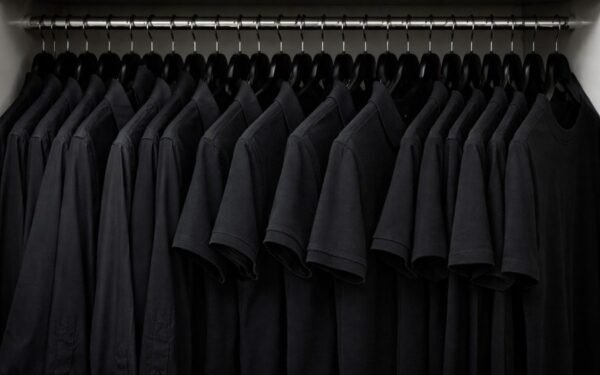
Two styling shortcuts do the work that money was supposed to do. The first is monochrome: dressing in one color family head-to-toe — all navy, all black, shades of cream and camel — always reads as expensive, because it removes the visual noise that makes outfits look assembled by accident and creates one long, deliberate line. The second is the one structured piece: a blazer, a tailored coat, a crisp overshirt, sharp shoes — a single element with architecture pulls an otherwise soft, cheap outfit into focus. Contrast with the mistakes they replace: visible logos (which let a brand’s marketing department dress you), and trend-chasing separates that date in a season and combine with nothing. A quiet, structured, monochrome outfit built from basics will out-dress a logo-covered one at five times the price, in every room, indefinitely. If you are rebuilding your whole sense of what suits you — not just polishing it — how to find your personal style in your 30s is the longer project this article supports.
Where new money earns its keep: thrift like an editor
When you do buy, the budget multiplier is secondhand — but only with an editor’s eye. Thrift and resale reward people hunting natural fibers and quality construction: wool blazers, leather shoes and bags, silk shirts, sturdy denim — the garments that were expensive when new and durable enough to survive to the rack. They punish people hunting logos and trends, which arrive at thrift stores already dated. Inspect like the fakes-and-quality checks you would run anywhere: seams, linings, zips, underarms, and the true condition of leather. Budget the tailoring into the ticket as you shop — the $12 blazer is a $27 blazer, and it is still the best value in the building. One category to buy new without guilt: basics that touch skin and wear out honestly — underwear, socks, plain tees — where secondhand value is poor and hygiene is real. The system, assembled: thrift the architecture, buy the consumables new, tailor the difference.
Make it automatic: the ten-minute weekly rhythm
None of the above survives as a one-time purge; put-together is a rhythm, and the rhythm is smaller than people fear. Hang or fold clothes properly the day they are worn or washed — thirty seconds that prevents the wrinkle problem at its source. Steam while the kettle boils on the morning you will wear the thing, not in a Sunday marathon. Keep the shaver, the scissors, and the shoe brush in one small box where you dress, because maintenance tools stored elsewhere are maintenance that happens never. Lay out tomorrow’s outfit — five minutes at night — and the morning’s version of you, rushed and pre-coffee, inherits a decision made by the calm evening version. This is, in the end, what put-together people actually do differently: not owning better clothes, but running a tiny, boring, reliable system that keeps ordinary clothes in their best state. Boring is the whole trick. Boring is also free.
The under-$75 plan, in order
Weekend one: the steamer ($15) and the closet audit — steam everything, triage the unwearable, list what needs repair. Weekend two: the tailor run ($30 to $50) — trousers hemmed, one waist taken in, sleeves fixed on the jacket you wear most. Same day: the tells — buttons swapped, sweaters shaved, every shoe cleaned and polished (free). Haircut booked if it is overdue. Total damage: under $75 and two weekends, for a transformation that shopping could not have bought at five times the price. Maintain it with the cost-per-wear mindset from here on: a $150 item worn 100 times costs $1.50 per wear, while a $30 item worn twice costs $15 — expensive is not a price, it is a ratio. And do accessories really make a difference? Yes, in their proper role: one good watch, one real belt, one decent bag unify an outfit the way the structured piece does — as finish, not as camouflage. Watch what the professionals wear and copy the principles rather than the pieces; Who What Wear’s style coverage is a useful free feed of exactly that. Polished is not purchased. It is maintained — and maintenance, luckily, is the cheap part, the fast part, and the part entirely within your control starting this weekend.