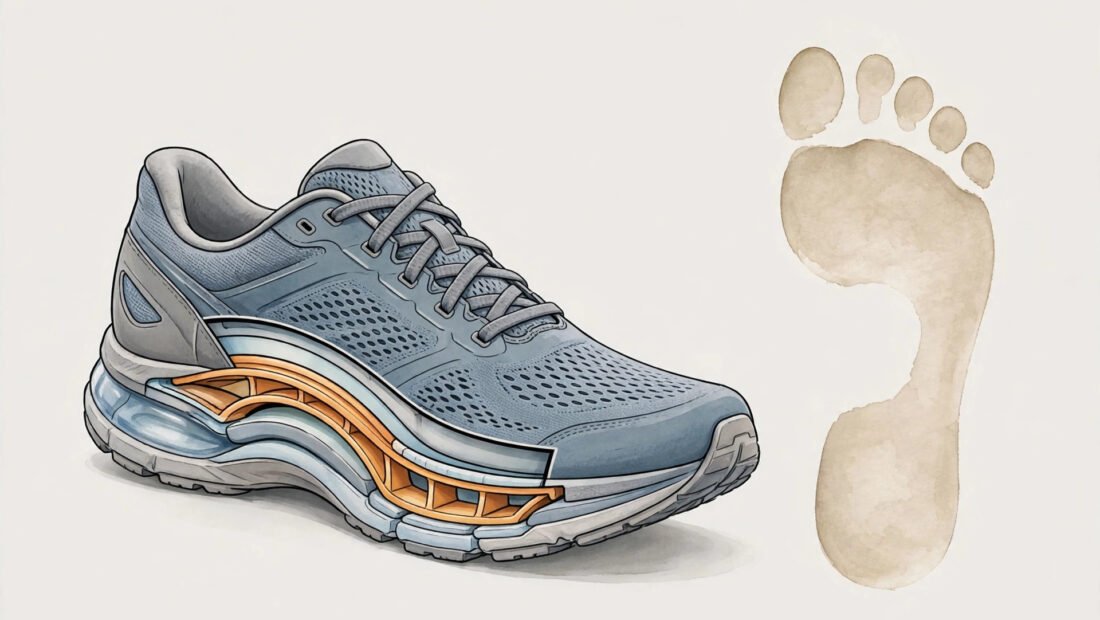
Step into wet sand with flat feet and the print left behind is one solid blob, with no pale gap under the arch where a higher foot barely touches the ground. That single image explains the foot, and it also explains the confusion in front of a shoe wall holding forty boxes, nearly all of them promising support. Forty promises cannot all be right for the same runner.
Flat feet are common, and flat does not automatically mean broken. The buying decision improves a great deal once two separate questions are kept apart: is the foot genuinely flat, and is that flatness causing a problem during running? A flat foot that runs pain-free for years needs a different purchase from a flat foot that aches under the arch, rolls sharply inward with every stride, and leaves knees sore by mile three.
Start With the Footprint Test
The wet-footprint test takes a minute. Wet the sole of the foot, step onto dry cardboard, concrete, or a paper bag, and look at the shape. A full, wide print with almost the entire sole showing and no inward curve at the arch points to a low or flat arch. A print with a narrow band connecting heel and forefoot points to a higher arch. Most runners land somewhere between the two extremes.
The result needs honest interpretation. Many flat feet are flexible, meaning an arch appears when the foot is off the ground or when standing on tiptoe, and these feet often run comfortably for decades with no special treatment. Rigid flat feet are a different case: the arch stays flat even off the ground, movement can feel stiff, and pain tends to show up sooner and stay longer. Flexible and painless usually means the shoe just needs to match the stride.
Stride matters as much as shape. Overpronation describes the foot rolling inward more than usual after landing, and flat feet often, though not always, overpronate. A worn old pair tells the story well: heavy wear along the inner edge points to inward roll, while even wear across a neutral pattern suggests the stride stays fairly straight despite the low arch.
Stability Shoes: The Default for Most Runners
Stability shoes are built for mild to moderate overpronation. They use firmer foam or a support structure under the arch and inner heel to slow the inward roll without forcing the foot into a rigid position. They still feel like normal running shoes, they come in a wide range of weights and cushioning levels, and every major brand sells several versions.
The advantages are balance and availability. A stability shoe gives guidance where a flat, rolling foot needs it, while leaving the rest of the stride alone. Weight stays reasonable, the ride stays comfortable for daily training, and finding a pair in the right size and width is rarely difficult.
The disadvantages are limits rather than flaws. A stability shoe cannot correct severe overpronation on its own, and its support elements are the first parts to tire as miles add up. A runner whose ankles collapse sharply inward may blow through the guidance and feel no better than in a soft neutral shoe. Even with those limits, one good pair of stability trainers covers about 90 percent of flat-footed runners and their training needs.
Motion-Control Shoes: Maximum Support, Real Trade-Offs
Motion-control shoes sit at the firm end of the support scale. They use stiffer materials, a broader and straighter shape, and stronger structures around the heel and arch to limit inward roll as forcefully as a running shoe can. They are designed for severe overpronation and for larger runners whose stride puts heavy demands on support.
The advantage is control that a stability shoe cannot match. For a runner whose feet roll hard enough to twist shoes out of shape within weeks, or whose pain clearly follows that roll, the firmer platform can be the difference between training and limping. The trade-offs are equally clear. Motion-control shoes are heavier, stiffer, and less forgiving underfoot.
That last point deserves weight. Support is not a scale where more is always better. Putting a mild overpronator in a maximum-control shoe is like wearing a cast for a mild sprain: the restriction itself becomes a problem.
Neutral Shoes With an Insole: The Flexible Middle Path
The third route pairs a neutral cushioned shoe, which has no built-in roll control, with a supportive insole placed inside it. This path suits the runner whose footprint is flat but whose stride does not roll badly: even wear pattern, no arch collapse in motion, discomfort limited to tiredness or mild arch fatigue on longer runs.
The advantages are choice and tuning. Neutral shoes offer the widest selection of cushioning, weight, and fit, including options for wide feet that stability lines sometimes skip. The insole can be swapped, upgraded, or removed without replacing the whole shoe, so support can be adjusted as strength and mileage change. The disadvantage is that the combination has a ceiling. An insole inside a soft neutral shoe will not hold back genuine overpronation for long, and stacking support into a shoe that already has some creates a crowded, unstable fit. Runners considering this route for injury prevention may also want to read up on how to prevent shin splints when you start running, since shin pain often gets blamed on shoes when training load is the larger cause.
Getting the Fit Right in the Store
Category means little if the fit is wrong, so the fitting routine matters. Shop late in the day, when feet have swollen to their largest, because a shoe that fits a fresh morning foot can pinch by mile six. Bring proper running socks rather than thin dress socks, since sock thickness changes the fit. Leave about a thumb’s width between the longest toe and the end of the shoe, because feet swell and lengthen during a run and toes need room on downhills.
Check heel lockdown next. The heel should sit snugly with minimal lift when walking and jogging in place; a slipping heel causes blisters and makes any support design work less well. Walk the store, jog if space allows, and use a slope or treadmill if the shop offers one, because a short downhill test reveals toe crowding that flat ground hides. Try both feet, since most people have one foot slightly larger, and fit to the larger one. A shoe that needs breaking in to stop hurting is the wrong shoe.
Insoles and Custom Orthotics: When Shoes Alone Are Not Enough
Quality over-the-counter insoles cost about $40 to $60, and for many flat-footed runners they solve the problem outright, either by upgrading a neutral shoe or by extending the support of a stability shoe. They are the correct second step when a well-chosen shoe gets a runner most of the way there but arch fatigue or mild pain remains. They are cheap enough to test honestly: if pain fades within a few weeks of gradual use, the question is answered.
Custom orthotics sit in a different price and purpose bracket at roughly $300 to $600, sometimes partly covered by insurance. That cost is warranted in defined situations: pain that persists despite proper shoes and a good over-the-counter insole, clear structural issues in the foot, or a diagnosed condition such as posterior tibial tendon dysfunction, where the tendon that supports the arch is failing. Custom devices are molded to the individual foot and prescribed after an examination, which is why they belong after simpler steps have been tried, not as a first purchase alongside new shoes. Background reading from the American Orthopaedic Foot and Ankle Society’s patient resources can help a runner understand which foot conditions call for that level of care.
Making Shoes Last and Knowing When to Replace Them
Running shoes wear out from the inside. The general replacement range is every 300 to 500 miles, and flat-footed runners should land on the earlier end, every 300 to 400 miles, because the support features they depend on break down faster than plain cushioning. A shoe can look clean and intact while its arch support has already softened past usefulness.
Rotating two pairs helps when the budget allows it. Foam needs about 24 to 48 hours to decompress fully between runs, so alternating pairs lets each shoe recover, extends the useful life of both, and varies the stress on the feet slightly from day to day. Rotation does not rescue a dead pair, but it slows the decline of two good ones.
Building Stronger Feet Over Time
Shoes manage load; they do not build capacity. Strengthening work reduces dependence on shoe support over time, because a stronger arch and stronger lower leg control the stride from inside the body. Short-foot exercises, where the toes stay relaxed while the arch is gently lifted, calf raises, and single-leg balance work all target the muscles that support the arch in motion.
When a Shoe Purchase Is the Wrong Next Step
Some signals point to a podiatrist rather than a checkout counter. Pain that keeps worsening despite correct shoes, pain concentrated in the tendon along the inside of the ankle, one foot flattening noticeably faster than the other, numbness, swelling that does not settle, or a rigid flat foot that has always been stiff all belong in a clinic. So does pain that changes how a person walks during normal daily life, not just during runs.
Verdict
For most flat-footed runners, the verdict is straightforward: buy a well-fitted stability trainer, test it with the late-day fitting routine, and run. Choose motion control only with clear evidence of severe overpronation or professional advice, since its weight and stiffness punish anyone who does not need them. Choose a neutral shoe plus a $40 to $60 insole when the foot is flat but the stride stays straight. Replace at 300 to 400 miles, rotate pairs if possible, build foot strength in the background, and escalate to custom orthotics or a podiatrist only when pain persists after the simpler steps have had a fair trial.