You do not need a gym to build muscle. You need progressive overload, enough protein, consistency, and a plan. Home workouts fail not because home lacks equipment, but because home lacks a program: random YouTube videos do not build muscle, but a structured minimal-equipment routine absolutely does. Here is the complete 2026 guide for Texans building muscle at home.
We will cover the minimal equipment worth buying, the full-body program, progressive overload without a gym, the 12-week progression plan, nutrition basics, and the mistakes that stall home gains.
The Minimal Equipment Worth Buying
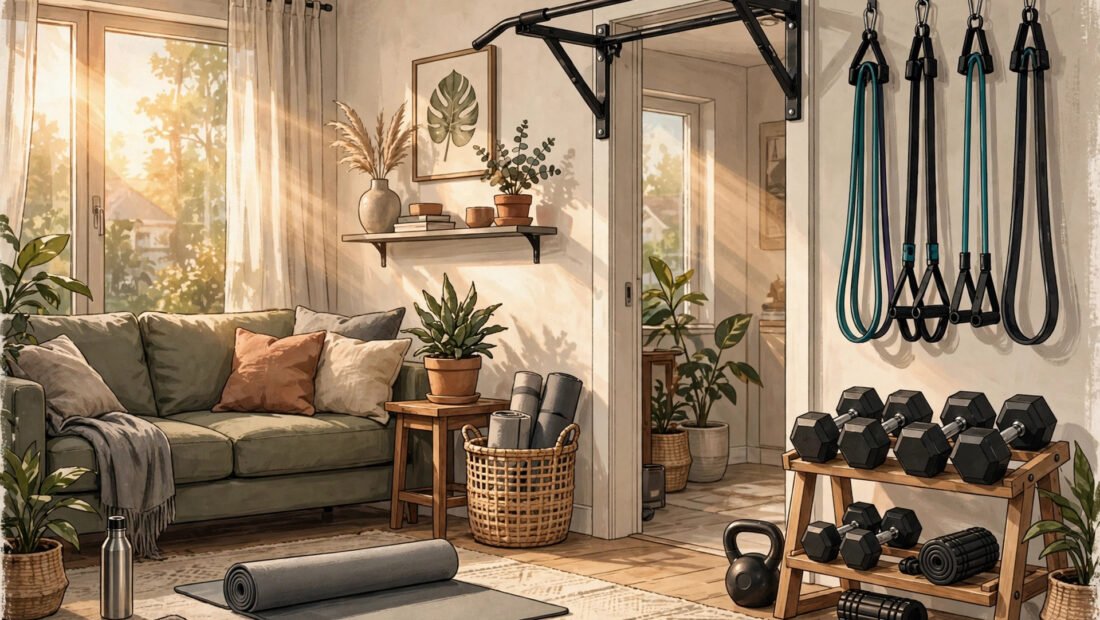
You can start with zero equipment, but a small investment dramatically expands what is possible. In priority order:
1. Adjustable dumbbells ($150-300). The single best home investment. They replace an entire dumbbell rack and enable progressive overload on every major movement. If you buy one thing, buy these.
2. Pull-up bar ($30-50). Doorway-mounted bars unlock the best upper-body pulling exercise. No substitute exists at home; rows help, but pull-ups are king.
3. Resistance bands ($30). A set with multiple resistances adds variable resistance, assists pull-ups, and enables exercises dumbbells cannot replicate well. Also travel-friendly.
4. Adjustable bench ($100-150). Unlocks incline pressing, Bulgarian split squats, step-ups, and proper row support. Worth it once you are committed.
5. Weight vest (optional). For advancing bodyweight movements when dumbbells are maxed.
Total for the full setup: $300-500, roughly 6-10 months of gym membership, owned forever. Start with dumbbells and add pieces as commitment proves itself.
The Full-Body Program (3x Weekly)
Full-body sessions three times weekly beat body-part splits for home trainees, because each muscle gets stimulated 3x weekly with limited exercise variety. The program:
Workout A: goblet squats (or dumbbell squats) 3×8-12, dumbbell bench press (floor press without bench) 3×8-12, one-arm dumbbell rows 3×10-15 each, Romanian deadlifts 3×10-15, plank 3×45-60 seconds.
Workout B: Bulgarian split squats 3×8-12 each leg, overhead dumbbell press 3×8-12, pull-ups (or band-assisted) 3x max reps, dumbbell hip thrusts 3×12-15, side planks 3×30-45 seconds each.
Alternate A and B across Monday/Wednesday/Friday. Rest 60-90 seconds between sets. Each session takes 45-60 minutes. This is a complete program: every major muscle group, balanced push/pull, progressive and sustainable.
The ACE home workout guidelines and CDC muscle-strengthening activity guidance support this structure: full-body, 2-3x weekly, all major muscle groups.
Progressive Overload Without a Gym
Muscles grow when challenged beyond their current capacity, progressively over time. At a gym, you add plates. At home, you progress through multiple variables:
Increase weight: adjustable dumbbells make this straightforward. When you hit the top of the rep range with good form, increase weight next session.
Increase reps: work within rep ranges (8-12 for most lifts). Start at 8, add reps weekly until 12, then increase weight and drop back to 8. This double progression is the engine of home gains.
Increase difficulty: elevate feet for push-ups, slow the tempo (3-second negatives), add pauses at the hardest point, switch to single-leg or single-arm versions. Mechanical disadvantage is free weight.
Increase volume: add a set when progress stalls. Going from 3 to 4 sets adds 33% more stimulating reps.
Decrease rest: shorter rests increase metabolic stress, a secondary growth driver. Do not sacrifice form for density, but 60-second rests are plenty for most home work.
Track every session in a notebook or app: exercise, weight, reps. If the numbers are not going up over weeks, something (effort, food, sleep) needs fixing. Sound programming principles, applied consistently, are what separate home trainees who grow from those who spin their wheels, and the NSCA on progressive overload principles has the science.
The 12-Week Progression Plan
Weeks 1-4: Learn and adapt. Light weights, perfect form, full range of motion. Soreness is normal; sharp pain is not. Focus on the movement patterns, not the numbers.
Weeks 5-8: Build momentum. Push weights up weekly using double progression. You should be noticeably stronger than week one. Take progress photos and measurements now; the mirror lies daily but tells truth monthly.
Weeks 9-12: Push and assess. Continue progression, add a set to lagging movements, and evaluate: what grew, what stalled? Use the answers to design the next 12-week block, adjusting exercise selection for weak points.
After 12 weeks: deload for one easy week (half volume), then start a new block with slight variations (swap goblet squats for split squats as the primary, for example). Long-term progress comes from stacking these blocks for years.
Nutrition: The Other Half of Muscle
Training provides the stimulus; food provides the building materials. The essentials:
Protein: 0.7-1.0g per pound of bodyweight daily. A 180-pound person needs 130-180g. Spread across 3-4 meals. This is the single most important nutritional factor, and most home trainees under-eat it dramatically. See how much protein you really need for the detailed math.
Calories: to build muscle, eat at a slight surplus, roughly 200-300 calories above maintenance. Too large a surplus adds fat faster than muscle; too little stalls growth. Track weight weekly: gaining 0.5-1 pound per week is the sweet spot.
Consistency over perfection: hitting protein and calories daily matters more than meal timing, supplements, or organic sourcing. Master the big rocks before optimizing pebbles.
For budget-friendly high-protein eating, cheap high-protein meals on a budget is essential reading.
Mistakes That Stall Home Gains
Program hopping. Switching routines every three weeks because of boredom or Instagram. Muscle takes 8-12 weeks to respond to a stimulus; changing constantly means never adapting to anything. Pick the program above and run it for 12 weeks minimum.
Training to failure every set. Grinding every set to absolute failure fries recovery without extra growth. Stop 1-3 reps short of failure on most sets; save true failure for the last set of isolation work occasionally.
Ignoring legs. Upper-body-only home routines create imbalances and leave half your muscle-building potential untapped. Legs contain the body’s largest muscles; training them drives systemic growth.
No progression tracking. “I think I’m getting stronger” is not data. Log every session. What gets measured gets managed.
Under-eating. You cannot build a house without bricks. If strength stalls for a month and sleep is fine, eat more. Most stalled home trainees are simply under-fueled.
Skipping the habit foundation. The best program is useless without consistency. If motivation is the issue, building a consistent workout habit addresses the behavioral side that programs ignore.
Frequently Asked Questions
Can I build serious muscle at home, or just “tone”?
Serious muscle. With adjustable dumbbells, progressive overload, and adequate protein, home trainees can build impressive physiques. The ceiling is slightly lower than a fully equipped gym (heavy barbell work is hard to replicate), but 90% of results are achievable at home.
How long until I see results?
Strength gains in 3-4 weeks (largely neurological), visible changes in 8-12 weeks, significant transformation in 6-12 months. Take monthly photos; daily mirror checks miss gradual progress.
Do I need cardio too?
For muscle building, 1-2 short cardio sessions weekly support recovery and heart health without impairing gains. Excessive cardio competes for recovery resources; keep it moderate during muscle-building phases.
What if I only have 20 minutes?
Do a condensed full-body circuit: squats, push-ups, rows, 3 rounds with minimal rest. Twenty focused minutes 3x weekly beats zero minutes. Scale the program to your life, not the reverse.
When should I join a gym instead?
When you have maxed your adjustable dumbbells on key lifts with good form and need heavier loading (typically 1-2 years in), or when you want barbell-specific strength. Many home trainees never need to; many eventually want to. Both are fine.
The bottom line: buy adjustable dumbbells, follow the A/B full-body program three times weekly, progress via double progression, eat 0.7-1g protein per pound at a slight surplus, log every session, and run 12-week blocks. Home muscle is not a compromise; it is a complete path for those who program it properly.