Checking crypto prices 40 times a day isn’t investing — it’s a dopamine slot machine that happens to involve your savings. Every compulsive check invites an emotional decision, and emotional decisions are where beginners lose money. The solution isn’t more willpower; it’s automation. Price alerts let the market come to you: set your levels once, live your life, and get notified only when something actually deserves your attention. This guide covers every good way to set crypto price alerts in 2026 — free tools, exchange features, and the alert strategy that keeps you informed without making you twitchy.
Why Alerts Beat Checking (The Psychology)
Constant price-checking does three damaging things. First, it manufactures urgency — a 3% dip feels like a crisis when you’re staring at it, but it’s noise on any meaningful timeframe. Second, it erodes your strategy — every check is an opportunity to abandon your plan for an impulse. Third, it costs attention — the scarcest resource you have, spent watching numbers flicker. Alerts invert this: you define in advance what matters (a level, a percentage move, a portfolio threshold), and the market notifies you only then. It’s the difference between a smoke detector and staring at the stove all day.
Method 1: Exchange-Native Alerts (Simplest)
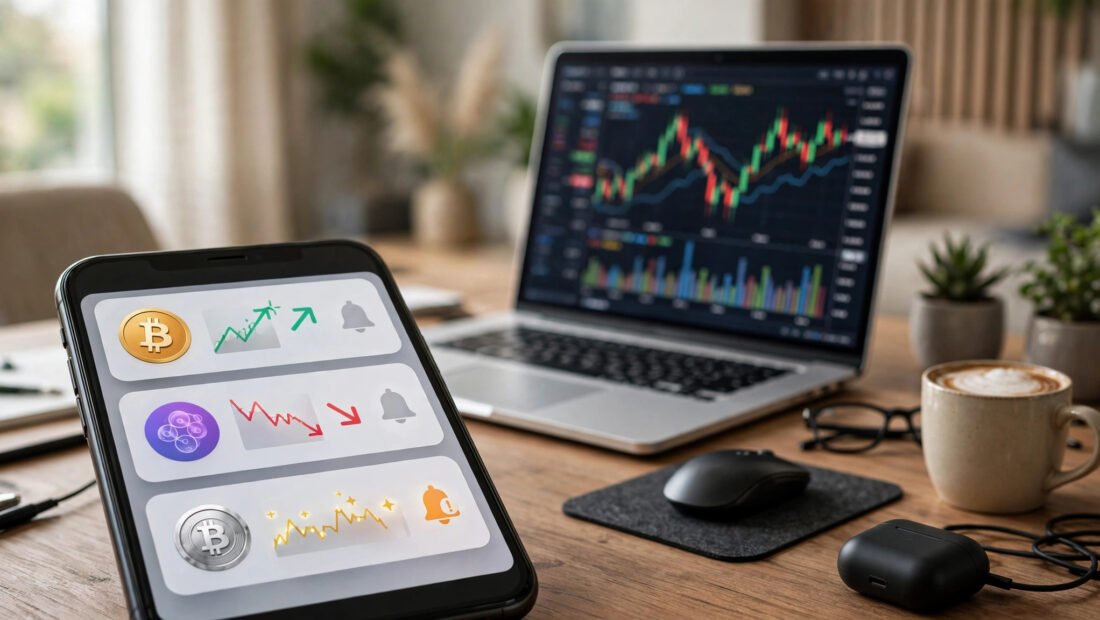
Every major exchange now includes alert features — start here since you’re already logged in. Coinbase: price alerts via the app for any listed asset, with push notifications at your chosen levels. Kraken: alerts through the app and Pro interface, including percentage-change triggers. Cash App: basic Bitcoin price alerts. Setup takes two minutes: pick the asset, set the price or percentage, choose push notification. Limitations: alerts are basic (usually simple price-cross triggers), and they only cover assets on that exchange. But for “tell me if Bitcoin crosses $X,” native alerts are all most beginners need.
Method 2: Dedicated Alert Apps (Most Powerful)
For more sophistication, dedicated apps offer what exchanges don’t:
- CoinGecko / CoinMarketCap apps (free): alerts on thousands of coins, percentage-change triggers, and portfolio tracking in one place. The free tiers cover everything a beginner needs.
- TradingView (free tier): the gold standard for technical alerts — price crosses, indicator conditions, drawing-tool triggers. Overkill for most beginners, perfect if you’re learning technical analysis.
- Delta / CoinStats (free tiers): portfolio-first apps where alerts tie to your actual holdings (“notify me if my portfolio drops 10%”) rather than abstract prices — arguably the most useful alert type for investors.
All offer push, and most offer email. Enable push for urgent levels, email for informational ones — notification triage prevents alert fatigue, which is the number-one reason people disable alerts entirely.
Method 3: Automation and Bots (Hands-Free)
For the automation-minded: IFTTT and similar services connect price triggers to actions — flash your smart lights when Bitcoin moves 5%, log prices to a spreadsheet hourly, get a phone call for extreme moves. Exchange APIs let programmers build custom alert logic (e.g., “alert me only if the move happens on high volume”). Telegram/Discord alert bots push notifications to channels you already watch. These are power-user tools — start with methods 1–2, and graduate here only if you enjoy the tinkering. Complexity you don’t need is just another thing to maintain.
The Alert Strategy That Actually Works
Tools are easy; strategy is the hard part. Set three alert tiers:
Tier 1 — Action levels (few, important): prices where you’d actually do something: your planned buy-the-dip level, your take-profit target, your stop-review threshold. These deserve push notifications. You should have 2–4 total. If an alert fires and you wouldn’t act, it shouldn’t be Tier 1.
Tier 2 — Awareness levels (moderate): significant market moves worth knowing about — 10%+ daily moves in major holdings, all-time highs, breakdowns below key supports. Email or batched digest is fine. These keep you informed without demanding action.
Tier 3 — Never: every 2% wiggle, hourly updates, alerts on coins you don’t own “just in case.” This tier is the slot machine. Delete these on sight.
Review and prune monthly: stale alerts from three months ago are noise. And pair your alert system with genuine security hygiene — two-factor authentication on your accounts and knowing how to spot a hacked email account matter more than any alert, because a compromised account makes price levels irrelevant.
What Alerts Can’t Do (Honest Limitations)
Alerts don’t fix bad strategy — they’ll faithfully notify you as a poor position bleeds out. They lag during extreme volatility (exchanges throttle notifications during crashes — the moment you most want them). And they can’t distinguish a meaningful breakout from a fakeout; that’s still your judgment call. Treat alerts as an attention-management tool, not an investment strategy. The strategy — what you’ll buy, at what levels, and why — has to exist before the alerts matter. For the broader risk framework, Investor.gov’s crypto investor guidance is the sober starting point, and Forbes’ crypto coverage tracks the tools landscape as it evolves.
Alerts for Taxes and Portfolio Health
Beyond price levels, set alerts that serve your financial hygiene. Portfolio milestone alerts (“notify me when my total crypto value crosses $X”) help you rebalance on schedule instead of by emotion. Tax-loss harvesting alerts notify you when a position drops enough to make harvesting worthwhile before year-end. Stablecoin depeg alerts — if you hold dollar-pegged stablecoins, an alert for any meaningful deviation from $1.00 is genuine risk management, since depegs have preceded major losses. And set a calendar reminder (not a price alert) to review your overall allocation quarterly — the most important “alert” isn’t price-triggered at all, it’s the discipline to reassess strategy on a schedule rather than on impulse.
Conclusion
Setting crypto price alerts means picking your method (exchange-native for simplicity, dedicated apps for power, automation for enthusiasts), then deploying the three-tier strategy: a handful of action-level push alerts, awareness-level digests for big moves, and ruthless deletion of everything else. Set them once, prune monthly, and reclaim the dozens of daily checks for your actual life. The market will still be there when your alert fires — and you’ll meet it with a clear written plan instead of a nervous twitch.
Frequently Asked Questions
What’s the best free crypto price alert app?
CoinGecko’s free app covers most beginners’ needs (thousands of coins, percentage triggers, portfolio alerts). Exchange-native alerts are even simpler if you only track a few assets.
Can I set alerts for percentage changes, not just prices?
Yes — most dedicated apps and TradingView support percentage-move triggers (e.g., “alert me if Ethereum moves 10% in 24 hours”), which are often more useful than fixed price levels.
How many price alerts should I set?
Fewer than you think: 2–4 action-level alerts with push notifications, plus a handful of awareness-level ones. Dozens of alerts just recreate the checking habit through notifications.
Do price alerts work during market crashes?
Usually, but with delays — exchanges and apps throttle notifications during extreme volatility. Don’t rely on alerts as your only risk management; position sizing matters more.
Can alerts be sent via text message?
Some services offer SMS, but push notifications and email are more common and reliable. SMS alerts are also a phishing vector — verify any crypto SMS is from a service you configured.