A home dermaroller online costs about fifteen to twenty dollars. A single professional microneedling session in a Texas clinic runs closer to three hundred dollars, and more with add-ons. Both get sold under the same word, microneedling, and a shopper could be forgiven for assuming the clinic is charging fifteen times more for the same job. It is not the same job. The home tool and the clinic pen differ in needle depth, in sterility, in how the skin is injured, and in what results are even possible, so the honest comparison has to weigh each side on its own terms before any verdict makes sense.
What Both Sides Are Trying to Do
The shared idea is controlled injury. Hundreds of tiny needle punctures trigger the skin’s repair response, and over the following weeks that repair lays down new collagen and elastin. Done at the right depth, the process can soften acne scars, fine lines, enlarged pores, and rough texture. Depth is where the two versions split. Home rollers typically use needles from about 0.2 to 0.5 millimeters long. At around 0.25 millimeters, the needles barely pass the surface layer, so the main effect is helping products absorb better, with only mild collagen stimulation. Professional pens reach from about 0.5 to 2.5 millimeters, into the dermis where collagen actually forms, and a trained operator adjusts that depth across the face, shallower on the forehead, deeper on scarred cheeks.
The tool shape matters too. A roller enters the skin at an angle as it rolls, then exits at an angle, which can drag and tear slightly. A motorized pen stamps straight up and down. On shallow cosmetic rolling the difference is small. At deeper settings it is one of the reasons deep work belongs on a pen, in trained hands, and not on a roller in a bathroom.
The Case for At-Home Rolling
The pros are easy to state. Cost is the obvious one: a home roller costs a fraction of one clinic visit, and there is no appointment, no travel, and no series of sessions to schedule around work. Convenience follows from that, since a shallow session takes minutes at home in the evening. For the narrow job home rolling can actually do, the results are real: serums absorb noticeably better after a 0.25 millimeter session, skin can look a little fresher and smoother with regular use, and mild texture roughness can improve over time.
There is also a control argument. You decide the pressure, the frequency, and the products, and you can stop the moment anything stings or looks wrong. For a careful person with healthy skin, no active breakouts, and a simple goal like getting more out of a hydrating serum, shallow home rolling is a reasonable, low-intensity cosmetic habit rather than a medical procedure, and judging it by clinic standards would be unfair to it.
The Case Against At-Home Rolling
The cons begin with sterility. Skin punctures are openings, and a device that cannot be fully sterilized, stored in a bathroom drawer and reused for months, carries a real infection risk, including bacterial infections that need medical treatment. Clinic treatments use single-use sterile needle cartridges opened in front of you. No home alcohol soak fully closes that gap, which is why hygiene discipline at home has to be strict rather than casual.
Technique is the second problem. Pressing too hard, dragging the roller, or rolling the same patch over and over can tear skin instead of puncturing it, and torn skin can scar. The third problem is pigment. Inflammation from needling can trigger dark patches after healing, known as post-inflammatory hyperpigmentation, and the risk is higher in medium to deep skin tones and higher still when depth is uncontrolled. Texas has a large population for whom that risk is not theoretical. A fourth problem is what goes on the skin afterward. Fresh micro-channels absorb far more of anything applied, so fragrances, strong acids, vitamin C, and retinoids that sit fine on intact skin can irritate or harm skin that has just been rolled. The popular habit of layering an active serum right after rolling is where many home routines go wrong.
Finally, home rollers dull. Needles bend and blunt with use, and a dull roller tears rather than punctures, so a tool kept too long quietly becomes a worse tool. Anyone rolling at home needs to replace the device on schedule, disinfect it with a seventy percent isopropyl alcohol soak before and after every use, work only on clean skin with gentle pressure and no dragging, skip active breakouts, eczema, and rosacea flares entirely, and follow with only plain hydrating products such as a simple hyaluronic acid serum or an unperfumed moisturizer. Deeper home devices, at 0.5 millimeters and beyond, also need two to four weeks between sessions for healing, which is another sign that depth changes the category of the thing.
The Case for Seeing a Professional
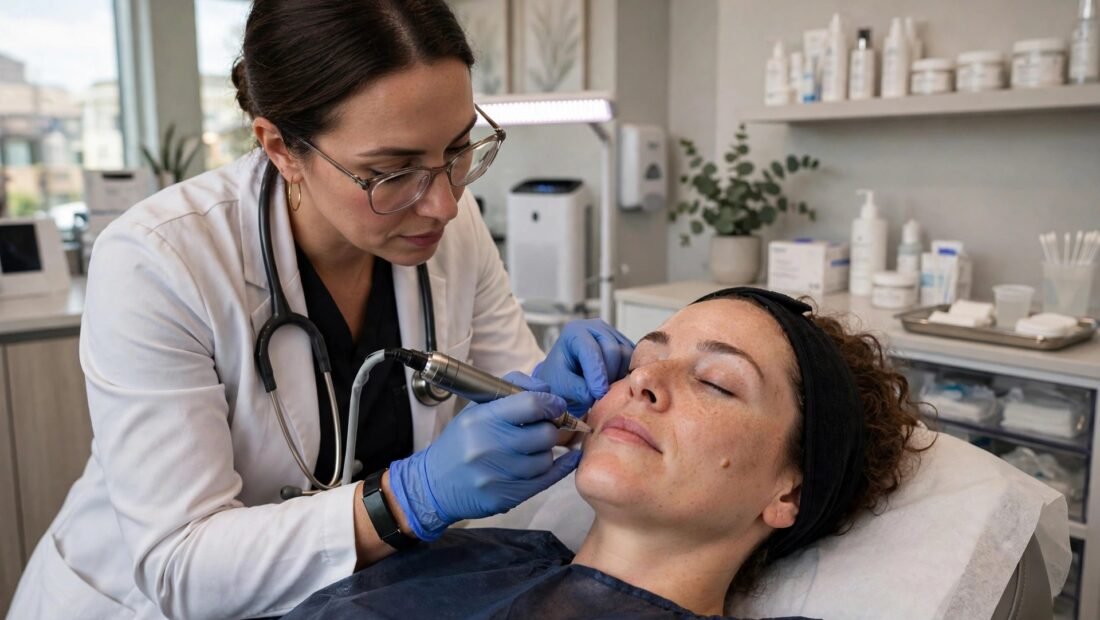
The pros on the clinic side are depth, sterility, and judgment. A professional can reach the dermis safely, which is the only place where acne scars, surgical scars, and stretch marks can be genuinely improved. Treatment in Texas metros typically runs $200 to $400 per session for standard microneedling and $500 to $700 with platelet-rich plasma added, with three to six sessions commonly recommended for scarring. That pricing stings, but it buys a consultation first: screening for conditions that rule treatment out, a depth plan for your skin tone and scar type, sterile single-use cartridges, and combination options such as radiofrequency or prescription topicals that no home setup can offer.
Judgment after treatment matters as much as the session itself. A clinic can tell normal healing redness from an early infection, adjust the next session’s depth based on how your skin responded, and manage pigment risk with pre- and post-treatment care for skin tones that need it. That supervision is a large part of what the fee covers, and it is the part home users most often underestimate until something heals badly.
The Case Against the Clinic Route
The cons are cost, time, and access. Several sessions at several hundred dollars each is a serious outlay for a cosmetic goal, and the honest person should ask whether the target problem justifies it. Mild dullness does not. Shallow texture that a good basic routine might improve does not either, and spending clinic money before sorting out sunscreen and a sensible routine is poor order of operations, much like the wider question of whether expensive skincare beats drugstore brands, where price alone proves nothing. Professional treatment also brings downtime: redness for days, strict sun avoidance afterward, and no heavy sweating for forty-eight to seventy-two hours while the skin heals, which takes planning in a Texas summer.
Quality varies as well. Med-spa standards and training differ, so vetting is on you: look for a dermatologist, or a physician assistant, nurse practitioner, or licensed aesthetician with specific microneedling training working under proper supervision, single-use cartridges, and a real consultation rather than a sales pitch. Bargain treatment with doubtful devices or reused parts is worse than no treatment at all. Guidance from the American Academy of Dermatology’s microneedling guidance points the same way, favoring trained professionals for anything beyond the shallowest cosmetic use.
One more home-use detail separates careful rollers from careless ones: frequency. Shallow rolling for product absorption is sometimes done weekly, but skin still needs time to settle between sessions, and rolling over skin that is still red, flaky, or tender from the last session stacks irritation on irritation. Keep a simple log of dates and how the skin looked the next morning. If redness lasts beyond a day, if new breakouts cluster where you rolled, or if dark marks appear, those are signals to stop and reassess rather than to roll more gently and carry on. A home tool gives no professional to notice those patterns for you, so the log, dull as it sounds, does the noticing. It also keeps expectations honest, because mild texture change over eight to twelve weeks is easy to miss day to day and easy to invent without notes.
Texas Sun and Heat Change the Timing
Whichever route you choose, freshly needled skin is sun-sensitive while it heals, and Texas sun is unforgiving about that. Plan on diligent SPF 30 or higher and real sun avoidance for days after any session, home or clinic, because skipping protection invites exactly the dark patches you may be treating. Heat adds a second scheduling rule: sweating into healing micro-channels irritates them, so book sessions, and plan home rolling, for stretches when hard workouts and yard work can pause for two to three days. A winter or early spring series is simply easier to heal through than an August one.
Verdict, by Goal and Risk Tolerance
For better serum absorption and mild surface freshness, on healthy skin with no active breakouts, shallow home rolling at about 0.25 millimeters is a reasonable choice, provided the hygiene protocol is followed without shortcuts and expectations stay modest. It will not fix acne scars, deep lines, or loose skin, and pretending otherwise wastes both money and skin.
For scars of any kind, stretch marks, significant texture change, or pigmentation concerns on medium to deep skin, the verdict is professional, without much room for debate. Those goals need dermal depth, sterile single-use equipment, and depth control that home tools cannot supply safely. If budget is the barrier, the honest move is to save toward fewer, properly done sessions rather than to push a home roller deeper and hope. The fifteen-dollar tool and the three-hundred-dollar session are not rivals. They are different tools for different jobs, and matching the tool to the goal is the whole decision.