
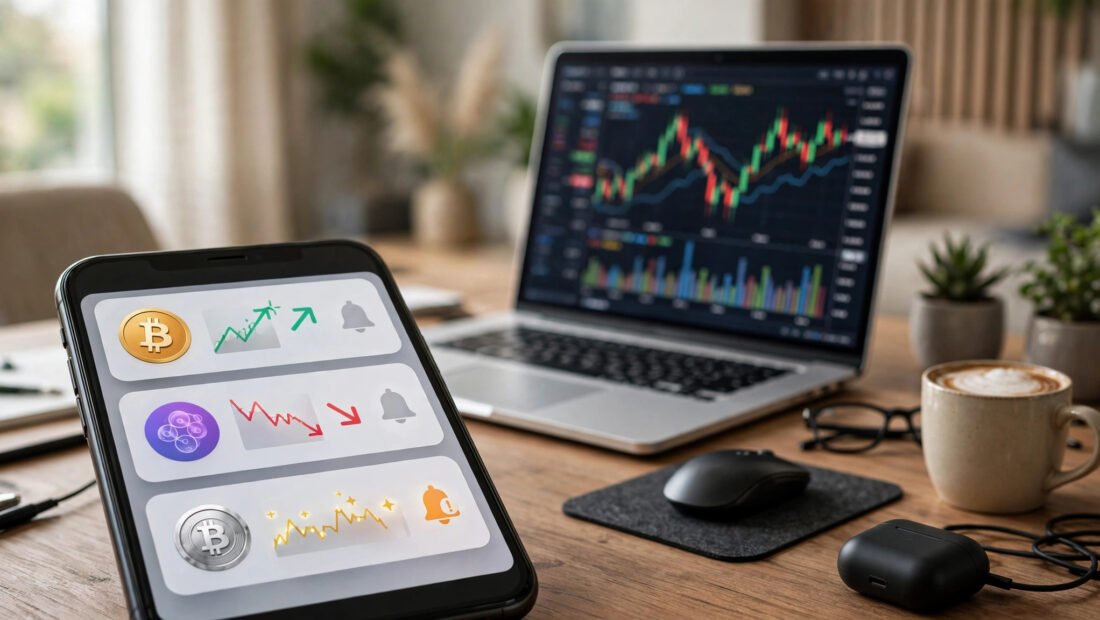
Thirty unlocks before lunch. A glance while the coffee brews, another in the elevator, another at a red light. Each check feels responsible, like keeping an eye on your money, yet the behavior underneath looks a lot less like investing and a lot more like a slot machine: pull, watch the numbers spin, feel a small jolt, pull again. A coin that moved three percent while you stared at it feels like an emergency. On any chart longer than a day, that same move is ordinary noise. The habit is the problem, and willpower is a weak fix for it. A small set of well-chosen price alerts is a better one, because the market comes to you only when something you decided in advance actually happens.
Mistake One: Treating Every Wiggle as News
The first mistake is setting the bar for attention far too low, or having no bar at all and checking on impulse instead. Crypto moves around the clock, and small moves are constant. A two or three percent swing in a major coin can happen while you make lunch. If every swing gets your attention, your attention stops meaning anything. You end up reacting to the most recent move instead of your original plan, buying after a jump because it feels like momentum and selling after a dip because it feels like danger. Neither feeling is information.
The fix starts with a blunt question for each holding: at what point would I actually do something? A level where you would buy more, a level where you would trim, a level where you would stop and review whether the original reason for owning it still holds. Moves that cross none of those lines do not deserve a notification, and they certainly do not deserve thirty manual checks a day.
Mistake Two: Alerts on Coins You Do Not Own
The second mistake is curiosity dressed up as research. Alerts on coins you do not own, tokens a friend mentioned, whatever is trending that week, all of it creates a stream of prompts with no decision attached to them. Each one still pulls you into the app. Each one still ends with you scrolling prices you swore you were done scrolling. Curiosity alerts are how a tidy alert system quietly turns back into the checking habit with push notifications doing the pulling.
Keep the alert list tied to your actual holdings and your actual watchlist, meaning coins you have a written reason to consider buying at a stated price. Everything else can wait for a calm, scheduled look at the market, once a week or once a month, when a headline coin can be judged with a clear head instead of in the thirty seconds after a buzz in your pocket.
Mistake Three: Dozens of Alerts, All Set to Shout
The third mistake is volume. Ten price levels on one coin, alerts on every holding, every channel set to push, sound on. Within a week the phone buzzes so often that the brain files crypto alerts under ignore, right next to app update notices. That is alert fatigue, and it defeats the whole system at the exact moment it matters, because the one alert that signaled a genuine move looks identical to the forty that signaled nothing.
Notification triage solves this. Push notifications, the loud kind, belong only to levels where you would act the same day. Everything merely interesting belongs on email or in a daily digest you open when you choose to. If an alert would not change what you do today, it has no business interrupting today.
Mistake Four: No Plan Behind the Alert
An alert that fires into a vacuum still leads to an emotional decision, just a slightly better-timed one. The fourth mistake is setting levels without writing down, in advance, what each level means. When the phone buzzes at midnight and the price has dropped sharply, a person with no plan improvises, and improvisation under stress usually means panic selling or doubling down without thinking. A person with a plan reads the note they left themselves: review the position, check whether anything fundamental changed, act only on the step written earlier.
Keep that plan short. For each major holding, three lines are enough: the buy level and why, the trim or take-profit level and why, and the review level where you reconsider the holding entirely. Alerts then become the delivery system for decisions you already made calmly, which is the entire point. Protect the accounts those decisions live in, too, since none of this matters if access is sloppy; start with the safest crypto wallet setup for beginners and basic account security before refining alert strategy.
The Correct Way: Build Three Tiers
With the mistakes cleared away, the working system is simple and has three tiers. Tier one is action levels. These are few, usually two to four across your whole portfolio, and they get push notifications. A planned buy level on a coin you have researched. A take-profit target on a position that has run. A stop-and-review threshold where you promised yourself an honest look. If a tier one alert fires and you would not act, it was set wrong and should be moved or deleted.
Tier two is awareness. Big daily moves in your major holdings, say ten percent or more in a day, a break below a price you consider important support, or a new all-time high on something you own. These are worth knowing about, not worth being woken up for. Email or a batched digest handles them well, and a weekly glance through them gives you a feel for the market without living inside it.
Tier three is never. Every two percent wiggle, hourly updates, coins you do not own, coins you sold months ago. Delete tier three on sight whenever it creeps back in, because it always creeps back in. Review the whole list once a month and prune anything stale. Prices from a plan you no longer hold are pure noise, and noise is what you built the system to escape.
Picking the Tool That Fits
For most people, the alerts already inside their exchange app are enough. Major exchanges offer free price alerts by app, set by picking an asset, choosing a price or a percentage move, and turning on push. Setup takes about two minutes per alert, and the limits are honest ones: the triggers are simple, and they only cover assets listed on that exchange. If you hold a few coins in one place, start there and add nothing else.
Dedicated tracking apps add power for people who hold coins across several platforms. Portfolio-based apps can alert on your holdings as a whole, for example a notice if your total portfolio drops ten percent, which for a long-term holder is often more useful than any single coin price. Charting platforms go further, with alerts tied to percentage moves over a set period or to drawn levels on a chart. Percentage triggers deserve special mention: an alert for a ten percent move in twenty-four hours often says more than a fixed price, because it adjusts to whatever the current price happens to be.
Automation tools sit at the far end, linking price triggers to other actions like logging prices to a spreadsheet or sending a message to a channel you already read. They are enjoyable to build and easy to overbuild. Add automation only when the simple tiers leave a real gap, not as a weekend project that becomes one more system to maintain.
Alerts That Guard More Than Price
A few alerts protect you in ways that have little to do with trading. If you hold dollar-pegged stablecoins, set an alert for any meaningful move away from one dollar. A stablecoin slipping off its peg has, in past episodes, been an early sign of serious trouble, and hearing about it early is genuine risk management rather than price watching. Portfolio milestone alerts also help at tax time and rebalance time, flagging when a position has fallen enough that harvesting a loss is worth considering, or when one holding has grown so large that your allocation no longer matches the plan you wrote.
One more safeguard is not a price alert at all. Put a repeating calendar reminder, quarterly is plenty, to review your whole allocation in one sitting. Strategy should change on a schedule, in daylight, not coin by coin in response to buzzes. Fraud awareness belongs in the same routine, since alert fatigue and constant app-opening raise your exposure to fake apps and phishing; the SEC’s Investor.gov crypto fraud alerts are a sober place to check the current schemes before trusting any new tool with your holdings.
What Alerts Honestly Cannot Do
Alerts manage attention. They do not fix a weak strategy, and they will politely notify you all the way down if a poor position keeps falling. They can also lag or thin out during violent market moves, when exchanges and apps are under heavy load, which is exactly when people expect them to be fastest. And no alert can tell a lasting breakout from a brief fake move that snaps back an hour later. That judgment, and the written plan behind it, stays yours.
Used well, though, the trade is a good one. Set a handful of action levels with push turned on, park awareness moves in a digest, delete everything else, prune monthly, and let the phone stay quiet the rest of the time. The market will still be there when a real level is hit. You will meet it with a note you wrote while calm, instead of a thumb that has already checked thirty times today.



1 Comment