
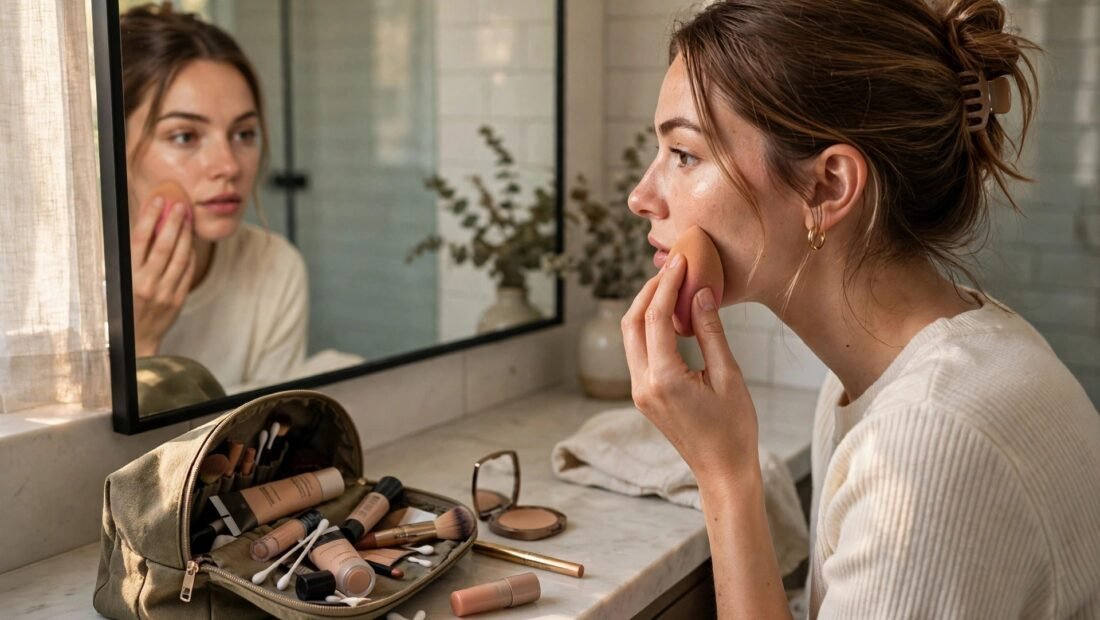
Flawless at 8 in the morning, cracked and patchy by 3 in the afternoon — that daily slide is rarely bad luck. Cakey foundation is almost never one cause. It is five causes working together, and each one has a different fix. Change the wrong one and nothing improves. Find your actual cause and the afternoon problem often disappears within a week.
Why does foundation separate and settle by afternoon?
Foundation is a thin film of pigment, oils, and setting ingredients sitting on skin that never stops moving. Through the day your skin produces oil and sweat, your face moves thousands of times, and air conditioning dries the surface while outdoor heat softens the film. A thin, well-matched film flexes with all of that. A heavy or poorly matched film cannot. It pools in pores, clings to dry flakes, cracks over lines, and lifts around the nose and upper lip. Afternoon cake is that film failing under normal daily stress, made worse in Texas by heat and humidity.
Could you simply be using too much product?
Yes, and this is the most common cause by far. Foundation applied heavily in the morning has nowhere to go as oil and sweat build underneath it. The excess sits on top of the skin and outlines every pore and fine line. The fix costs nothing: use about half of what feels normal. Apply one thin layer, blend it fully, and add a second thin layer only where you still see redness or uneven tone. Use concealer for single spots instead of spreading more foundation everywhere. Less product also means less product to break down, which is why sheer layers almost always outlast one thick coat. Shade mistakes make overload worse, because the wrong colour tempts you to pile on more, so it pays to confirm how to choose the right foundation shade before blaming the formula.
Is your formula wrong for your skin type?
Often, yes. A matte, full-coverage formula on dry skin grabs every flake and looks cracked within hours. A rich, dewy formula on very oily skin slides, shines, and separates by lunch. Match the finish to the skin underneath it. Dry skin does best with luminous or satin liquids that stay flexible. Oily skin does best with matte or long-wear formulas that resist oil breakthrough. Combination skin usually needs both approaches at once: a longer-wearing product through the T-zone and a lighter, more forgiving finish on the cheeks. Full coverage also deserves suspicion. More pigment and more film-forming ingredients mean more material available to cake, so a medium, buildable formula is the safer daily choice for most people.
What does proper skin prep actually involve?
Prep is a sequence, and the waiting times inside it matter as much as the products. Start with a moisturiser matched to your skin type: a light gel for oily skin, a richer cream for dry skin. Then wait until it has fully absorbed, about 3 to 5 minutes. Foundation spread over half-absorbed moisturiser slides across the surface and separates by afternoon, no matter how good the foundation is.
Next comes primer, matched to the concern rather than applied out of habit. Choose a hydrating primer for dry patches, a mattifying primer for an oily T-zone, and a gripping primer when long wear is the main goal. Many faces need zoning, not one primer everywhere: mattifying down the centre, hydrating on the cheeks. Then apply foundation in thin layers. A damp sponge sheers product out and suits dry skin well. A dense brush worked into the skin suits oily skin better. Use less product where lines sit, around the eyes, mouth, and forehead, because those areas show cake first.
Where does sunscreen fit in the morning order?
Sunscreen goes on after moisturiser and before primer and foundation, and it needs time to set. The full morning order runs like this: moisturiser, sunscreen, a wait of about 5 minutes for the skincare layer, then ideally a full 15 minutes for the sunscreen to set before makeup goes over it. That wait feels long on a busy morning, but rushing it is a common hidden cause of pilling and separation. Some sunscreen and foundation pairs simply fight each other. If a combination pills every time, change the pairing rather than scrubbing harder. A sunscreen known to layer well under makeup, or a well-tested sunscreen-foundation pairing, ends that fight for good.
Can too much powder cause the caking?
Yes, quickly. Setting powder has a real job, but excess powder plus afternoon oil forms a paste that looks thick, dry, and cracked at the same time. Powder with a light hand. Press it into the skin instead of sweeping it across, tap excess off the brush before it touches your face, and concentrate on the T-zone where oil actually appears. Dry cheeks and the under-eye area need very little powder, and often none. In Texas humidity powder feels essential at 8 a.m., yet the heavy morning layer is exactly what turns to cake by 3 p.m. A light dusting plus a setting spray to melt the layers together holds better than powder alone.
Is cakey foundation a sign of dry skin?
Sometimes. Dehydrated skin sits underneath a large share of cakey afternoons. Skin short on water drinks foundation unevenly, then pushes it back to the surface as the day goes on. The clue is timing: makeup that looks good for two or three hours and then steadily worsens often points to dehydration rather than a bad product. The fix there is skincare, not more makeup. Add a hydrating serum, use enough moisturiser, and give it a week before judging the foundation again. Oily skin cakes too, though, when powder overload and product overload combine with natural oil. So treat dryness as a strong suspect, not the only one.
Does primer actually prevent cakey foundation?
A primer matched to the problem helps a great deal. It smooths the surface, gives foundation something even to grip, and slows either oil breakthrough or moisture loss, depending on the type. The wrong primer makes things worse. A heavy mattifying primer under a matte foundation on dry skin stacks dryness on dryness. Layers that have not set cause trouble too: primer spread over wet moisturiser, then foundation spread over wet primer, gives you three sliding layers instead of one stable film. Let each layer settle for a minute or two. Primer is one part of a system. It cannot rescue a wrong formula or a double-thick application.
How do Texas heat and air conditioning make it worse?
Texas days attack makeup from both directions. Outside, temperatures near 100°F soften the foundation film while humidity melts and separates it, and sweat breaks the layer down fastest at the hairline and upper lip. Inside, air conditioning at 68°F dries the surface and stiffens what is left. Walking between the two all day, from a hot car park into a cold office and back out at lunch, stresses the film over and over. Thin layers and flexible finishes survive that cycling best. Long-wear, transfer-resistant formulas earn their keep here. Blotting papers earn theirs too. A quick blot at midday removes the oil that would otherwise mix with powder and product through the afternoon.
How can you rescue cakey makeup at 3 p.m. without starting over?
Start by removing oil, not by adding product. Press blotting paper over the shiny, patchy areas and lift the oil away. Next, mist the face lightly, or pat a tiny amount of moisturiser or emollient directly over the worst cakey patches with a fingertip. Then press a clean, damp sponge over those areas. The sponge re-melts the makeup back into the skin and picks up the excess sitting on top. Work in small sections: around the nose, across the chin, over any dry flakes on the cheeks. The one move to avoid is adding more powder on top of cake. Powder over an already cakey film only thickens it and makes every crack more visible. Fresh foundation layered over cake does the same. Rescue means thinning and re-blending what is already there.
What should you change first if it happens every day?
Change one thing at a time, starting with amount. Halve the foundation for three days and judge the result at 3 p.m., not in the morning mirror. If cake remains, check the prep waits next, then the powder habit, then the formula itself. Daily rescue missions are a sign the morning routine needs work, not a sign you need a more expensive foundation. Testing matters as well: judge any new product after a full Texas day, at 5 p.m., not under shop lighting at 10 a.m. For technique checks on layering and application order, Allure’s foundation application guides are a solid reference to compare against your own routine.
Most afternoon cake clears once the real cause is fixed: thinner layers, a formula matched to your skin, prep given its full few minutes, powder kept light and in the T-zone, and dehydrated skin treated at the skincare level. Keep blotting papers in your bag for the Texas days that test even a good routine, and use the blot, mist, and sponge press to save the rest.




1 Comment