A shot dropping in at 45 degrees sees a target roughly twice as large as one arriving flat at 30 degrees. That single fact explains a large share of missed shots at every level. Accuracy starts as geometry, then becomes a short checklist of repeatable mechanics. Run the checklist on every rep, fix one flaw at a time, and structure practice so good form survives tired legs and a closing defender.
The Shooting-Form Checklist
- Balance first: feet shoulder-width apart, shooting foot slightly ahead, knees bent, weight centred before the ball moves.
- Eyes on the target: pick one spot, usually the back of the rim, find it early, and hold your gaze there through the release.
- Elbow in line: shooting elbow tucked under the ball, pointing at the rim, never flared out to the side.
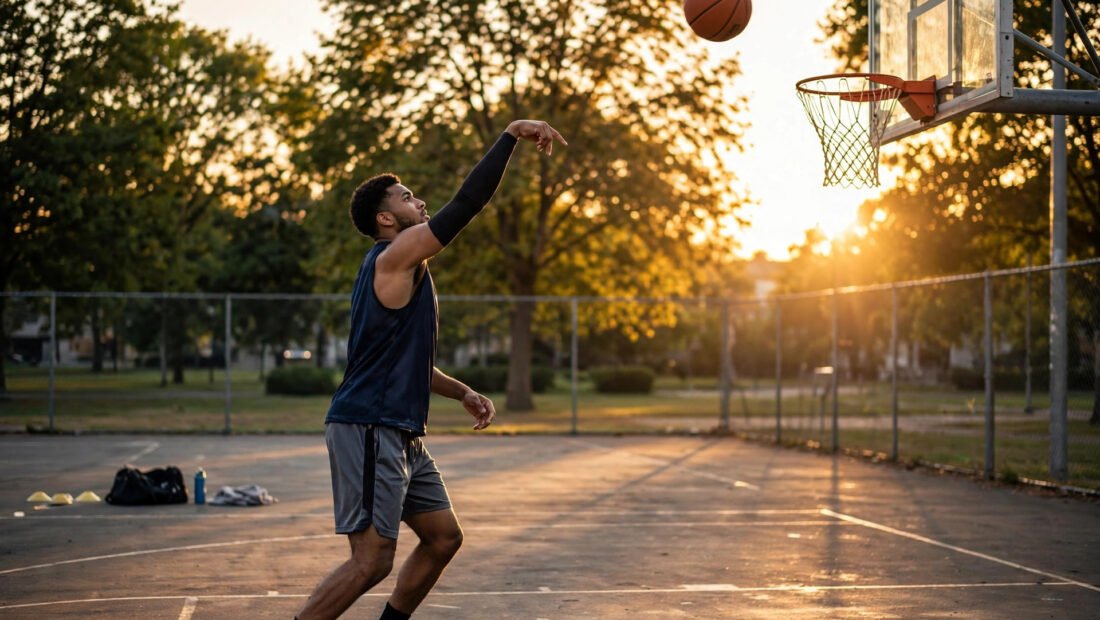
- Arc on every shot: the ball peaks well above the rim and drops in steeply, near a 45-degree entry angle.
- Follow-through held: wrist snapped, fingers pointing down, hand held up until the ball reaches the rim.
- Legs drive the power: the shot rises from bent knees in one smooth motion, not from an arm push.
- Same routine, every time: identical dribbles, breath, and set point on free throws and practice reps alike.
- Good shot selection: open, balanced, in-rhythm attempts count as part of accuracy, not a separate topic.
That checklist is the BEEF principle with the extras that decide real games: Balance, Eyes, Elbow, Follow-through, plus arc, legs, routine, and selection. Work through the items in order during practice, because the early ones support the later ones. A shooter with perfect follow-through and broken balance still misses.
Balance: The Base Every Shot Stands On
Set your feet shoulder-width apart with the shooting-side foot a half-step ahead. Bend the knees so you can rise straight up without leaning. Weight stays centred, chest up, shoulders facing the rim or turned only slightly.
Off-balance shots are low-percentage shots, full stop. Drifting sideways, fading without need, or shooting while falling forward forces the arms to correct mid-flight, and corrections made in the air rarely work. In practice, check your landing. If you finish a jump shot two feet from where you took off, or stumbling to one side, the base was wrong before the ball ever left your hand. Land in roughly the same spot, balanced, ready to move.
Eyes and Elbow: The Two Quiet Fixes
Pick a small target and lock on early. Most strong shooters aim at the back of the rim. On bank shots, the target becomes the backboard square. Either way, the eyes find the spot before the shot starts and stay there through release. Watching the ball in flight or glancing at a defender breaks the connection between aim and motion. Your hands follow your eyes more faithfully than they follow your intentions.
The elbow decides direction. It should sit under the ball, roughly forming an L shape, aligned with the rim. A flared elbow pushes the ball off line and is the most common mechanical flaw in recreational players. It is also one of the easiest to fix, because you can feel it. Form shooting close to the basket, with one hand, exposes a flare instantly: the ball spins sideways or drifts right or left. Ten minutes of close one-hand shooting a few times a week straightens the line faster than any lecture.
Follow-Through and Arc: Where Makes Are Decided
Finish every shot the same way. Snap the wrist so the fingers point down toward the floor, as if reaching into a cookie jar on a high shelf, and hold that position until the ball hits the rim. Shooters who drop the hand early tend to shoot flat and short. Holding the finish gives you instant feedback, too. A straight, relaxed follow-through with the middle finger pointing at the target usually means the release was clean.
Arc deserves its own emphasis because the geometry is so forgiving. A flat shot at a 30-degree entry sees a narrow, elliptical opening. A shot entering near 45 degrees sees an opening roughly twice as large. Same rim, same shooter, bigger target. Most amateur misses are flat, not off line. Shoot higher than feels natural. Aim for a peak well above the rim, and film your shot from the side to check it. What feels exaggerated on the court usually looks correct on camera. A partner holding a hand high, or shooting over a raised obstacle in drills, builds the habit quickly.
Fix One Flaw at a Time
Resist the urge to rebuild everything in one week. Pick the biggest flaw first, usually elbow flare or flat arc, and work on that single fix for 2 to 3 weeks until it holds without conscious effort. Then address the next item on the checklist. A full rebuild attempted at once destroys accuracy and confidence together, because every rep feels foreign. Steady, single changes keep most of your shot intact while one part improves. The checklist makes this orderly: test each item in form shooting, find the worst offender, fix it, and move down the list.
How a Good Practice Session Is Built
Quality beats quantity, every time. A focused 30 to 45 minute session with a few hundred quality shots builds more accuracy than 1,000 lazy ones taken while chatting and drifting around the court. Lazy reps ingrain lazy mechanics. Structure the session in blocks.
Start with form shooting close to the basket for about ten minutes. Stand a step or two from the rim and shoot with perfect checklist mechanics, one hand first, then two. This calibrates touch before fatigue arrives. Move next to spot shooting: five spots around the arc, a set number of makes at each before moving on. Finish with game-speed work and a block of free throws taken with your full routine.
Set process goals rather than outcome goals. A goal you fully control, such as holding your follow-through on every rep this week, beats a goal like shooting 45 percent, because percentages swing with shot difficulty and luck while process stays in your hands. Track the numbers anyway. Log makes and attempts by spot and by session in a notebook or app. Patterns in the log point straight at the next fix: a weak left corner, a drop-off late in sessions, or free throws that trail your jump shooting.
Accuracy transfers across sports more than players expect. The same ideas of a repeatable motion, one fix at a time, and logged reps drive progress in how to improve your tennis serve’s power and accuracy.
The Mental Routine That Holds Up Under Pressure
Shooters keep shooting through misses. A short memory is a skill, and a pre-shot routine is how you build it. Use the same small sequence before every free throw and every practice shot: dribbles, a breath, eyes to the target, shoot. The routine settles the mind because it gives attention a job. After a miss, replace outcome thoughts with one mechanical cue from the checklist, such as elbow in or hold the finish. Treat practice misses as data rather than verdicts. A miss long means legs or arc. A miss left means elbow or balance. Read the miss, adjust one thing, and take the next rep.
Shot Selection: The Hidden Half of Accuracy
Percentages reflect the shots you choose as much as the form you use. Open, balanced, in-rhythm shots go in more often at every level of basketball. Contested, off-balance, out-of-rhythm shots drag a good shooter’s numbers down to an average shooter’s level. Passing up a crowded long two, relocating after a pass, and attacking a close-out to reach a cleaner look all raise accuracy without changing your mechanics at all. Track shot quality for a few games alongside makes and misses. Most players are surprised by how many low-percentage attempts they felt forced into. Cutting those is the fastest percentage gain available.
Legs, Core, and Range
A shot’s power comes from the legs. Strong legs and a stable core keep the upper body quiet and the motion repeatable, and they extend range without an arm push that wrecks form. Squats, lunges, and calf work build the base. Core work keeps the torso steady through the rise. Tired legs flatten arc late in games, which is why shots fall short in the fourth quarter even when form felt fine in the first. If your three-point shot loses its arc late, the fix is usually conditioning, not a new release. Conditioning work also protects practice quality, since the last hundred reps of a session only help if the mechanics still match the first hundred.
Why Practice Form Deserts Players in Games
Game shots arrive faster, with a defender closing and lungs burning. Practice taken at walking pace, from a standstill, with no pressure, does not prepare the checklist to survive those conditions. Close the gap deliberately. Shoot off movement: catch on the run, take one dribble into a pull-up, cut to a spot and shoot on arrival. Add close-out drills where a partner rushes at you as you catch. Shoot sets after sprints so some reps happen under real fatigue. The goal is a form that holds at game speed, against a contest, in the last minutes. Build toward that in layers, stationary first, then moving, then pressured, and the practice version and the game version become the same shot.
Benchmarks Worth Aiming At
Honest targets keep motivation grounded. In pickup games, 40 percent or better from the field is solid, and 35 percent or better from three is strong. In organised leagues with real defence, shooting above 42 percent overall marks a reliable scorer. Track free throws separately, because they isolate pure mechanics: 70 percent or better is a good recreational benchmark. Compare your log against those numbers every month or so, not every session. Real improvement shows in monthly trends, while single sessions swing wildly.
For drill ideas and form breakdowns, USA Basketball’s coaching and player development resources publish free material that matches the checklist approach well.
Texas Reps: Heat, Wind, and Outdoor Rims
Outdoor practice in Texas adds its own conditions. Summer blacktop gets brutally hot by midday, so shoot early in the morning or in the evening under lights. Hydrate before and during the session, because dehydration dulls focus and shortens good reps. Outdoor rims are often stiffer than indoor rims, and wind moves the ball in flight. Both demand a touch more arc and a softer touch, which happen to be good habits indoors as well. A shooter whose checklist holds on a windy outdoor court in August owns a shot that travels anywhere.
None of this requires rare athletic gifts. It requires a checklist, honest tracking, and the patience to fix one flaw at a time.