
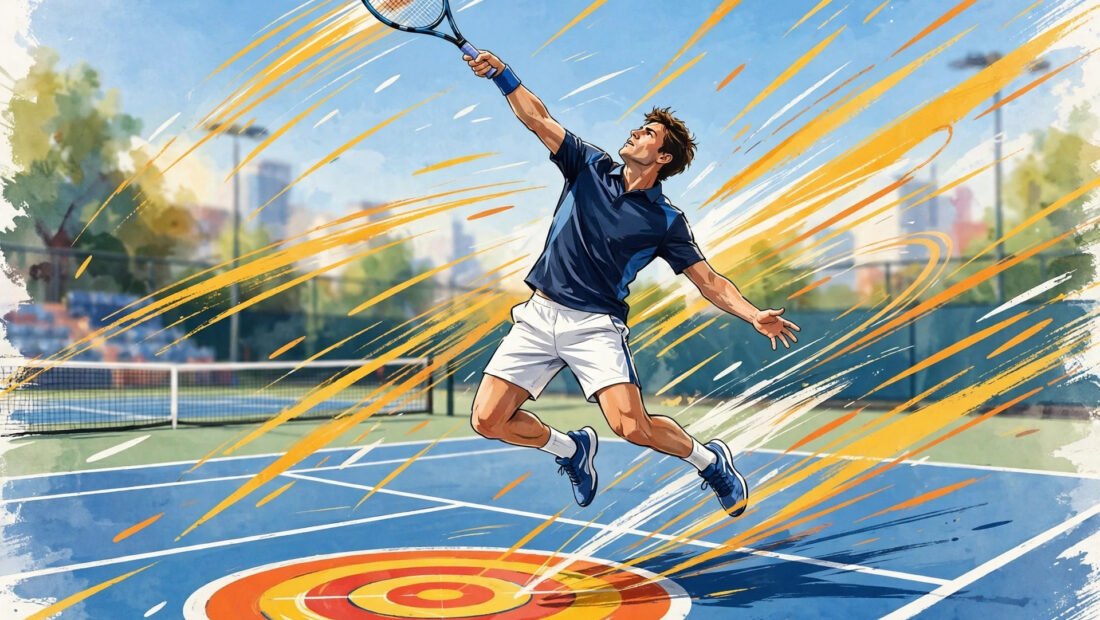
Stand behind the baseline and watch where the ball lands when you toss it for a serve. If it drifts a foot behind your head, you already know the most important thing about your serve: the swing is not the problem. Every adjustment you make to your arm, your wrist, and your follow-through is repairing the wrong part of the motion, because a serve built on a bad toss cannot be saved downstream. Fix the mistakes in the order they happen, starting with the toss, and the power and accuracy you have been chasing become much simpler problems.
Recreational serves break down in predictable places. Players chase the ball with their racket, muscle the shot with their arm alone, open their chest too early, and then protect a weak second serve by pushing it in with no spin at all. Each mistake has a plain cause and a plain correction. Work through the faults first. The correct motion at the end will feel less like a new technique and more like what is left when the errors are removed.
Mistake 1: The Toss Wanders, So Every Serve Starts Differently
The wandering toss is the most common fault and the most damaging, because it makes consistency impossible. Toss the ball behind your head and you will arch your back and spray the serve. Toss it too far to the side and you will reach, lose balance, and dump the ball into the net. Toss it too low and the whole motion rushes, shoulders first, racket late. Add a bent tossing arm and the release point changes on every single serve. Players then blame their swing for errors that were decided before the swing began.
Pay attention to where your toss would land if you let it fall. That landing spot tells the truth your feelings hide. For a right-handed player, a sound toss rises straight up, slightly in front of the body and slightly to the right, peaking at the height of your full racket reach, and would land just inside the baseline if untouched. A toss that would land behind you or far to your left is faulty no matter how good the contact felt afterward.
Mistake 2: Muscling the Ball With the Arm Alone
The second fault is trying to create pace with the serving arm by itself. The arm tightens, the shoulder does all the work, the ball goes slower than expected, and the shoulder aches the next day. This is how a strong, athletic player ends up serving softer than a smaller player with better mechanics. Arm-only serving also destroys accuracy, because a tight arm cannot repeat the same path twice.
Real pace travels up the body. The legs bend and drive, the hips turn, the trunk coils and uncoils, the shoulder whips through, and the forearm rotates at the end. The arm is the last link in that chain, not the engine. When a serve feels effortful and slow at the same time, the chain is broken somewhere below the shoulder, most often because the knees never bent or the body never coiled.
Mistake 3: Skipping the Trophy Position
Watch a strong server freeze at the top of the motion and you will see a clear shape: knees bent, tossing arm pointing up, racket dropped behind the back, weight loaded and ready. Coaches call it the trophy position, after the pose on top of a trophy. Amateurs skip it. They lift the ball and swing in one hurried piece, with no loaded pause, no racket drop, and no stored energy to release.
Without that loaded shape there is nothing for the legs to drive into. The serve becomes a push instead of a throw. Players who skip the trophy position often look rushed even when they are not trying to hurry, because the motion has no middle. Every part happens at once, and timing falls apart under pressure, which is why this fault shows up worst on break points and second serves.
Mistake 4: Opening the Chest and Dropping the Tossing Arm Too Early
Two linked faults bleed power in the middle of the motion. The first is opening up: turning the chest toward the net before contact. That early turn unwinds the coil you built in the trophy position and leaks energy sideways instead of sending it into the ball. The second is dropping the tossing arm the instant the ball leaves the hand. The tossing arm sets the shoulder angle and guides the whole motion. Drop it early and the front shoulder collapses, the head pulls down, and the serve dives into the net.
These faults explain a familiar pattern: practice serves that look fine and match serves that fall apart. Under pressure, the body rushes to face the target, the arm drops, and the motion shortens.
Mistake 5: Foot Faults and a Timid, Spin-Free Second Serve
Foot faults are the quietest way to lose free points. Stepping on or over the baseline before contact hands the point away, and many players do it on every serve without knowing, because their starting stance creeps forward over weeks. Tournament opponents and honest partners will eventually call it, and a habit built over months is hard to move in a weekend.
The second serve holds the opposite fault: too little ambition instead of too much movement. Afraid of the double fault, players push a slow, flat ball with no spin that lands short and sits up to be attacked. The returner steps in, takes a full swing, and the server starts the rally on defense. A second serve that lands reliably but invites a crushing return is not safe. It is just a slower way to lose the point. Compare that with a first serve blasted flat at full effort that lands only 40 percent of the time: the math of that pattern means the timid second serve decides most of your service games.
The Correct Way: Build the Motion in Order
Start with the toss, alone, with no racket swing at all. Stand near a fence and toss the ball so it rises along the fence line and lands in the same small area, slightly in front of you. Fifty quiet tosses a day for two weeks will stabilize most toss faults for good. It is dull work and it changes everything, because a repeatable toss makes every other fix testable.
Next, rehearse the trophy position as a held shape. Get into it, knees bent, tossing arm straight up, racket dropped behind your back, weight on the back foot, and hold for five seconds. Repeat it 20 times. You are teaching your body a position, not a swing. Pair it with a towel drill: hold a towel and swing through the serving motion, listening for a clean snap at the point where contact would happen. That snap comes from the forearm rotation, called pronation, that strong servers use at the top. When the towel snaps on command, the arm action is close.
Then add targets. Place cones or towels in the service box, one wide, one down the T, one into the body position, and serve sets of 20 balls at each in rotation, keeping a simple score. Scored practice builds accuracy in a way that casual serving does not, because every miss is recorded by your own count. For reference material and slow-motion examples of the full motion, the USTA’s tennis instruction resources provide clear breakdowns of the toss, trophy position, and contact sequence.
Build the second serve as a real shot. Use heavy topspin or slice: brush up the back of the ball, aim three to four feet above the net, and target the middle of the box to start. Spin pulls the ball down into the box and kicks it up awkwardly for the returner. Practice it in blocks of 50 serves with no flat first serves mixed in, until it lands about 90 percent of the time. Once it is that reliable, reshape your first serve around it: hit the first ball at about 80 percent effort with spin and placement rather than at full flat power. The small loss in speed buys a large gain in first serves landed, and an 80 percent serve placed well beats a full-power serve in the net every time.
Reset your feet while you are at it. Begin every practice serve with your toes an inch behind the baseline and leave them there until the spacing feels automatic. Stay sideways longer through the motion, keeping the tossing arm up until the racket starts upward, then tuck it in. Let the legs start the swing and let your chest face the net only during the follow-through.
Use Video and a Patient Timeline
Your phone is an honest coach. Film from the side to see the toss, trophy position, and leg drive, and from behind to see toss placement and rotation. Compare one element at a time with slow-motion footage of strong servers. Film monthly rather than daily, since changes need weeks to settle, and keep the old clips.
Expect a reliable, sound serve to take about two to three months of focused practice, two or three sessions a week. On Texas outdoor courts, schedule those sessions early or late in the day through the summer, and hydrate like it matters, because it does. Players who have recently taken up other racket sports, even total beginners working through pickleball rules for total beginners, will notice the same lesson in both games: the shot you control completely is the shot worth practicing alone.
Work in order and the fix sequence is short. Stabilize the toss. Load the trophy position. Let the legs and rotation produce the pace. Keep the arm up and the chest sideways until the right moment. Give the second serve real spin and real trust. Do that, and the ball that used to land a foot behind your head stops sabotaging you, because the serve finally starts where it should: with a toss you can set your watch by, and a motion built to deserve it.




1 Comment