
Most beginners give away their first points in exactly the same three ways. They serve from the wrong spot on the court. They step into the kitchen and volley a ball they were not allowed to touch in the air. Then they stop mid-game to argue about a score that nobody called out loud and nobody tracked. None of those mistakes has anything to do with athletic ability. All three disappear once you learn the order of play, step by step, before you worry about spin or power.
Pickleball looks simple because the court is small and the paddle is light. The rules are specific, though. A serve has to travel a certain way. The first two shots have to bounce. One strip near the net changes what you can do. Learn those pieces in order and you can play a clean game on your first day, from Houston to West Texas.
Step 1: Set Up the Court and Pick Up the Right Gear
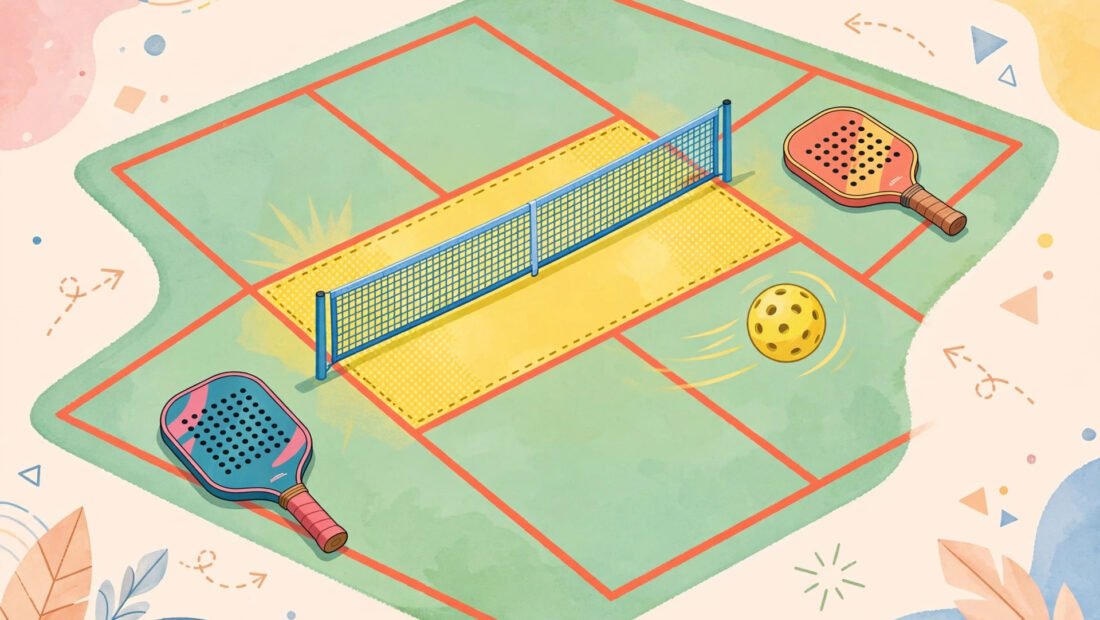
Start with the space itself. A pickleball court measures 20 feet wide and 44 feet long, the same size as a badminton court and roughly a quarter of a tennis court. The net sits 36 inches high at the sidelines and dips to 34 inches in the middle. On each side, a line 7 feet from the net marks off the non-volley zone, which everyone calls the kitchen. Behind that zone, a center line splits the rest of the court into two service boxes, left and right.
You need very little to play. A solid-face paddle with no strings costs about $30 to $60 for a solid beginner model. Skip the cheapest wooden paddles in a two-pack, since they feel dead in the hand and make soft shots harder to learn. The ball is hard plastic with holes, similar in spirit to a Wiffle ball but built for this game. Outdoor balls have smaller, more numerous holes than indoor balls, so grab the type that matches the surface. Court shoes are the best footwear choice. Running shoes will do for a first session, but their tall, narrow heel makes sideways steps risky, and pickleball is full of sideways steps.
Many Texas parks lend paddles and provide balls, so a first outing can cost nothing. In summer, bring extra water and favor morning or evening games.
Step 2: Take the Correct Serving Position
Almost every beginner fault starts before the ball is even hit, with feet in the wrong place. To serve, stand behind the baseline, between the center mark and the sideline on your side. At least one foot must stay behind the baseline and not touch it until after you strike the ball. Your target is not straight ahead. Every serve travels diagonally into the service box across the net on the opposite diagonal, the same basic geometry as tennis doubles.
Which box you serve from depends on your score. When your score is even, serve from the right side. When it is odd, serve from the left. In doubles, each partner serves in turn before the serve passes to the other team, except at the very start, when only one partner on the first team serves before the first side-out. Before each serve, check: feet behind the line, target box on the diagonal, partner near the baseline.
Step 3: Hit the Serve Underhand, Low, and Deep
The serve must be hit underhand. Your arm moves in an upward arc, the paddle head stays below your waist at contact, and the highest part of the paddle stays below your wrist. You may drop the ball and let it bounce before serving if your local game uses the drop serve, or you can toss it gently and strike it out of the air with the volley serve. Either way, the motion stays underhand and controlled.
Aim deep rather than hard. A soft serve that lands near the back of the service box pushes the receiver back and buys your team time. A fast serve that sails long is just a lost serve. Pickleball gives you one serve attempt, not two. There is no second serve to save you, so consistency is the whole job here. Keep the ball clear of the kitchen. A serve that lands in the kitchen or on the kitchen line is a fault, even if everything else looked perfect.
New players who come from tennis often want to blast this shot, but pickleball rewards placement over pace at the start. If racket sports are new to you, the contrast helps: reading about how to improve your tennis serve for power and accuracy shows how different that overhead weapon is from the quiet, underhand pickleball serve that simply needs to start the rally in the right box.
Step 4: Call the Score Out Loud Every Single Time
Scoring causes more beginner arguments than any rule on the court, and the fix is a habit, not a talent. Only the serving team can score points. If the receiving team wins the rally, no point changes hands. The serve simply moves to the next server or to the other team. That is called a side-out. Games are usually played to 11 points, and you must win by 2.
In doubles, call three numbers before you serve: your team’s score, the other team’s score, and your server number, either 1 or 2. A call of 4-2-1 means your team has 4 points, the other team has 2, and you are the first server for your team on this turn. In singles, the call is just two numbers, your score and your opponent’s score.
Call it loudly enough for all four players to hear, and call it before you start your motion. If you forget the score mid-game, ask. Players do this constantly and no one minds. What frustrates people is a server who mumbles, serves fast, and then disputes the score six rallies later. The loud call is also your own memory aid. Saying the number locks it in.
Step 5: Respect the Two-Bounce Rule on Every Rally
After the serve, each side must let the ball bounce once before hitting its first shot. The serve itself bounces in the service box. The return of serve must also bounce before the serving team hits it. Only after those two bounces can anyone volley the ball out of the air. Players call this the two-bounce rule, and it is the rule tennis converts break most often, because charging the net and volleying the return feels natural to them.
The rule keeps rallies fair. Without it, a strong server could rush the net and end points at once. Stay near the baseline for the first two shots, let the bounces happen, then move forward as a pair. If you are unsure whether a bounce was still required, let the ball bounce. A bounce is always safe; a volley taken one shot too early is always a fault.
Step 6: Play Around the Kitchen Without Volleying From It
The kitchen is the 7-foot zone on each side of the net, plus its lines. You may stand in the kitchen at any time. You may hit a ball from the kitchen after it bounces. What you may not do is volley a ball while any part of your body or anything you are wearing touches that zone. Your momentum counts too. If you volley near the line and your forward step or stumble carries you into the kitchen, that is a fault. The same applies if your paddle or hat falls into the zone during the volley.
This rule shapes the whole sport. Without it, tall players would park at the net and smash every ball down. With it, players learn the soft game: dinks that drop just over the net, drop shots, and patient resets. As a beginner, keep your feet behind the line when you volley, step in only for balls that have bounced, then step back out. For the complete official wording, keep USA Pickleball’s official rules and beginner resources bookmarked.
Step 7: Spot the Faults That End a Rally
A fault ends the rally at once. If your team was serving, you lose the serve. If your team was receiving, the servers score a point. The common beginner faults are worth memorizing as a short list: volleying from the kitchen, volleying before the two bounces are done, serving into the net or outside the correct box, hitting the ball out of bounds, hitting the ball into the net, and touching the net with your body or paddle while the ball is live.
Line calls have their own customs. A ball on a line is in, with one exception: a serve landing on the kitchen line is a fault, because the serve must clear that zone. The team on the side where the ball lands makes the call. If you did not clearly see a gap between ball and line, the ball was in. Call your own faults plainly and move on.
Step 8: Follow the Habits That Get You Invited Back
Rules tell you how to play. Habits tell people whether they want to play with you again. Call the score every time, as covered in Step 4. Make honest line calls. Do not aim hard slam shots at a clearly weaker or older player in a casual game; work on placement instead and save full pace for matched competition. Apologize briefly when a shot clips the net and dribbles over for a lucky point, then play on.
On busy Texas courts, learn the local rotation on your first visit. Many courts use paddle stacking, where your paddle holds your place in a rack or line. Watch one rotation and follow the local pattern.
Most beginners rally well within two or three sessions and play full games within a month. Steady dinks and a reliable third-shot drop build over three to six months. Serve from the right spot, stay out of the kitchen on volleys, and call the score like you mean it, and the points you lose will be honest ones, lost to better shots rather than to rules you had not learned yet.




1 Comment