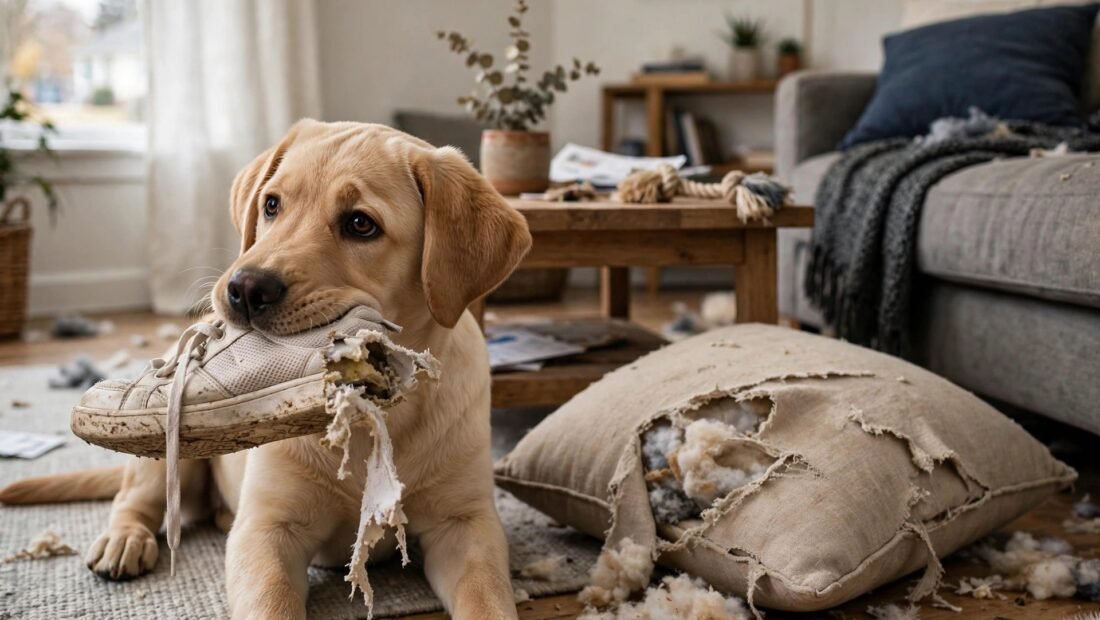
Look at the pattern before you look at the damage. The baseboards are chewed in a neat line at snout height. The door frame near the handle is scored. It happens on workdays, when the house sits empty for nine or ten hours, and it never happens on weekends when people drift in and out all day. That pattern points in one direction. A dog that destroys things only when left alone is not being spiteful, stubborn, or badly raised. The chewing is a symptom, and the schedule, the energy level, and the dog’s feelings about being alone are where the answer lives.
Destructive chewing has four different causes that can look identical in a wrecked living room. Boredom, separation anxiety, age, and hunger each need a different response. Treating an anxious dog as merely bored wastes months. Treating a teething puppy as anxious creates worry where patience would do.
Boredom and an Underused Brain
Boredom is the most common cause by a wide margin. The typical pet dog sleeps 12 to 14 hours a day, needs 1 to 2 hours of real activity, and in many homes receives a short leash walk and then a long, empty day. Chewing fills that gap perfectly from the dog’s point of view. It occupies the mouth, burns a little energy, relieves mild stress, and produces interesting textures and tastes. A couch cushion is, to an under-stimulated dog, a puzzle that fights back just enough to stay fun.
The signs of boredom chewing are scattered and opportunistic. The dog chews what is available: shoes, remotes, cushions, books, a child’s toy left on the floor. The damage is spread across the day, with naps in between. A camera usually shows a calm dog that wakes, wanders, chews for a while, and sleeps again. High-energy breeds carry the highest risk. Labradors, border collies, huskies, and Belgian Malinois are all popular in Texas, and all of them were bred to work for hours. Adolescent dogs under 2 years old combine that energy with weak impulse control, which is why so much destruction peaks between 6 and 18 months.
The dose matters. A leashed walk around the block is a bathroom trip, not real exercise. Genuine output means 30 to 60 minutes of aerobic work before the alone stretch: fetch, a flirt pole, a jog, swimming, or hard play in a secure yard. Mental work counts heavily too. Fifteen minutes of training or nose games, with treats hidden around a room, tires many dogs more than a half hour of walking.
What the dog can chew while alone shapes the outcome. A Kong packed with peanut butter and kibble and frozen overnight can occupy a dog for about 45 minutes. Lick mats, snuffle mats, and puzzle feeders stretch a small amount of food into a long activity. Choose long-lasting chews the dog cannot swallow in chunks, supervise the first few times, and rotate options daily.
Separation Anxiety and Genuine Panic
Separation anxiety looks like boredom chewing from the doorway and nothing like it on camera. The destruction concentrates on exit points: door frames, window sills, blinds, the crate door itself. It starts within minutes of departure, not after a nap. The dog may drool, pant, howl, pace, urinate or defecate indoors despite being housetrained, or injure itself trying to escape. This dog is not having fun and is not passing time. It is panicking, and the chewing is an attempt to get out, not an attempt to be entertained.
A pet camera is the clearest way to tell the two apart. The bored dog chews in bursts between rest. The anxious dog is distressed from the first minute and does not truly settle. That distinction decides the whole plan, because the boredom fixes, more toys and a longer walk, barely touch panic. Guidance collected in the ASPCA’s dog behavior guidance treats separation anxiety as a condition that needs gradual desensitization and, in many cases, veterinary help, rather than stricter management alone.
The training for anxiety moves slowly on purpose. The owner picks up keys, puts on shoes, and then sits back down, repeating departure cues until they mean nothing. Next comes stepping outside for 10 seconds and returning calmly, then a minute, then several minutes, always coming back before distress spikes. Departures and returns stay deliberately dull. Long emotional goodbyes teach the dog that leaving is a major event. So do wild greeting rituals at the door. Calm exits, a stuffed toy, and a low-key return keep the emotional temperature down.
When panic is severe, a veterinarian belongs in the plan early. Anti-anxiety medication such as fluoxetine does not sedate a dog into obedience. It lowers the baseline level of fear enough that the gradual training can actually work. Severe or self-injuring cases may need a veterinary behaviorist. None of this is a training failure by the owner. It is a medical and behavioral condition, and it improves with proper treatment far more reliably than with punishment, which only adds fear to fear.
Teething, Adolescence, and a Mouth That Explores
Age explains a large share of chewing that worries new owners. Puppies chew because teething hurts, roughly through the first 6 months, and because mouthing is how a young dog investigates the world. Cold chew toys and frozen wet washcloths soothe sore gums better than a shoe does. Puppies also need close supervision and a confined, puppy-proofed space when supervision is impossible, since a puppy cannot be expected to know rules it has not been taught yet.
Adolescence brings a second wave. From about 6 to 18 months, dogs have near-adult strength, high energy, and immature judgment. This wave does fade. Most dogs settle by 2 to 3 years, provided their needs were met along the way. But habits rehearsed daily for a year do not vanish on a birthday, which is why management matters now.
Confine the unsupervised dog to a dog-proofed room or pen. Remove shoes, remotes, cords, and trash. Leave legal chewing options in their place. For young dogs, structured confinement paired with training, including how to crate train a puppy fast, stops the behavior from being rehearsed while exercise, training, and maturity do the curing.
Hunger, Diet, and Chewing That Turns Into Swallowing
A smaller share of destructive chewing starts in the stomach. Dogs fed too little, dogs on poor-quality food that leaves them unsatisfied, and dogs with absorption problems sometimes chew and swallow non-food items, a pattern called pica. The target list is the warning sign: socks, underwear, fabric, plastic, rocks, and pieces of toys that are ingested rather than merely shredded. Shredding a cushion is a behavior problem. Swallowing the cushion stuffing is a medical risk, because intestinal blockages can kill a dog and often require emergency surgery.
Any dog that regularly eats non-food items needs a veterinary visit. The vet can check whether the diet is adequate and whether the amounts fed match the dog’s needs. At home, feed measured meals on a steady schedule and keep laundry, small objects, and trash behind closed doors. Vomiting, loss of appetite, lethargy, or straining after a chewing episode means the dog should be seen the same day. Also remove dangers a bored dog can reach: sugar-free gum and other products with xylitol can be lethal in small amounts, as can medications, chemicals, and electrical cords.
The Alone Hours Themselves
Whatever the cause, the length and shape of the alone time decide how hard the problem becomes. Adult dogs need a bathroom break and a reset during a long absence. In Texas metros, commutes of 45 minutes or more each way are normal, which turns an 8-hour workday into 10 hours alone for the dog. At that length, a midday break stops being a kindness and becomes a requirement. A dog walker, a neighbor swap, a lunch trip home, or a daycare day or two each week can be the actual solution, not an extra.
Practice on days off too. Five calm, successful 20-minute absences teach more than one failed 8-hour stretch. And never punish damage found hours later. A dog cannot connect anger at 6 p.m. with chewing at 10 a.m. It only learns that your homecoming is tense, which adds anxiety. Clean up quietly, note what was chewed and when, and adjust the plan.
Heat, Storms, and Other Texas Pressures
Texas adds two pressures that owners in milder states rarely face. The first is heat. Real exercise in summer has to happen early in the morning, before about 8 a.m., or late in the evening. Midday exertion risks heatstroke, especially for heavy-coated and flat-faced breeds. Owners who skip the morning session because it is early and cannot exercise the dog at noon end up with exactly the outcome the schedule predicts: an unexercised dog alone all day and a damaged house at night. The morning session is the load-bearing wall of the whole plan from May through September. Swimming, where it is available, is the one midday-friendly exception, since it works the body hard while the water carries the heat away.
The second pressure is storms. Texas thunderstorms are loud, frequent, and often arrive while owners are at work. Noise-sensitive dogs may chew doors and window frames only on storm days, which can be mistaken for separation anxiety. Note whether the damage clusters around bad weather. A dog that is calm alone on clear days and frantic during thunder has a noise problem, and that problem needs its own desensitization work and a conversation with a vet about storm-day support.
Put the pieces together and the workday pattern explains itself. Weekday chewing at snout height, in a house emptied by long Texas commutes, usually means a dog whose exercise, company, or confidence runs out hours before anyone comes home. Shorten the alone stretch, spend the dog’s energy before it starts, leave work the dog is allowed to do, and treat panic as panic when the camera shows it. The chewing stops when the hours that produce it change.