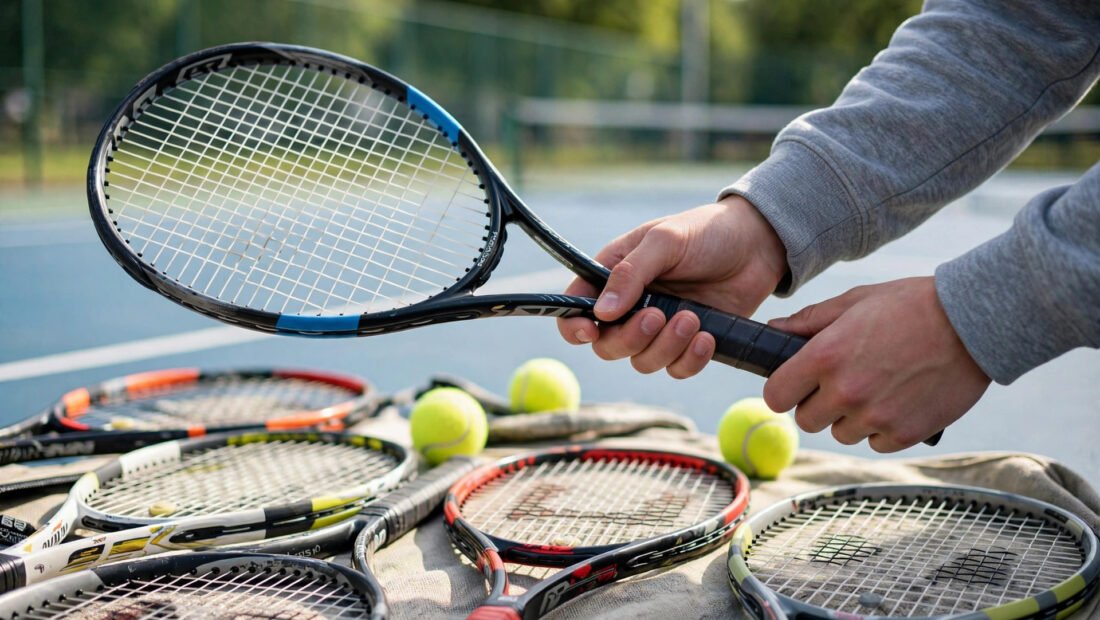
Stand in front of the racket wall at any large sports store and every frame seems to make the same promise. Lightweight power. Pro feel. Perfect for beginners. The prices run from about $30 to $300, the handles all feel similar at a glance, and the spec cards read like a foreign language. The way through that wall is not to read every card. It is to check a short list of specs in a fixed order, head size first, weight second, grip size with real care, and the rest after. Get those right and the racket will forgive the mishits every beginner makes. Get the grip wrong and your wrist will tell you about it for weeks.
What to Have Ready Before You Shop
You need very little to choose well, but bring these items and facts with you.
- A soft tape measure or a ruler, for checking grip size at home before you go
- Your shoe size and height are not needed, but your dominant hand is, since grip is measured on that hand
- A budget range in mind, with $60 to $120 as the honest window for a real beginner frame
- Access to a demo program if the shop or a local club offers one, so you can hit with two or three frames before paying
- A plan for strings, since many frames ship with basic factory strings that you may replace sooner than you expect
Beginner rackets fall into a clear family called game-improvement or power frames. They have oversized heads, lighter weight, and stiffer, more powerful builds made for players who are still learning to swing through the ball. The other families can wait. Tweener frames, with heads around 98 to 104 square inches, suit improving intermediates. Player or control frames, smaller, heavier, and more flexible, suit advanced players who make their own power. Learning in a control frame is slow and sore work, like learning to drive in a race car when a simple sedan would teach you faster.
Step 1: Choose the Head Size
Start at 105 to 110 square inches. That range gives a beginner a large sweet spot, real power with a short swing, and forgiveness when contact lands off center, which will happen often in the first months. Heads from 105 to 115 square inches count as oversized, but the top of that range can feel clumsy and hard to aim. The 105 to 110 window is the practical sweet spot. Control suffers a little compared with a small head, but control is not yet your problem. Getting the ball over the net and deep enough to rally is the problem, and a bigger head solves it.
Hold the frame and take a few slow shadow swings. The head should feel present but not like a sail catching wind. If the shop allows, bounce a ball on the strings. Off-center hits on a large head should still send the ball forward with a solid feel rather than a harsh twist in your hand.
Step 2: Pick a Weight You Can Swing for an Hour
Look for 255 to 280 grams strung, roughly 9 to 9.9 ounces, with 260 to 280 grams as the best balance for most adults. In that range the racket is light enough to move quickly at the net and kind to the shoulder over a long session, yet heavy enough to stay stable when a harder ball arrives.
Two weight mistakes are common. The first is buying a heavy pro-style frame to look serious. Heavy frames demand fast, full swings and good timing. In beginner hands they cause late contact and arm fatigue within weeks. The second is going under 250 grams to make the racket feel effortless in the store. Ultralight frames can twist on mishits and send more shock to the arm. Texas heat makes the lighter end tempting during long summer sessions, but stable and light beats feather-light over a full hour of hitting.
Balance connects to weight. Beginner frames are usually head-heavy or evenly balanced, which adds power without a fast swing. You do not need to obsess over balance points yet. If two frames weigh the same and one feels far easier to swing, trust that feel. It is balance at work.
Step 3: Measure Your Grip Size Carefully
This is the step beginners skip, and it matters most for comfort and injury risk. A grip that is too small makes you squeeze harder to stop the handle twisting, which strains the forearm tendons. A grip that is too large limits wrist movement and makes the serve and topspin shots awkward. Wrong grip size is a leading equipment cause of tennis elbow, and it is fully preventable in the store.
Use the finger test. Hold the racket with an eastern forehand grip, as if shaking hands with the handle. With your other hand, slide your index finger into the gap between your ring finger and your palm. The finger should fit snugly. If it will not fit, the grip is too small. If there is loose space around it, the grip is too large. Common adult sizes are 4 1/4 inches, often marked L2 and common for women, and 4 3/8 inches, marked L3 and common for men, but hand size varies a lot, so measure rather than guessing by gender.
When you fall between sizes, choose the smaller one. You can build a handle up with an overgrip, which adds a small amount of size and also gives a fresh, tacky surface. You cannot shrink a handle that is too big. Replace overgrips often. In sweaty Texas summers a worn, slippery overgrip forces a tight death grip on every shot, and that clench, repeated for an hour, is what hurts elbows. A fresh overgrip is cheap. Forearm pain is not.
Step 4: Settle Length, Balance, and String Pattern
Length is an easy call. Standard 27 inches suits virtually every adult beginner. Extended frames at 27.5 inches add reach and serve power but cost maneuverability at the net and on quick reactions. Leave them for later.
For string pattern, choose an open 16 by 19 pattern. Open patterns let the strings move and grip the ball, giving more spin and easy power. Dense 18 by 20 patterns give control and string durability for advanced hitters who already swing fast. As a beginner, free spin and power help you keep the ball in with margin over the net, so 16 by 19 is the right default.
Step 5: Choose Strings and Tension for Your Arm
The frame is only half the feel. Strings are the other half, and beginners should start soft. Multifilament strings are the most comfortable choice, with synthetic gut as a solid lower-cost option. Both forgive off-center hits and treat the arm kindly.
Avoid polyester strings at the start. Poly is stiff, low-powered, and built for advanced players who swing very fast and restring often. In a beginner frame it feels board-like and is a classic cause of arm pain. There will be time for poly later if your game ever needs it, and many players never need it at all.
For tension, string 3 to 5 pounds below the mid-point of the range printed inside the racket throat. Lower tension gives more power and a softer feel. If you play daily in peak Texas heat, heat can soften a string bed slightly, so a pound or two tighter in August is a reasonable small adjustment, but do not chase it as a beginner. Restring at least once a year even if a string never breaks, because strings lose tension and elasticity over time and dead strings punish the arm. A widely used rule is to restring about as many times a year as you play in a week.
Once the basics are set and you start playing points, serve practice is where a forgiving frame pays off fastest, and working through how to improve your tennis serve’s power and accuracy is far easier when the grip fits and the strings are soft enough to practice without soreness.
Step 6: Demo, Check the Price, and Buy
Hit before you buy when you can. Many Texas shops and clubs run demo programs that let you borrow two or three frames for a week. Thirty minutes of real hitting tells you more than thirty reviews, because your hand learns grip comfort and your arm learns weight in a way no spec sheet can teach.
On price, $60 to $120 buys a genuine beginner frame from Wilson, Head, Babolat, or Yonex entry lines. Below $50, frames are often poorly made, with weak materials and poor factory strings that hold back learning. Above $150, a beginner pays for precision and feel that developing strokes cannot use yet. Last year’s models deserve a close look. Racket design changes slowly, and prior-year frames often sell at 30 to 40 percent discounts while playing almost the same as the current version.
For structured help beyond the shop, the USTA’s beginner tennis resources point new players toward starter clinics and programs. One early lesson to set your grip and basic stroke shape can save months of unlearning, and it makes the racket you just chose work the way it should. After that, regular court time does the rest. City recreation programs and club beginner clinics across Texas give new players a low-cost place to use that court time with other learners at the same level. The right racket will not play for you, but the wrong one will quietly fight you on every swing, and beginners have enough to learn without that fight.