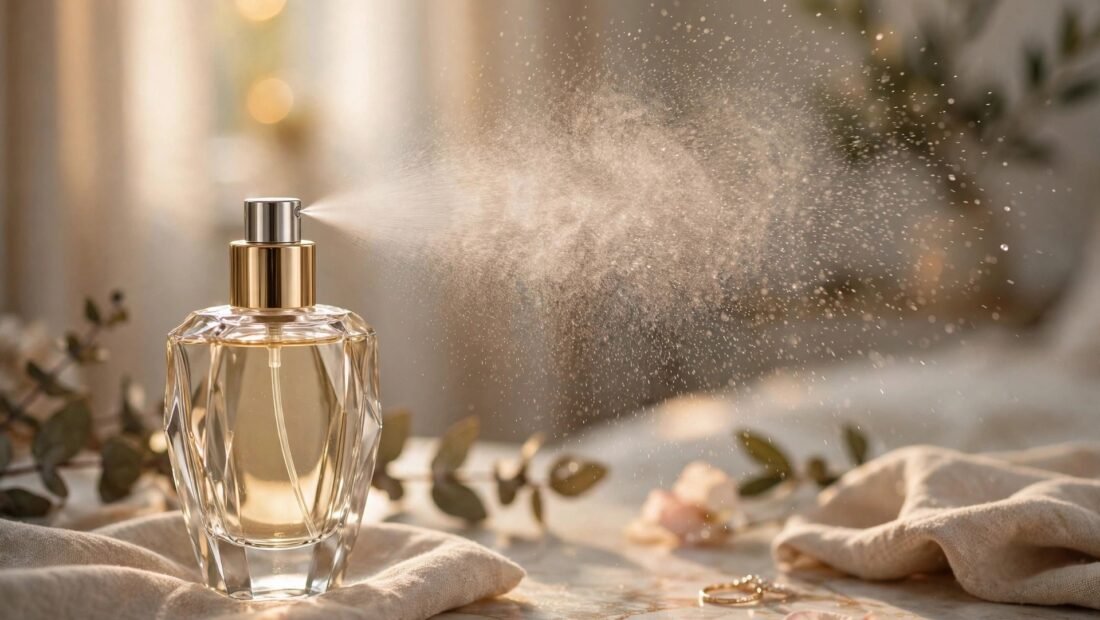
You spray at eight in the morning, walk out feeling finished, and by lunch the scent seems to have left the building without you. A coworker steps into the elevator at five and still smells unmistakably like her perfume, which raises an unfair question. Is her bottle better, or is something else going on? Almost always, something else is going on. Longevity runs on concentration, skin prep, placement, and storage, in that order, and Texas heat tests every one of them. The questions below follow that order, so each answer builds on the last.
Why does perfume fade so fast in the first place?
Fragrance is built in layers that evaporate at different speeds. Top notes, often citrus and light florals, lift off within minutes. Heart notes carry the middle hours. Base notes such as woods, musk, amber, and vanilla are heavy molecules that cling longest. A scent heavy on top notes will feel bright and then thin, no matter how carefully you apply it.
Heat speeds the whole process. Warm skin pushes fragrance molecules into the air faster, which is why a scent projects strongly during the first hour in Texas and then seems to vanish. Sweat and dry air pull in opposite directions at once, strong early throw, shorter total life. That pattern is chemistry, not a faulty bottle, and it is why the steps that follow focus on slowing evaporation and giving the scent something to hold onto.
Can you still smell it after an hour, or has your nose quit?
Often the nose quits first. Olfactory fatigue sets in within about 20 minutes, meaning your brain stops reporting a steady scent that is still present. Other people can still smell it clearly. Before deciding a perfume has failed, ask someone you trust, or step outside into fresh air for a few minutes and then notice the scent again as you re-enter your own space.
That said, fatigue is not an excuse for every early fade. If a trusted person confirms the scent is gone by midday, treat that as real information about concentration, prep, or storage, and work through the next questions rather than spraying on more and hoping.
What concentration actually lasts all day?
Check the label before blaming your skin. Parfum or extrait, at 20 to 30 percent fragrance oils, typically lasts 8 to 12 hours or more. Eau de parfum, at 15 to 20 percent, usually gives 6 to 8 hours and is the practical sweet spot for all-day wear. Eau de toilette, at 5 to 15 percent, tends to last 3 to 5 hours and needs a refresh for a full day. Eau de cologne and body sprays, at 2 to 5 percent, last about 1 to 3 hours. They are refreshers, not all-day scents.
Price does not override those numbers. An affordable eau de parfum with strong base notes will outlast a pricey eau de toilette on most skin. If all-day wear is the goal, buy the higher concentration of a scent you like rather than the famous name in a weaker form. Test on skin for a full day before committing, because paper strips cannot show the dry-down at hour six, and the dry-down is the perfume you will actually live in.
How should you prep your skin before spraying?
Moisturized skin holds fragrance far longer than dry skin. Dry skin absorbs and sheds fragrance oils quickly. Apply an unscented lotion or a light body oil to the spots where you will spray, let it sink in for a minute, then spray. That single step commonly adds hours, and it costs almost nothing.
A tiny dab of petroleum jelly on a pulse point works as a stronger base. It forms an occlusive layer that slows evaporation from that spot. Use very little. A thick layer feels greasy and can dull the opening notes.
Timing after a shower helps too. Warm, slightly damp skin right after showering takes fragrance well. Pat dry, moisturize, then spray. Spraying onto bone-dry skin hours later, after lotion has worn off and skin has cooled, gives the scent far less to hold.
Where should you spray for the longest wear?
Warmth releases scent, so pulse points are the classic targets: the base of the throat, behind the ears, and the inner elbows. Inner elbows deserve more use than they get. Wrists are popular but wash off through handwashing and desk contact, so they fade first in real life even though they smell strong at the start.
Hair holds scent longer than skin. A light mist through the ends, or a dedicated hair perfume made with less drying alcohol, can carry a scent trail for hours. Texas wind then works for you instead of against you, moving that scent as you move.
Fabric holds scent longest of all. A spray on the chest of a shirt or on a scarf can still be present in the evening. Test an inner seam first, and never spray silk or pale delicate fabrics without checking for staining. Behind the knees is the quiet overachiever. Warmth plus airflow as you walk builds a soft trail without a heavy cloud at face level.
Stay near three to five sprays total across those points. More spray does not stretch the timeline. It makes the first hour louder and then follows the same fade curve, while also crowding anyone in a small office or car. Heat and scent share a close relationship with other beauty routines too, and the same Texas conditions that shorten perfume life explain how to stop makeup creasing under your eyes in the heat, since both come down to what heat and humidity do to products sitting on skin.
Should you rub your wrists together after spraying?
No. Put that habit down. Rubbing creates friction heat and crushes the delicate top notes, which shortens the bright opening and speeds evaporation. Spray each spot and let it dry untouched. It feels passive. It works better.
Which fragrance families last, and which fade by design?
Orientals and ambers, woods, and gourmand scents built on vanilla and tonka last longest, often eight hours or more, because their molecules are heavy and slow to leave skin and fabric. Florals, chypres, and musks sit in the middle, around four to seven hours depending on the blend. Citruses, green and aquatic notes, and light aromatics are shortest at roughly one to three hours. They are built for freshness, not endurance.
If you love citrus, there are two honest options. Accept a planned refresh during the day, or layer the citrus over a musky or lightly vanilla base, through a matching lotion or a base scent, so something remains after the citrus lifts. Layering matching body lotion under the same fragrance is the simplest version of this and stacks the same notes in two formats that fade at different rates.
For deeper notes on specific bottles, blends, and reported wear times, Allure’s fragrance application and storage guides are a useful companion when comparing how a scent is meant to be applied and kept.
How does Texas heat change the plan?
Expect strong projection early and a faster fade later. Counter it with base-note-heavy scents, fabric application, since clothes do not sweat scent off the way skin does, and lighter total spraying in summer. Heavy orientals that feel elegant in winter can project overwhelmingly at 100 degrees, so reduce sprays rather than switching away from a scent you love.
Carry a small travel atomizer, around 5 milliliters, for one midday spray on fabric. That single refresh resets the curve honestly. Needing it in Texas is normal planning, not a sign that your morning routine failed.
How should you store perfume so it does not spoil early?
Keep bottles cool, dark, and dry. A hot, humid, bright bathroom is the worst common storage spot in a Texas home, and a car is worse still. Heat and light break down fragrance oils, flattening the scent and cutting its staying power before it ever reaches your skin. A bedroom drawer or a closet shelf away from direct sun will keep a bottle true far longer.
Keep the cap on and the bottle upright, and avoid shaking it. If a once-loved perfume now smells sharp, thin, or simply off and fades within an hour, suspect storage damage before suspecting your skin. A degraded bottle cannot be rescued with better technique.
Does spraying more ever help?
Only up to a point, and that point arrives quickly. The first proper sprays on prepped pulse points do the work. Extra sprays on the same spots mostly evaporate on the same schedule, so the fade time barely moves while the opening gets harsh. If a scent feels too weak after prep and placement are right, the honest fixes are a higher concentration, a base-note-heavier version of a similar scent, or a planned midday refresh, not a cloud of extra sprays in the morning. A lighter hand with the right concentration reads as polished. A heavy hand with a weak concentration reads as strong for twenty minutes and gone by lunch, which is the exact problem you set out to solve.
How can you test a perfume fairly before buying it?
Ask for a sample or spray one wrist in the store and live with it for the full day. Note what it smells like at the first spray, at lunch, and in the evening. That three-point check shows the top, heart, and base in real conditions, on your skin, in Texas air. Test only one scent per day, since two scents mix in the air and muddy the judgment. If the evening check still pleases you and a trace remains on a sleeve the next morning, the bottle has passed the test that matters for daily wear.
What if perfume irritates your skin?
Longer wear means longer contact, so sensitivity deserves respect. If scents cause itching, redness, or headaches, patch-test new fragrances on a small area first and give it a day. Fabric and hair application help here as well, since they deliver scent with less direct skin contact. If reactions keep happening across many products, fragrance-free personal care for the base routine, with scent kept to clothing, is often the workable middle ground.