
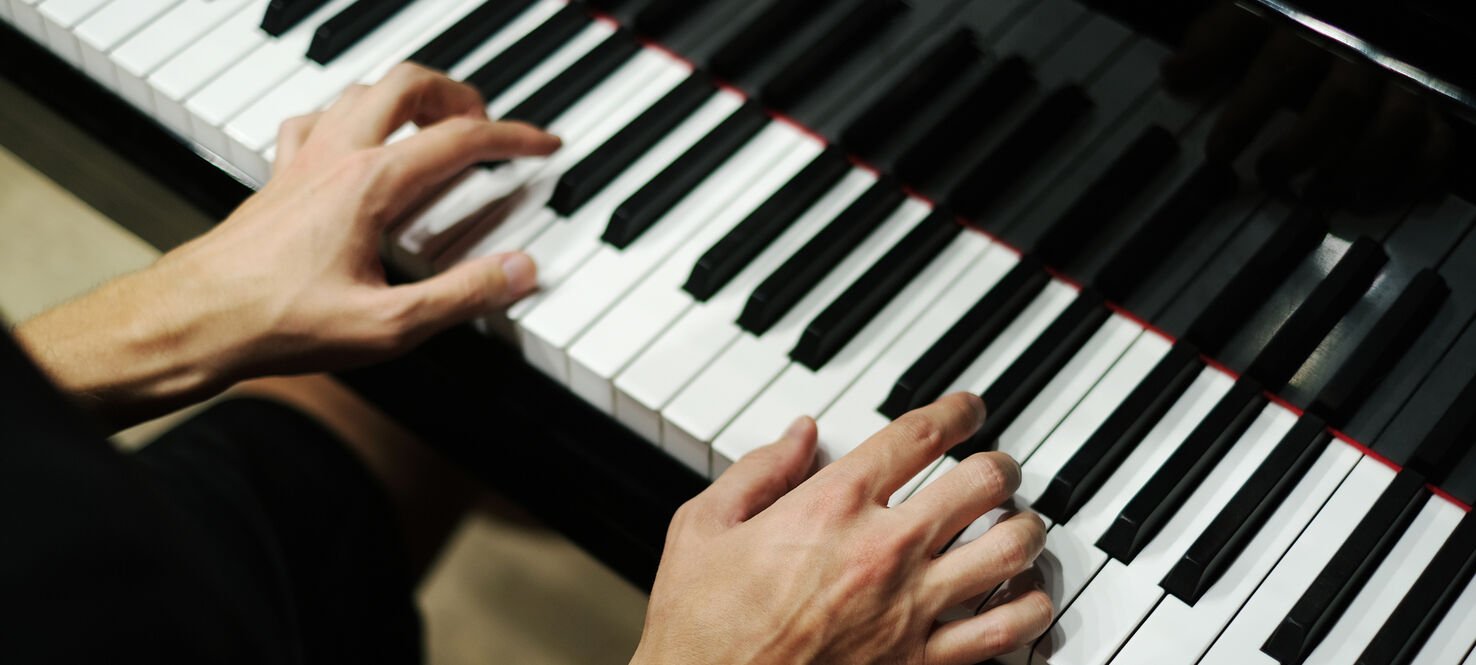
Six months. Two years. Ten years. Search how long piano takes and all three answers appear, stated with full confidence, and the strange part is that none of them is lying. Each one measures a different finish line. Six months gets simple songs with both hands. Two to three years gets playing that sounds genuinely good to most listeners. A decade gets professional depth. The confusion disappears once the stages are laid out in order, with what each stage actually feels like from the bench, what practice it assumes, and where people commonly stall.
Stage One: The First One to Three Weeks
The opening weeks are about geography and touch. You learn where the notes live on the keyboard, how the pattern of black keys repeats, how fingers are numbered, and how to sit and hold your hands without tension. Posture feels fussy at first and then stops being a thought.
By week two or three, most beginners practicing 20 to 30 minutes a day, four or five days a week, can play a simple one-hand melody such as Ode to Joy or Twinkle Twinkle. It will sound plain and careful, because it is. It will also be unmistakably music, and that early win matters more than it looks. It proves the keyboard is readable, and it carries motivation into the harder coordination work ahead. Progress in this stage is fast and visible, which is true of no later stage, so enjoy the steep part of the curve while it lasts.
Stage Two: Two to Three Months, Both Hands Together
This is the first real wall and the first real breakthrough, and they are the same event. Playing easy pieces with both hands together asks the brain to run two patterns at once. The method that gets most people through is unglamorous. Practice each hand alone until it feels easy, then combine them at a much slower tempo than feels natural.
By the end of this stage, simple two-hand pieces hold together at a steady tempo most of the time. Reading is still slow. Many learners at this point rely partly on tutorials or memory, which is fine for now, though the next stages reward reading more and more. The common stall here is skipping the slow hands-separate work and repeatedly crashing at the same bar. Slow down further, shrink the section to two bars, and the wall gets thinner.
Stage Three: Three to Six Months, First Real Songs
Somewhere in this window, playing starts to feel like playing. Both hands cooperate on easy arrangements, basic sheet music reading becomes workable, and tempo steadies. Pieces sound like songs rather than exercises, and playing for another person stops feeling like an apology.
If the goal is simple pop songs with basic chords, this is roughly where they arrive, usually between three and six months. You will still be a beginner, but a confident one, with a small set of pieces you can play start to finish. Keep that set alive by replaying it weekly. A small repertoire you own fully teaches more than a long list of half-learned pieces, and it gives every later stage something solid to build on.
Stage Four: Six to Twelve Months, Solid Late Beginner
By six to twelve months of steady practice, the picture firms up. Reading is more fluent, the repertoire widens across easy to moderate pieces, and dynamics enter the picture, playing loud and soft on purpose to shape a piece rather than merely surviving it. Accompanying yourself singing, or playing pop and simple film themes for fun, starts to work at this level.
This is also where learning to read music early pays its dividend. Tutorial-only learners often feel faster in month two, but readers overtake them within the first year because readers can start new pieces without a video for every song. Pairing reading practice with outside drills helps, and MusicTheory.net’s free lessons and exercises give beginners a free way to build note reading and rhythm skills away from the keyboard. At the bench, the metronome becomes the honest friend in this stage. Uneven timing is the clearest sound that separates beginners from intermediates, and steady metronome work is how it gets fixed.
Stage Five: One to Three Years, Early Intermediate
Between one and three years, playing crosses a line that listeners can hear. The hands work with real independence. Chords and scales are understood, not just copied. Pieces sound musical, with phrasing and expression, and most non-musicians will describe the playing as genuinely good. Favorite styles open up properly here, classical, pop, film music, and early jazz among them.
Timelines for specific songs sharpen at this stage. Intermediate arrangements of favorite songs typically take one to two years of total learning to play well. That can sound slow until you hear the difference between a simplified version and a full arrangement. They are different pieces wearing the same title, and the fuller one is worth the wait.
Instruction matters more from here on. Online courses serve the first year or two well, but a teacher catches technique problems, flat fingers, wrist tension, uneven touch, that learners cannot see in themselves. Many players settle into a hybrid, structured online work with a monthly teacher check-in, and that mix carries them through this stage without the cost of weekly lessons. Hand independence remains the hardest skill in the whole journey, and it develops mainly through patient, slow, separate-hand practice on harder material, the same method from Stage Two at a higher level.
Reading fluency is the other engine of this stage, which is why working through how to read sheet music from scratch early, even alongside tutorials, changes what is possible by year two.
Stage Six: Three to Five Years, Confident Intermediate
Past the three-year mark, progress stops being about new tricks and becomes about depth. Pieces take longer to learn because they are harder, not because learning has slowed. Touch, pedaling, and voicing, bringing one line out of a chord texture, refine steadily. Repertoire can stretch toward advanced classical pieces in the three to five year range, depending on the piece and the practice behind it.
Practice quality now outweighs practice quantity by a wide margin. Thirty focused minutes aimed at weak bars will beat two hours of playing through favorites. Recording yourself once a month is a strong habit in this stage and every stage. Daily progress is invisible. A recording from three months ago is not, and hearing that gap is the most reliable motivation there is.
Stage Seven: Five Years and Beyond, Advanced Playing
At five years and beyond, the work is interpretation. Challenging repertoire becomes reachable, expression becomes personal, and the piano shifts from a project with milestones to a skill you simply have. At ten years and beyond, with sustained serious practice, professional-level mastery is the honest description, though professionals themselves keep learning, so even that line is a marker rather than a finish.
Adults sometimes reach this part of the timeline and wonder whether starting late capped them. For reaching intermediate and even advanced recreational levels, it did not. Adults often learn faster than children in the early stages because they understand structure and practice on purpose. Children have an edge in long-term physical facility when they start young and continue for many years, but that edge decides concert careers, not whether an adult can play beautifully for a lifetime.
Between the Stages: Plateaus Are Part of the Process
Every learner hits flat stretches where weeks pass and nothing seems to improve. Hands that cooperated last month stumble on a new piece. Reading that felt fluent at one level feels slow again when the music adds sharps, flats, or a busier left hand. Those plateaus are not signs that the timeline has broken. They are what consolidation looks like. The brain is turning effortful steps into automatic ones, and that work rarely feels like progress while it happens.
The way through a plateau is to shrink the target rather than quit. Pick one weak passage, play it slowly with a metronome for ten minutes a day, and leave the rest of the piece alone for a week. Small, finished wins restart momentum better than marathon sessions. Most people who stop playing quit during a plateau, often just weeks before the next stage would have made the effort visible. Knowing that flat stretches belong inside every stage, rather than between them, helps learners stay long enough to collect the gains their practice has already paid for.
What Moves the Timeline Faster or Slower
Five factors bend every stage above. Consistency beats length first of all. Twenty focused minutes five days a week beats one two-hour weekend session, because gaps let the fingers forget. Prior musical experience helps next. A former choir singer or guitarist already owns rhythm and pitch sense and will move faster than a true beginner. Goals reshape the map entirely. Chord-based pop playing arrives far sooner than full classical score reading, so be honest about which finish line you mean.
Instruction quality compresses trial and error, and the instrument itself sets a floor. You do not need a grand piano, but you do need weighted keys. Practicing on light, unweighted keys builds the wrong touch, and a digital piano with 88 weighted keys is the sensible minimum for serious progress.
Daily amounts map cleanly onto the stages. Fifteen to twenty minutes a day gives slow, steady progress suited to casual learners. Thirty minutes a day is the sweet spot for most adults and is enough to reach late-beginner level within a year. Forty-five to sixty minutes a day speeds every stage noticeably. Two hours or more is serious-student territory, and it only pays when the time is structured. Choose the amount you can hold for six months, not the amount that sounds impressive for two weeks. The timeline is not really set by talent or by the calendar. It is set by whether you are still playing when the next stage arrives, and the stages reward the people who show up most days with songs they love on the stand.


2 Comments