
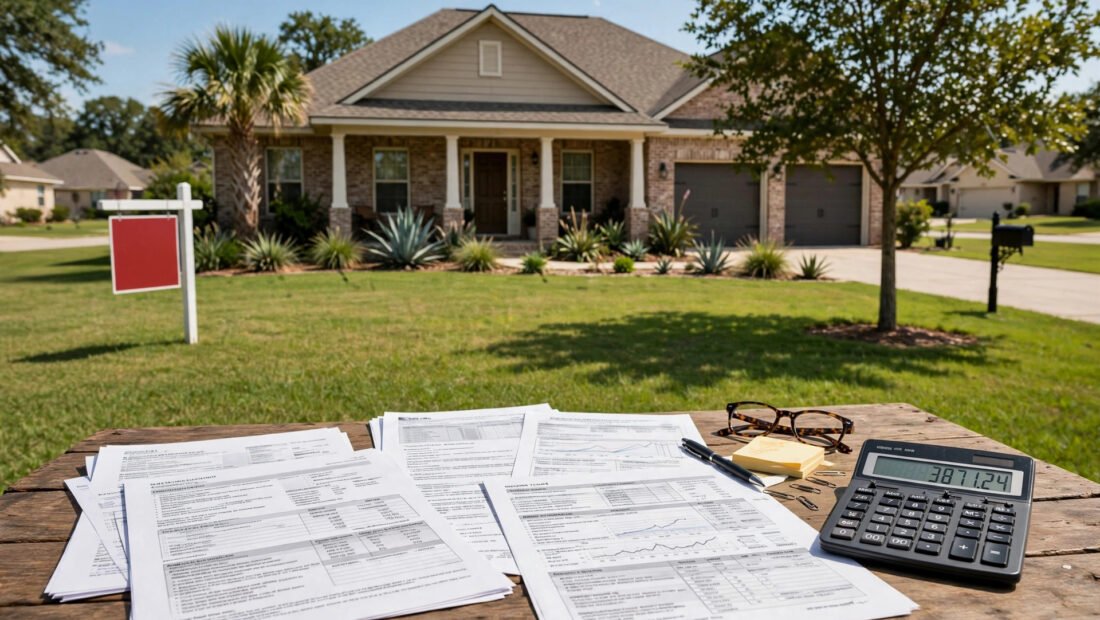
Two buyers close on the same street in Texas, on houses that cost the same, in the same week. One takes a 15-year mortgage. The other takes a 30-year. On paper the second loan looks like the worse deal by a wide margin, because over its full life it costs roughly twice the interest of the first. Yet plenty of smart first-time buyers pick the longer loan on purpose, and some of them come out ahead. The term you choose is not a test of who is good with money. It is a trade between a lower monthly bill now and a much lower total cost later, and the right side of that trade depends on your pay, your savings, and how steady your life looks for the next few years.
Start with one shared example so the trade is easy to see. Take a $350,000 loan. At illustrative rates of about 6.0 percent for a 15-year loan and about 6.75 percent for a 30-year loan, the 30-year payment for principal and interest is around $2,270 a month, and the total interest over 30 years comes to about $467,000. The 15-year payment is around $2,953 a month, and the total interest is about $181,000. The gap is close to $286,000 in interest saved, plus a home owned free and clear 15 years sooner. The 15-year also costs about $680 more every single month. Both of those facts are true at once, which is why the choice is harder than the headline number suggests.
The 15-year mortgage: the case for it
The strongest point in favor of the 15-year loan is the interest saving itself. A shorter term attacks the balance fast. In the early years of a 30-year loan, most of each payment goes to interest and the balance barely moves. With a 15-year loan, a much larger share of every payment goes to principal from the first month. Equity builds quickly, which matters if you need to sell in five or seven years. You leave with more of the sale price in your pocket instead of handing most of it to the lender.
The rate helps too. Fifteen-year rates typically run 0.5 to 0.75 percentage points lower than 30-year rates, because a lender who gets repaid sooner takes less risk. That lower rate and the shorter term work together. You pay less interest per dollar borrowed, and you borrow for half as long.
There is also a behavior point that is easy to underrate. The higher payment is forced saving. Nobody has to remember to send extra money or resist spending it. The loan simply takes the larger amount each month and turns it into ownership. For a household that knows extra cash tends to leak away on small upgrades and eating out, that built-in discipline has real value.
Being done sooner changes later life in a practical way. A buyer who closes at 35 and takes a 15-year loan is mortgage-free at 50. That frees a large monthly sum well before retirement, at an age when college costs, parent care, or a career change often show up. There is no investment return to calculate there. It is cash flow and peace of mind.
The 15-year mortgage: the case against it
The monthly cost is the obvious problem, and in Texas it is bigger than the loan payment alone suggests. Property taxes run about 1.6 to 2.2 percent of a home’s value each year, and there is no state income tax to soften that. On a $350,000 home, taxes alone can add roughly $500 to $650 a month. Add homeowner’s insurance, which is costly in hail and hurricane country, and the true monthly cost of the 15-year option can push well past what a first-time buyer’s budget can carry safely.
A tight payment also crowds out other goals. If the extra $680 a month means retirement saving drops below a healthy level, or the emergency fund never gets built, the interest saved on the house can be lost elsewhere. A house is hard to tap in a hurry. Home equity is not an emergency fund, and a buyer who is house-rich and cash-poor is exposed the first time a roof leaks or a job ends.
Flexibility is the other cost. The $2,953 payment is owed in good months and bad ones. A layoff, a medical bill, or a cut in hours does not lower it. Missed mortgage payments damage credit fast and, if the problem lasts, put the home itself at risk. A first-time buyer with variable income, a single income, or a job in a shaky industry should weigh that risk with care.
The 30-year mortgage: the case for it
The lower payment is the whole point, and it buys real things. It buys room to fund a retirement account, especially an employer plan with a match. It buys a bigger emergency cushion. It buys the ability to absorb a bad month without panic. For many first-time buyers, it also buys the house itself, since lenders qualify you on the payment. A lower required payment can be the difference between qualifying and not qualifying.
Time also softens a fixed payment. A payment that feels large in year one tends to feel smaller in year twelve, because pay often rises while the loan payment for principal and interest stays the same. Taxes and insurance can rise, but the loan part does not. Over a long stay, that slow easing is worth something.
The longer loan keeps options open for the money that is not going to the lender. Some buyers use the difference to build savings first, then decide later whether to invest it or send it to the loan. That question, pay off your mortgage early or invest: the real math, depends on your rate, your tax picture, and your comfort with risk, and it is worth running your own numbers rather than copying someone else’s answer.
The 30-year mortgage: the case against it
The total interest is hard to ignore. In the example above, the 30-year loan costs about $467,000 in interest on a $350,000 loan. You pay more in interest than you borrowed. If you stay in the home for the full term and never pay extra, that is the real price of the lower monthly bill.
Equity also builds slowly at first. In the early years the balance drops so little that a buyer who sells after three or four years may find that selling costs and a flat market eat most of what was paid in. That matters for buyers whose jobs or family plans may force a move.
The last weakness is human. The plan to invest the difference or pay extra later only works if it actually happens. For many households the difference quietly becomes spending. After ten years there is no investment account to show for it and no extra principal paid. The 30-year loan does not fail on math in those cases. It fails on follow-through.
A middle path worth knowing
Most 30-year mortgages allow extra principal payments without a penalty, though you should confirm that in your own loan papers before counting on it. That opens a middle path: take the 30-year loan for the lower required payment, then pay extra toward principal in months when money allows. An extra $500 a month, sent steadily and marked as principal only, shortens the loan by years and cuts a large share of the interest, while the required payment stays low enough to survive a rough stretch.
This path asks for the discipline the 15-year loan builds in for free. The fix is to automate it. Set the extra payment to leave your account on payday, the same day the regular payment is due, and treat a pause as a deliberate choice for a hard month rather than the new default.
Before signing either way, run both loans side by side with your real price, your real tax estimate, and your real take-home pay, using the CFPB’s mortgage comparison guidance as a neutral starting point. Lender quotes can differ, so compare the same two terms from the same lender and from at least one other lender.
Verdict for first-time buyers in Texas
Choose the 15-year loan if the full payment, taxes and insurance included, sits under about 25 to 28 percent of your take-home pay, if you already hold about six months of expenses in savings, if your income is steady, and if retirement saving can stay at 15 percent or more of pay even with the higher payment. When all four are true, the 15-year is usually the stronger choice. The interest saving is huge, the risk is contained, and the loan ends while you still have years to use the freed-up money.
Choose the 30-year loan if the 15-year payment would squeeze retirement saving, leave savings thin, or rest on overtime and bonuses to work. Choose it if your income varies, if you are buying near the top of what you can qualify for, or if this first home is likely a five-to-seven-year home rather than a long-term one. In Texas, where property taxes add hundreds a month before you spend a dollar on upkeep, breathing room is not a luxury for a new owner. It is protection.
Either way, judge the loan by the total monthly cost of owning, not the loan payment alone, and leave money aside for the repairs and bills that show up in the first year of any home. The cheaper loan on paper is only the smarter buy if you can carry it without starving every other part of your financial life.