
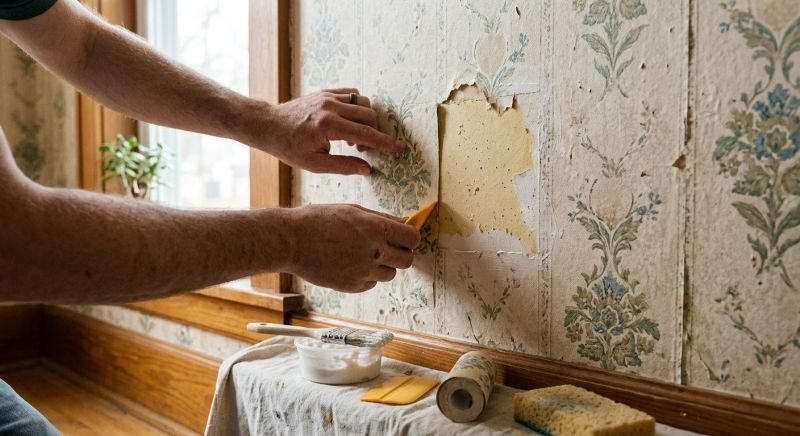
Our dining room had three layers of wallpaper, the oldest from the 1970s with a pattern that can only be described as aggressive. I spent a full Saturday learning that wallpaper removal is 10% technique and 90% patience, and that rushing is how walls get gouged.
How to remove old wallpaper without damaging walls depends on what kind you have and how it was installed. Here is the decision tree.
How Can I Remove Old Wallpaper Without Damaging Walls?
Start by identifying the wallpaper. Try peeling a corner: if the top vinyl layer pulls away leaving a paper backing, you have strippable or peelable wallpaper and you have won the lottery; pull the face off, then soak and scrape the backing. If nothing peels, you likely have traditional paper or grasscloth glued directly, and you will need moisture plus patience. Test a hidden spot with warm water: if the paper darkens and bubbles, water will work; if water beads off, you need a scoring tool first.
The core method is steam or hot water plus a scoring tool. How can I remove old wallpaper without damaging walls using steam? Score the surface lightly with a Paper Tiger tool (tiny perforations, not gashes), then apply steam with a rented wallpaper steamer ($50/day) or hot water with a sponge, working in 3-foot sections. Wait for the paste to soften, then scrape with a flexible putty knife held at a low angle. The steamer is dramatically faster than sponges for large areas and worth every penny of the rental.
- Test-peel a corner first. Strippable wallpaper pulls off dry. Know what you are fighting before choosing weapons.
- Score before soaking. Paper Tiger perforations let moisture reach the paste. Light pressure; gouges are forever.
- Steam beats sponges for big jobs. $50/day rental. Dramatically faster on whole rooms.
- Work in 3-foot sections. Soak, wait, scrape. Do not soak the whole wall at once.
- Scrape at a low angle. Flexible putty knife nearly flat to the wall. Steep angles gouge drywall.
- Keep the wall damp, not soaked. Saturated drywall bubbles and tears. Damp softens paste; soaked destroys walls.
- Clean paste residue after. Warm water and sponge the bare wall. Leftover paste ruins new paint.
- Prime with oil or shellac primer. Seals residual paste and stains. Then paint normally.
The damage usually comes from impatience: scraping before the paste softens, gouging with steep knife angles, or soaking drywall until the paper facing bubbles. If the drywall facing tears, let it dry completely, seal with oil-based primer, skim-coat with joint compound, sand, and prime again. Small tears are fixable; the key is stopping, letting things dry, and repairing rather than powering through wet.
When to Stop and Call a Pro (or Paint Over It)
Some wallpaper situations are not worth DIY: plaster walls with crumbling surfaces underneath, wallpaper applied directly to unprimed drywall (the facing tears off with the paper), or multiple painted-over layers fused into a single archaeological stratum. In these cases, a professional wallpaper remover ($300-$600 per room) has the experience to minimize damage, or the pragmatic alternative is skim-coating the whole wall and starting fresh.
Painting over wallpaper is the controversial shortcut. It works acceptably when the paper is firmly adhered, flat, and in good condition: seal seams, skim-coat the edges, prime with oil-based primer, and paint. It fails when the paper is loose, textured, or vinyl-coated. It is a compromise, not a best practice, but for a firmly-glued flat paper in a low-visibility room, it is a defensible one.
Quick Answers to Common Questions
What is the fastest way to remove wallpaper?
A wallpaper steamer after scoring. It softens paste in seconds per section versus minutes with sponges. For whole rooms, the $50 rental pays for itself in saved hours.
Will removing wallpaper damage drywall?
It can, if rushed. Soak adequately, scrape at low angles, and never saturate the wall. Minor facing tears are repairable with primer and skim coat.
Can I use fabric softener to remove wallpaper?
The popular DIY mix (fabric softener and hot water) works as a paste softener for some papers, but plain hot water or commercial remover works as well without leaving residue that can affect new paint.
How do I remove wallpaper border?
Same techniques on a small scale: score, soak with hot water, scrape gently. Borders often come off easier than full walls since there is less area fighting you.
My Wallpaper Removal Checklist
- Test-peel and water-test first. Know your wallpaper type before choosing method.
- Score lightly. Perforations, not gashes. Let moisture reach paste.
- Rent the steamer for big rooms. $50/day. Worth every penny.
- Scrape low and slow. Flexible knife, shallow angle, 3-ft sections.
- Clean, prime, repair. Remove paste residue, seal with primer, skim tears.
What I Would Do Next
The dining room took a full weekend and revealed perfectly good plaster underneath, which we painted a warm white that made the room feel twice as large. The aggressive 1970s pattern is gone, but I kept one square framed in the closet as a trophy. Some wallpaper removals are renovations; this one was an exorcism, and the steamer was the hero.
How to remove old wallpaper without damaging walls: identify the type, score lightly, steam in sections, scrape at low angles, and never soak the wall. Patience is the technique.
Rent the steamer, embrace the slowness, and reveal what is underneath.
For painted-over wallpaper, the calculus changes: the paint layer blocks moisture from reaching the paste, so scoring must be aggressive and steam sessions longer. Some pros recommend a chemical wallpaper remover gel for painted paper, applied after heavy scoring. If the paper was painted with oil-based paint, removal becomes genuinely miserable, and skim-coating over it starts looking like the rational choice rather than the lazy one.
Related reading: How Do I Find Good Local Restaurants While Traveling.
Related reading: What Is the Best Way to Pack Souvenirs without Breaking Them.
Related reading: How Do I Make Crispy Fried Chicken at Home.
For official guidance, check out EPA guidance on indoor air quality and Family Handyman project walkthroughs.



