
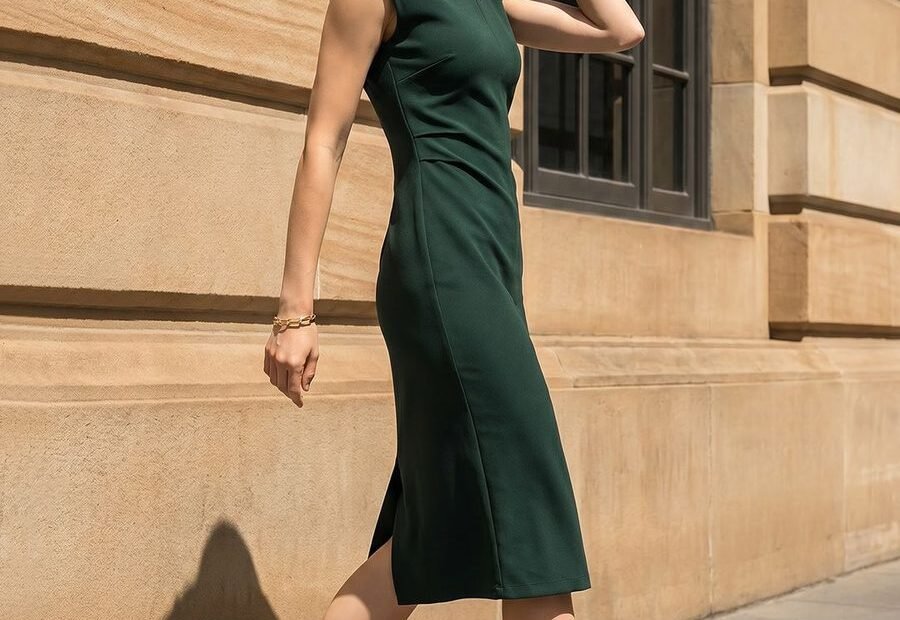
Short answer: pair a midi dress with shoes that either show the ankle cleanly or cover the leg deliberately — pointed flats, heeled sandals, sleek sneakers, or boots whose tops disappear under the hem. The midi is the most shoe-sensitive length in the wardrobe because its hem ends mid-calf, at the widest part of the lower leg, exactly where a badly chosen shoe draws a second horizontal line and chops the leg into segments. Every pairing below is really the same decision in different seasons: where does the eye’s line down the leg get interrupted, and by how much?
Why the ankle decides everything
A mini dress shows the whole leg; a maxi hides it. The midi negotiates: the visible leg is a short column from hem to shoe, and anything that bands across that column shortens it visually. This is why ankle straps come with a caution label on midi lengths. A strap circling the ankle — at the exact point where the leg is narrowest and the line most elegant — cuts it, and on a mid-calf hem the double interruption (hem above, strap below) can take visible inches off the wearer’s height. The strap is not banned; it is taxed. It works when the heel is high enough to restore the line, when the strap is thin or skin-toned, or when the dress’s hem sits higher, above the calf’s widest point. Otherwise, the same sandal without the strap flatters more. Silhouette literacy in general — which lengths want which proportions — is the foundation here, and MasterClass’s guide to dress types and silhouettes maps the midi’s proportions against the other classic lengths.
Heels: match the dress’s mood, not just its color
Heels are the midi’s oldest partner, and the pairing rule is mood before color. A pointed pump extends the leg’s line to a vanishing point and suits structured, tailored midis — the work-and-evening versions discussed in how to style the same dress for work and evening, where the heel swap does the day-to-night conversion. A strappy heeled sandal suits fluid, romantic midis and keeps the visible leg maximal. A block heel grounds prairie and retro dresses, whose volume would fight a stiletto’s sharpness. In each case the heel also does structural work: lifting the hem a few inches off the calf’s widest point, which is half the battle won by posture rather than by shoe design. Kitten heels are the compromise candidate — most of the line, little of the suffering — and they are chronically underrated for exactly this length.
Boots: the fall midi uniform
Boots solve the midi’s cold-weather problem completely, by removing the visible-leg column from the equation. Two configurations work. Ankle boots with a slim shaft and a heel, worn with a small gap of leg or tights between boot top and hem — the boot must hug the ankle, since a wide shaft at the calf’s widest zone doubles it. Or tall boots whose tops go under the hem, so dress and boot overlap into one continuous column with no interruption at all: the most lengthening winter pairing there is, and the answer to the tall-boots question before it is asked. Suede reads soft against knit midis; polished leather sharpens them. What fails is the in-between boot — mid-calf height meeting a mid-calf hem — two bands at the same altitude, arguing.
Sneakers and flats: yes, with rules
The sneaker-and-midi pairing is established now, and its rules are consistent: the sneaker must be clean, low-profile and minimal — a slim white leather court shoe, not a chunky trainer — and the dress should carry some structure or polish elsewhere so the combination reads as a decision. Flat shoes generally, from pointed flats to loafers, suit midis whose hems sit above the calf’s widest point or whose wearers are tall enough to spend the inches. The nude-to-you shoe is the quiet cheat code across all flat categories: a shoe matched to your skin tone removes the interruption entirely, the leg line runs unbroken to the toe, and the pairing flatters every midi in the closet regardless of its mood.
The hem-height matrix: not all midis are the same midi
“Midi” covers three different garments, and they want different shoes. The high midi, ending just below the knee or at the upper calf, is the most forgiving: the visible leg is long, the calf’s widest point may be covered or just revealed, and almost every shoe family works, including the ankle strap that longer midis tax. The true midi, ending at mid-calf — the widest point — is the strict one the rules above were written for: it needs the pointed toe, the nude finish, the disappearing boot, or the heel’s lift, and it punishes mid-calf boots and wide ankle straps without appeal. The long midi or maxi-midi, ending at the ankle bone, behaves like a maxi with better mobility: it wants the shoe mostly hidden or deliberately minimal — a slim sandal, a sleek boot underneath — and it forgives sneakers best of all, because the column of dress does the lengthening work itself. When a pairing fails mysteriously, the diagnosis is usually here: the shoe was chosen for “a midi” and the dress was a different midi. Measure the hem against your own leg, not the model’s, since the same dress is a high midi on one body and a true midi on another.
Color and finish: the shoe as punctuation
The second decision is what the shoe says at the end of the sentence. A shoe in the dress’s own color family extends the outfit into one long statement — elegant, lengthening, safe. A shoe in a deliberate contrast — black with a floral, red with a navy, metallic with everything — punctuates: it ends the dress decisively and makes the shoe a chosen accent, which works when the rest of the outfit is quiet enough to let it. The failure mode sits between them: the almost-matching shoe, close in color but off in tone, which reads as an accident rather than either decision. Finishes obey the same logic: patent and metallic raise formality, suede lowers it a notch, and a scuffed anything lowers it below the floor. Choose the punctuation first — extend, accent, or contrast — and let the specific shoe be whatever executes it. The midi, indifferent to fashion cycles, will keep asking its one question, and these are all the shapes the answer takes.
The monochrome option: one long line, head to toe
There is a pairing strategy that sidesteps most of the rules by dissolving the problem: dress in a single color family from shoulder to shoe. A black midi with black boots or black pointed flats, a cream knit midi with nude-to-you heels, a navy dress with navy suede — in monochrome, the interruption points vanish because there is no contrast to interrupt with, and the eye reads one column of color whose length is the whole figure. It is the most reliably lengthening way to wear the strict true midi, it forgives the ankle strap and the mid boot that polychrome outfits prosecute, and it is why stylists reach for it when a dress’s proportions are fighting back. Its only cost is a certain severity, answered by texture: matte knit against polished leather, ribbed against smooth. When a midi keeps defeating your shoe rack, stop changing the shoes. Change the color logic.
Proportion at the extremes: petite and tall
The rules were written for the middle of the height range, and both ends adjust them in the same direction: the hem’s landing point matters more than the dress’s nominal length. On a petite frame, a true midi can land at the ankle and become a maxi with ideas above its station — the fix is choosing the high midi, or hemming the true midi up to just below the knee, restoring the leg the design intended to show. On a tall frame, a high midi can land above the knee and read as a different, shorter dress — which is fine if intended, and the true midi that lands mid-calf is often the tall wearer’s most elegant option, with the full shoe rules applying. In both cases the mirror test is the hem against the calf: wherever the dress ends, that is the midi you are styling for. Buy the landing point, not the label.
Quick questions
Can I wear flats with a midi to a wedding? Yes — pointed, polished flats in a dressy finish (satin, metallic, patent) with a formal midi are entirely wedding-appropriate, and kinder than heels across a six-hour event. Avoid casual ballet flats and anything scuffed; formality lives in the finish.
What about tall boots with a midi in spring? The under-hem configuration works whenever the boot is sleek and the dress is light — a knee boot in a pale or matching tone under a floral midi is a legitimate spring outfit. Heavy black boots under a light dress need the dress to have some weight or darkness of its own to balance.
Do tights change the rules? They relax them. Sheer black tights unify the column so ankle straps and mid boots stop interrupting; opaque tights in the dress’s color family do the same in winter. A contrasting tight reinstates every band the shoe creates — choose accordingly.
The midi asks one thing of its shoes: decide where the leg’s line ends, and end it cleanly — at a pointed toe, under a hem, or not at all. Every successful pairing above is that decision, dressed for a different season.

2 comments