
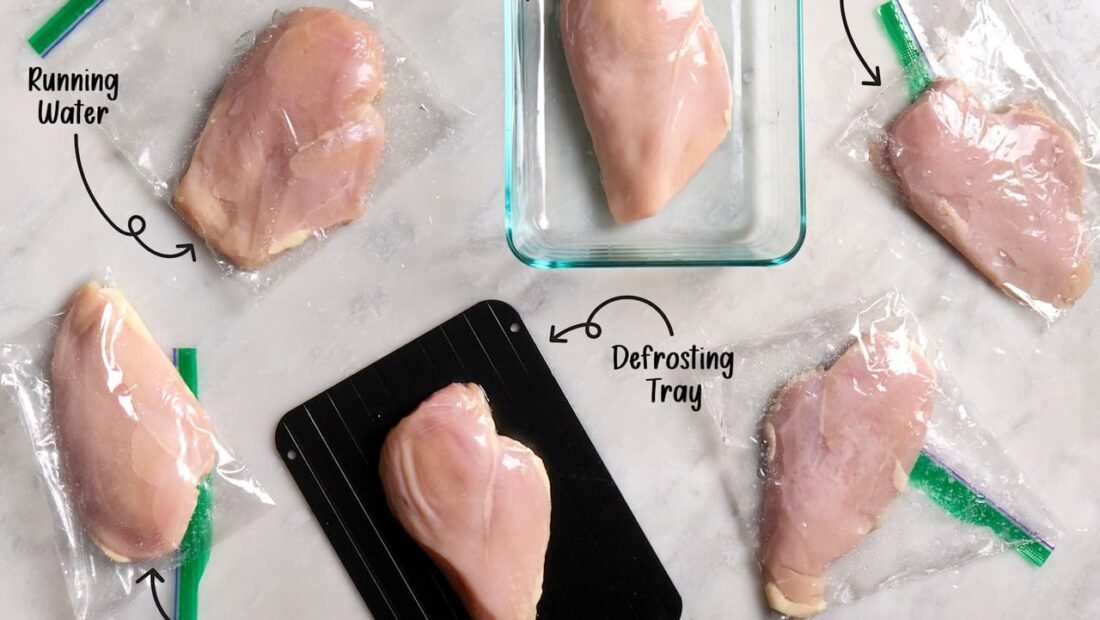
It’s 5 p.m., dinner is supposed to be chicken, and the chicken is a rock-solid brick in your freezer. We’ve all been there. The temptation is to leave it on the counter and hope for the best — but that’s exactly how food poisoning happens, and there’s a faster method anyway.
The best way to thaw frozen meat quickly and safely is the cold water method: sealed meat submerged in cold water, changed every 30 minutes. It’s dramatically faster than the fridge, completely safe when done right, and it works for everything from chicken breasts to steaks to ground beef. Here’s the full method, the timing, and the dangerous shortcuts to avoid.
The Cold Water Method: Best Way to Thaw Frozen Meat Quickly and Safely
Put the frozen meat in a leak-proof bag — squeeze out the air and seal it tight. Submerge the bag in a large bowl of cold tap water, making sure the meat stays fully underwater (a plate on top helps). Change the water every 30 minutes so it stays cold. A pound of chicken breasts or ground beef thaws in about an hour; a 3 to 4 pound roast takes 2 to 3 hours. Small items like shrimp or thin fillets can thaw in under 30 minutes.
Why cold water and not warm? Cold water conducts heat about 25 times better than air, which is why this beats counter-thawing on speed — but it stays cold enough to keep the meat’s surface out of the bacterial danger zone (40°F to 140°F). Warm or hot water would thaw the outside into the danger zone while the inside stays frozen. Cold water is the sweet spot: fast heat transfer, safe temperatures. Cook the meat immediately after thawing — don’t refreeze it raw.
The Fridge Method (Safest) and the Microwave (Fastest)
The refrigerator method remains the gold standard for safety: move meat from freezer to fridge and let it thaw slowly, about 24 hours per 4 to 5 pounds. It’s completely hands-off and the meat stays safe for a day or two after thawing. The only cost is planning — which is exactly what failed us in the 5 p.m. scenario. Pro tip: move tomorrow’s meat to the fridge tonight, every night, and you’ll rarely need emergency methods.
The microwave’s defrost setting is the fastest option — minutes, not hours — but it’s the trickiest. Microwaves thaw unevenly, leaving some spots partially cooked while others stay frozen. If you use it, cook the meat immediately afterward, no exceptions, because those warm spots are bacterial playgrounds. It’s a fine last resort for ground meat or chicken pieces you’ll cook right away; I’d avoid it for thick steaks where uneven thawing ruins the cook.
Reference: USDA: The Big Thaw — safe thawing methods.
Reference: FoodSafety.gov on safe food handling.
Thawing Safety Rules
From the USDA’s food safety guidance — these are non-negotiable:
- Never thaw meat on the counter. Room temperature puts the surface in the danger zone (40–140°F) for hours — this is the number-one thawing mistake.
- Never use hot water. It thaws the outside into the danger zone while the center stays frozen.
- Keep meat in leak-proof packaging during cold-water thawing so water doesn’t touch the meat and bacteria can’t spread.
- Change the cold water every 30 minutes to keep temperatures safe and thawing efficient.
- Cook cold-water- or microwave-thawed meat immediately. Fridge-thawed meat can wait a day or two.
- Don’t refreeze raw meat thawed by cold water or microwave without cooking it first. Fridge-thawed meat can be refrozen safely.
- When in doubt, cook from frozen. It’s safe — just add about 50% more cooking time and use a thermometer to verify doneness.
Cooking From Frozen: The Underrated Option
Here’s the secret the 5 p.m. panic doesn’t want you to know: you can often skip thawing entirely. The USDA confirms it’s safe to cook meat from frozen — you just need about 50% more cooking time. Frozen chicken breasts go straight into the oven or Instant Pot. Frozen ground beef can be browned from frozen with a bit of patience. Steaks can even be seared from frozen with excellent results (some chefs prefer it — the frozen interior gives you more time to build a crust before the center overcooks).
The main limitation is even cooking and seasoning — marinades won’t penetrate frozen meat, and very thick cuts cook unevenly. But for weeknight practicality, cooking from frozen beats risky counter-thawing every single time. Keep a thermometer handy, verify the internal temperature, and dinner is saved without any thawing at all.
Quick Answers to Common Questions
Is it really unsafe to thaw meat on the counter?
Yes — genuinely. The surface of counter-thawing meat sits in the bacterial danger zone (40–140°F) for hours while the center thaws, and bacteria double roughly every 20 minutes in that range. It might look and smell fine while harboring dangerous levels of bacteria. The cold-water method is actually faster than the counter anyway, so there’s no reason to risk it.
Can I refreeze meat after thawing it?
It depends on how you thawed it. Fridge-thawed meat can be refrozen safely (with some quality loss). Cold-water or microwave-thawed meat should be cooked before refreezing — don’t return it to the freezer raw. And meat thawed on the counter shouldn’t be refrozen or eaten; when food safety is uncertain, throw it out.
How long does meat take to thaw in the fridge?
About 24 hours for every 4–5 pounds — so a pound of chicken breasts thaws overnight, while a 12-pound turkey needs 3 days. Plan backwards from dinner: move tomorrow’s meat to the fridge tonight, every night, and emergency thawing becomes rare. A whole turkey needs serious advance planning — check a thawing chart, not your optimism.
More from Daily USA Post
- Our complete guide: what are the best true crime podcasts for beginners
- how can I watch local news without a cable subscription — what you need to know
- Keep reading: how do I start collecting vinyl records on a budget
The best way to thaw frozen meat quickly and safely is sealed in cold water, changed every 30 minutes — about an hour per pound. The fridge method is safest when you plan ahead; the microwave works only if you cook immediately after. Never use the counter or hot water, and remember that cooking from frozen is always a safe backup. Set a nightly reminder to move tomorrow’s meat to the fridge, and the 5 p.m. panic becomes a rare event.




2 Comments