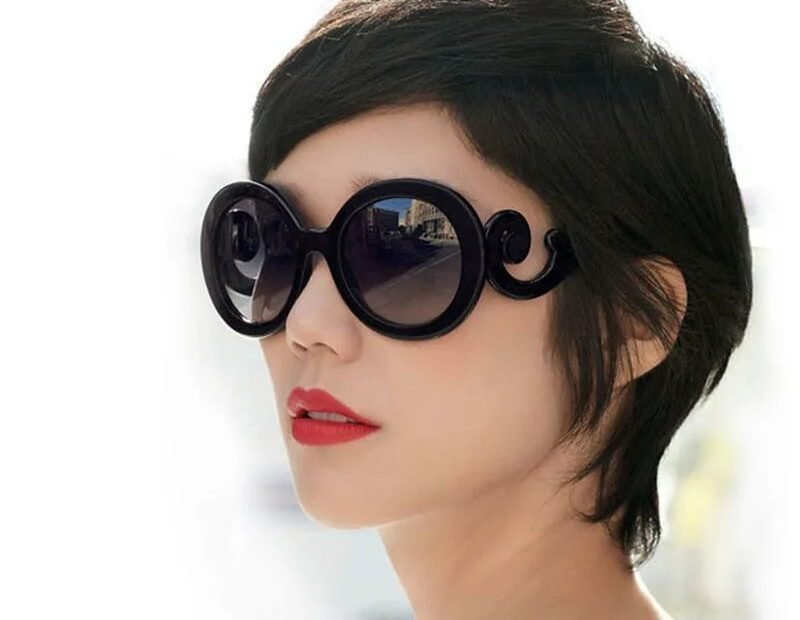
Every pair you try on somehow makes your face look rounder than it did bare. That is the round-face sunglasses paradox: the most common shapes in the shop — round, small, soft — are drawn from the same geometry as the face itself, so they repeat it instead of answering it. A round face has no weak features to hide; it has curves that want one straight line to argue with. The right frames supply contrast: angles against curves, width against fullness, an upswept corner against a soft jaw. Five frame families compete for the job. Weighed one by one, the ranking is clear — and the pair to avoid is as important as the pair to buy.
The ground rule: width matters more than height
Before shapes, one measurement governs everything. Frames for a round face should be as wide as the face, or slightly wider — never narrower. A narrow frame squeezes the widest part of the face outward around it, exaggerating fullness, while a frame that meets or slightly exceeds the face’s width contains it. Tall lenses are the second trap: depth adds to the round read, so prefer frames wider than they are tall. Keep those two rules and even an imperfect shape behaves; break them and even the right shape fails. In the shop, judge from the front, in the mirror, at arm’s length — and use the phone-photo test before buying: a front-facing photo flattens the compliments of a three-quarter mirror angle and shows you the face the world and every future photo will see, including the ones planned in what to wear for family photos at the beach.
Rectangular and square frames: the default answer
Straight lines are the direct antidote to curves, and rectangular frames are the most reliable choice for a round face. The corners interrupt the face’s outline, the horizontal emphasis widens rather than rounds, and the effect reads as definition — cheekbones appear, the jaw gains intent. Wayfarer-style trapezoids belong to this family and add a slight downward widening that flatters most round faces. Choose medium to bold acetate over thin wire versions: the frame needs enough presence to hold its line against a full cheek. If you buy one pair and stop reading here, buy these.
Cat-eye and upswept frames: the lift
Frames that sweep upward at the outer corners — cat-eyes, upswept rectangles, anything with a lifted browline corner — perform a small optical lift on the whole face. The rising line draws the eye up and out, lengthens the read of the face, and sharpens the cheek area below it. This family is the most expressive of the options: a gentle upsweep is office-safe, a dramatic one is a style statement. On round faces it is also the most forgiving family for smaller sizes, since the upsweep supplies the width cue that a smaller frame otherwise lacks — but hold the width rule anyway. Dark colors in this shape define most strongly; the color rule comes below.
Browline frames: structure on top, air below
Browline (clubmaster-style) frames put a bold, straight bar across the top and keep the lower rim light or rimless. For a round face this is clever engineering: the strong top line supplies the angle, while the open lower half avoids adding weight around the cheeks and jaw, where a full thick frame can double the roundness it was meant to correct. They suit people who found full rectangles too heavy or too severe. The one caution is proportion — the top bar should sit at or just above your natural brow, not float high on the forehead.
Aviators: the conditional yes
Do aviators work on a round face? Conditionally. The classic teardrop is a curve, and small aviators repeat the face’s geometry and fail. But large aviators with a straighter top bar and an angular or squarer lens variant pass the tests that matter: width at or beyond the face, a straight line across the brow, enough scale to hold their own. If your heart is set on them, choose the biggest, squarest version in the line and check it in a front photo. And whatever the shape, the lenses must do the actual job of sunglasses — full UV protection, which the eye-health guidance in the American Academy of Ophthalmology’s sunglasses advice sets out plainly: fashion shape comes first here, but UV400 or 100% UV protection is the non-negotiable under it, and polarized lenses are a comfort upgrade for glare, not a protection one.
Lens color: the dial nobody mentions
Frame shape gets the debate, but lens tint quietly changes how a face reads. Dark neutral lenses — grey and green-grey — deepen the frame’s defining effect and suit the contrast strategy best, because they let the frame’s line do the talking. Brown and amber lenses warm everything, including your skin tone, and pair well with tortoise frames. Mirrored and heavily colored lenses move the statement from the frame to the lens: they can absolutely work, but they become the outfit’s loudest element, which is a different purchase decision from flattering shape. Gradient lenses, dark at top and lighter below, are the pragmatic middle — full glare protection where the sky is, lighter where you read a menu or a dashboard. Choose the tint after the shape, in daylight, by the same front-facing photo rule: the mirror lies about color less than about shape, but it still flatters.
The try-on protocol: five checks in the shop
Run the same five checks on every candidate pair. One, the width check: frame edges should meet or just exceed your face’s widest point, seen straight on. Two, the brow check: the top bar should follow your brow line, sitting at or slightly above it — a frame that floats high looks surprised, one that cuts across the brow looks stern. Three, the cheek check: smile; if the lower rim rides up onto your cheeks, the fit or the shape is wrong and it will annoy you by noon. Four, the nose check: bridges that slip will slip forever, and on sunglasses there is no nose-pad adjustment on most acetate frames — a sliding pair is a rejected pair. Five, the photo check: one front-facing phone photo, no angle, no mercy. A pair that passes all five, in one of the recommended families, in your preferred tint, is not a lucky find. It is a correctly run protocol.
Face-shape honesty: round, or just round-ish?
One diagnostic caution before the ranking hardens, because self-diagnosed face shape is unreliable and the wrong label buys the wrong frames. A genuinely round face is about as wide as it is long, with full cheeks and no strong angles at jaw or forehead. An oval face is longer than it is wide, and it can wear almost anything — including, notably, the rounder frames banned here. A square face has the angles a round face lacks, and it wants the opposite prescription (softer, rounder frames) — which is why borrowing a friend’s flattering pair is such a unreliable test when your shapes differ. The mirror test that sorts it out: trace your face’s outline with a finger or a dry-erase marker on the mirror, step back, and look at the shape rather than the person. If the outline is a circle, the advice above is yours. If it is an oval or a rectangle wearing a round reputation, take the width rule, keep the try-on protocol, and let the shape rules soften accordingly.
One frame or two: the small rotation
A practical closing note on quantity. A round face is best served by two frames in rotation rather than a growing collection: one dark, structured everyday pair built on the first recommendation above, and one lighter or more expressive pair for variety — the metal geometry or the colored acetate. Two pairs also halve each pair’s wear, and sunglasses die mostly by accumulation: scratches, loosened hinges, the sat-on incident. Buy the everyday pair with real care for fit and lens quality, since it will mediate most of your sunny hours, and let the second pair be the experiment where a bolder color or a squarer line gets its chance. If the experiment wins compliments for a season, it graduates. This is the same edited-wardrobe logic that governs shoes and bags, applied at eye level: fewer, better, actually worn.
What to leave on the shelf, and the color rule
The rejected family is small round and oval frames — the Lennon circle and its soft cousins. They mirror the face’s own shape, shorten it, and round it further; on a round face they are the only genuinely wrong answer. Small frames of any shape fail the width rule and join them. Color is the last dial: dark frames — black, deep tortoise, espresso — define and sharpen, adding the contrast round faces benefit from; pale, clear and pastel frames soften and recede, which some wearers prefer for a gentler effect, at the cost of the definition the shape was chosen to create. Prescription wearers follow the same rules with one addition: high prescriptions thicken lens edges, so choose acetate frames with enough rim to hold the edge, and ask the optician about lens thinning. The recommendation stands as ranked: rectangular for reliability, upswept for lift, browline for lightness, aviators only in their large angular form — and round frames for round faces, never.