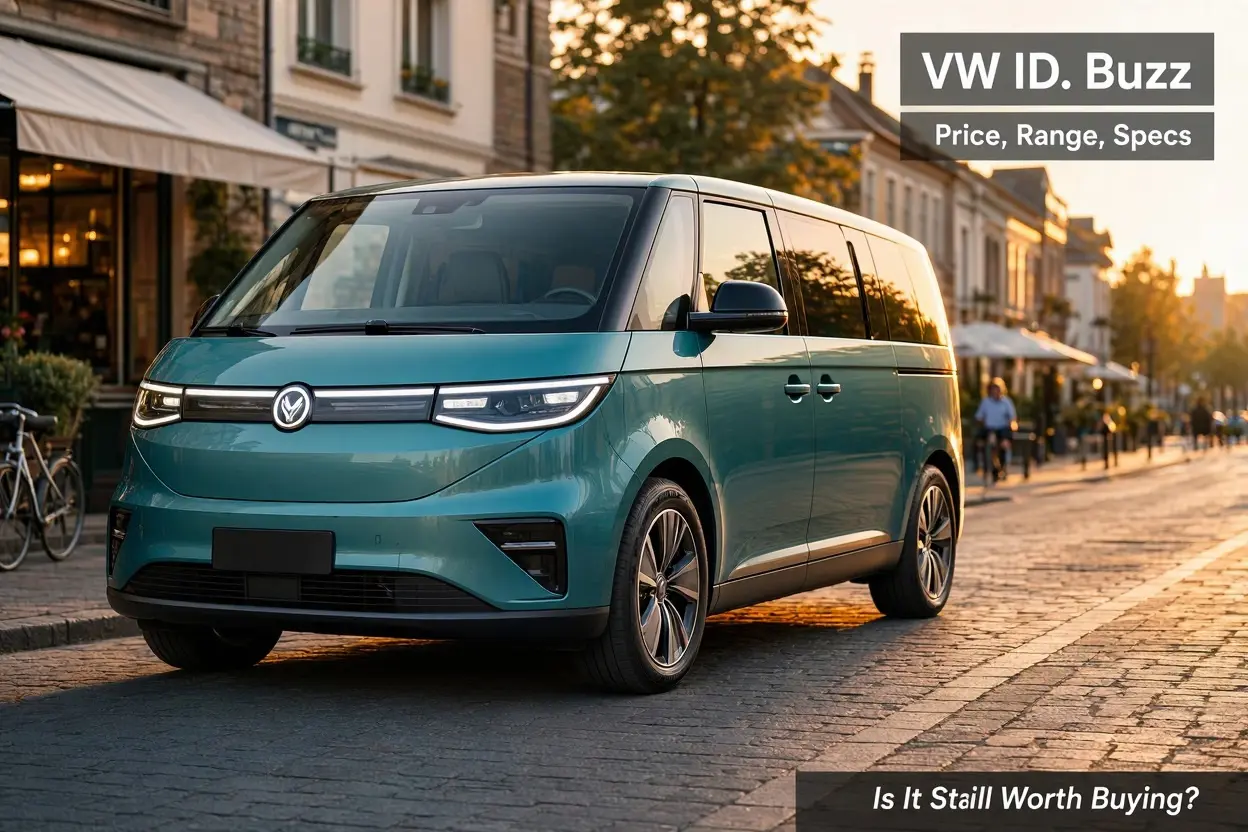
It usually goes like this: you fall for the two-tone paint and the bus-shaped charm in photos, you find one on a dealer lot, and then you read the window sticker — $61,545 for the base model, once the destination fee is added — and feel your enthusiasm wobble. The VW ID. Buzz asks a lot of money for a van, even an electric one. So is it still worth buying? Run the checklist below and you will have your answer by the end, because the Buzz is a wonderful vehicle for some buyers and a poor deal for others, and the difference is entirely in the details.
The ID. Buzz Buyer’s Checklist
- ☐ Your real price is the sticker plus $1,550 destination — but dealers have discounted these, so never treat MSRP as final
- ☐ EPA range is 234 miles (rear-wheel drive) or 231 miles (all-wheel drive) from a 91-kWh battery — fine for most weeks, tight for road-trip duty
- ☐ Fast charging takes you from 10% to 80% in about 26 minutes on a DC fast charger
- ☐ You actually need three rows / van space — if not, cheaper EVs do the rest better
- ☐ It is a big vehicle in parking garages and old driveways — check your space
- ☐ You have compared it honestly against the Kia EV9, which offers more range for similar money
- ☐ You understand US availability has been stop-start, with model years skipped — confirm what your dealer can actually sell you
The Price, Without the Gloss
At launch in the US, the ID. Buzz Pro S started at $59,995, the Pro S Plus at $63,495, and the launch-only 1st Edition at $65,495 — all before destination. Add the $1,550 destination charge and the base van is a $61,545 purchase, with well-optioned examples passing $70,000. That is serious money, and it is the single biggest argument against the Buzz.
But the launch story is not the 2026 story. The Buzz sold slowly at those prices, and dealers responded the way dealers do: by 2026, listings for the Pro S around $48,000–$49,000 — roughly $15,000 under the original sticker — have been spotted at US dealerships. That gap matters enormously to the verdict. At $61,545 the Buzz is a boutique purchase competing against better-value rivals; at $48,000 it becomes a genuinely interesting one. Your first job as a buyer is finding out which price your market is on. Full specs and trim details live on Volkswagen’s official ID. Buzz page.
Range and Charging: the Honest Numbers
The US-market Buzz carries a 91-kWh battery. The EPA rates it at 234 miles of range in rear-wheel-drive form and 231 miles with all-wheel drive. Two honest caveats belong here. First, that is below the roughly 270 miles VW hinted at early on — a bus-shaped box pushes a lot of air, and physics collects its fee. Second, cold weather trims it further; winter testing has shown the Buzz landing around 30 miles short of its rated figure in the cold, which is normal for EVs but worth planning around.
Charging is the brighter side of the ledger. Plugged into a DC fast charger, the Buzz goes from 10% to 80% in about 26 minutes, which makes road-trip stops reasonable — a coffee and a stretch, not a meal. At home on a Level 2 charger, an overnight fill is effortless. For a family whose driving is school runs, commuting, and weekend trips within a couple of hours, 234 miles is a non-issue. For a family whose summer means 500-mile days, it is a real constraint, and no amount of charm changes that.
Space, Seats, and Living With It
This is where the Buzz earns its price. The US version is the long-wheelbase model with three rows, seating up to seven, in a cabin that feels more lounge than minivan — huge windows, a tall airy roofline, sliding doors that make school parking lots painless, and seats that fold into genuinely useful cargo configurations. Performance is adequate rather than thrilling: the rear-drive version makes enough power for relaxed driving, the all-wheel-drive adds a second motor and more confidence in bad weather, and neither pretends to be a sports car. It is also, be warned, a wide and tall vehicle; tight parking structures and narrow garage doors are legitimate daily annoyances, which is why the checklist told you to measure your space first.
The Comparison That Decides It: ID. Buzz vs Kia EV9
Nearly every Buzz shopper should cross-shop the Kia EV9, because on paper it wins a lot. At the Buzz’s launch, an EV9 with captain’s chairs and 304 miles of range cost $59,200 — more range for less money, with a shorter-range EV9 undercutting the entry Buzz by about $5,000. The EV9 also charges quickly, seats three rows of people, and comes from a brand deep into its EV stride. What it does not have is the Buzz’s character, its sliding doors, or its van-flat cargo floor. So the decision sharpens: if your spreadsheet is in charge, the EV9 probably wins; if the vehicle is also something you want to love looking at — and you can find a discounted Buzz — the gap narrows to almost nothing. Our breakdown of the real five-year cost of an electric car versus a gas car is worth reading before either purchase, because charging, insurance, and maintenance change the math beyond sticker prices. You can also verify any trim’s official efficiency figures at the EPA’s FuelEconomy.gov.
A Word About Availability Before You Fall in Love
The Buzz’s US story has been stop-start since launch — a long wait for the long-wheelbase version, a modest first production run, and model years that have not flowed in the tidy annual rhythm buyers expect from Volkswagen. Practically, that means dealer stock is thin and uneven: one store may have three vans in the colors nobody wanted, while the next has none and a waiting list. This cuts both ways for you. Thin stock explains why some dealers still quote full sticker with a straight face — and why the discounted listings reward buyers willing to search a few hundred miles wide and travel for the right van. Before you plan around a purchase, call and confirm the exact vehicle exists on the lot; online inventory for low-volume EVs is famously optimistic, and a ” Buzz in stock” that turns out to be a demonstrator with 4,000 miles on it should be priced like one.
What the Trims Actually Get You
The launch lineup was simple. The Pro S is the rear-wheel-drive base model and, frankly, the sweet spot — it has the range advantage, the full three-row layout, and the lowest price. The Pro S Plus adds the option of all-wheel drive, a premium sound system, a head-up display, and surround-view cameras; nice, but each of those is a want rather than a need. The 1st Edition was a launch-only bundle with two-tone paint and special trim, and it is now a used-market curiosity rather than a new purchase. Notice what even the base model includes, because EVs at this price often hide essentials in packages: the big battery is standard across the range, so you are never paying more for range itself — only for driven wheels and comfort extras. That makes a discounted Pro S the rational buy and the higher trims a treat you should make yourself justify out loud.
Ownership Costs Beyond the Sticker
A Buzz is cheaper to run than a comparable gas van in the ways EVs usually are: home charging undercuts gas prices per mile in most states, there are no oil changes, and brake pads last far longer thanks to regenerative braking. Set against that, budget honestly for three things. Tires: a heavy electric van on large wheels wears them faster than a sedan, and replacements are not cheap. Insurance: EVs with aluminum body panels and big glass can cost more to repair after a knock, and quotes vary wildly between insurers, so price insurance before you sign, not after. And depreciation: the slow early sales that created those $48,000 listings also mean used values are soft, which is bad news for flippers and excellent news for anyone buying a two-year-old example. If you are patient, the used market may be the smartest place to buy a Buzz at all — the first owner absorbed the drop, and the battery warranty (typically 8 years or 100,000 miles on the pack) still has years to run.
So, Is It Still Worth Buying?
Yes — for a specific buyer, at the right price. Buy the ID. Buzz if you need three rows and van utility, your driving fits inside 200 miles a day, you can charge at home, and your dealer is pricing it in the high $40,000s rather than the low $60,000s. Skip it if road trips are your life, if your parking is tight, or if the quote in front of you says $61,545 — at that number, the EV9 and a dozen other EVs simply give you more vehicle for the money. The Buzz is not a bad value that got worse, or a great value that got better. It is a characterful, compromised, charming van whose worth depends almost entirely on the number on your particular sticker.