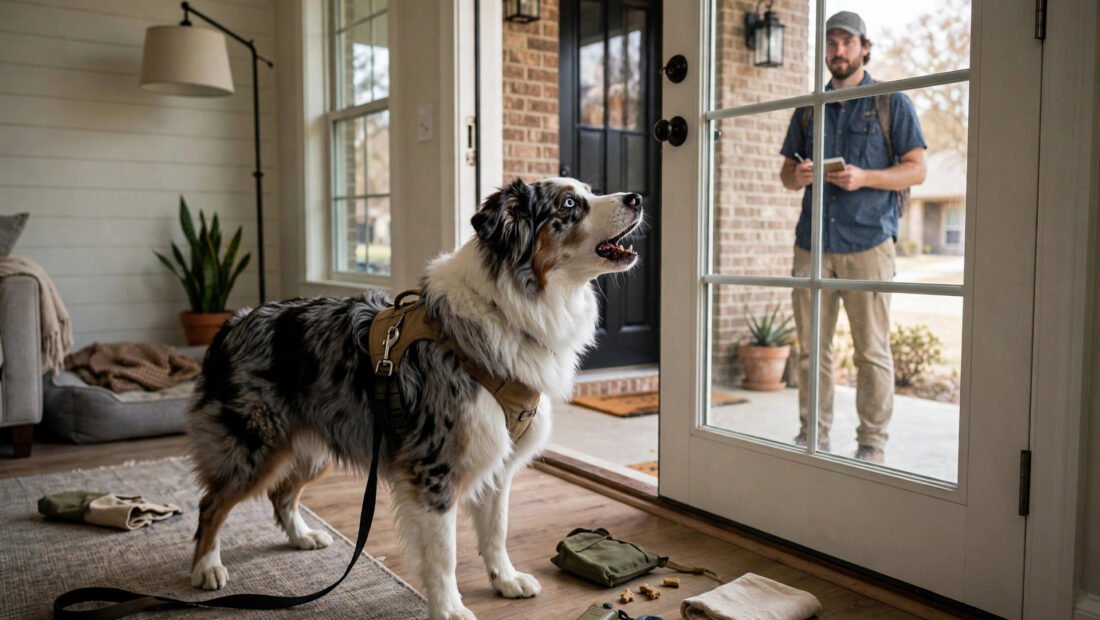
It is 6:45 on a Texas evening, the yard finally cooling, and a delivery driver rings at the gate. The dog, who has rehearsed this exact moment a thousand times from the yard, hits the fence at full volume — barking, lunging, locked in — while dinner waits and the neighbors listen. The owner in this walk-through is an illustration, not a real person, but every step she takes is the protocol real trainers teach for a dog who barks at every stranger. Her fix starts a few days earlier, with a notebook, good treats, and a decision to stop guessing.
First, She Works Out Which Problem She Actually Has
That week, she watches instead of shouting. She notes what sets the dog off, how his body looks while he barks, and what he seems to want to happen. She does this because barking at strangers is four different problems wearing one coat, and the training diverges by driver. Generic advice fails precisely because it treats all four as one disobedience problem.
The first driver is territorial barking at the boundary of the property. The dog treats the fence, the front window, and the gate as a line to defend, and every stranger who walks away teaches him that barking made them leave. The second driver is alarm barking at anything new: a hat, a stroller, a scooter, a sound that was not there yesterday. The dog is startled or unsure and barks to raise the pack and create distance. The third driver is fear barking, from a dog who wants the stranger gone because the stranger scares him — ears back, weight shifted away, barking while backing up. The fourth driver is excitement and frustration barking, from a dog who desperately wants to reach the person and is furious at the fence, the leash, or the glass in the way. That dog often sounds fierce and greets the same person happily once no barrier stands between them.
Her dog, she decides, is mostly territorial at the fence with a strong alarm streak at the door. That mix points her plan: management to stop the daily rehearsals, a clear off-switch cue, and steady desensitization to door and street sounds. A fearful dog would get a slower, distance-first plan. A frustrated greeter would get impulse-control work. Naming the driver first is what keeps the next month from being wasted effort.
Management Comes Before Training
Before any lesson, she changes the house, because a dog rehearsing the behavior eight hours a day at the fence is practicing faster than any lesson can unpick it. She puts window film on the street-facing glass in the front room, so passersby become soft shapes instead of clear triggers. A radio and a white-noise machine move near the front door to blunt the sharp sounds — the gate latch, footsteps on the porch, a package set down — that used to fire the first bark. Yard time becomes supervised instead of solo. The dog still goes out, still sniffs, still does his business, but he no longer spends an unsupervised afternoon running the fence line and logging a hundred victories over people who were never coming in.
She also separates two problems that get tangled together. A dog who explodes at strangers and a dog who destroys things when left alone need different plans — the chewing pattern behind why your dog chews everything when left alone is separate from fence barking. In her house the indoor behavior is calm, so management goes at the boundary.
Teaching the Off-Switch: Thank You, Quiet
With rehearsals cut down, she teaches the foundation skill indoors at low stakes, long before the next real delivery. The sequence is called thank you, quiet, and its logic is simple. The dog is allowed to do his job briefly, then asked to hand the situation over, then paid well for doing so. She stages an easy trigger — a soft knock she makes herself from another room — and lets the dog give two or three barks. She says thank you in a warm, calm voice, the way you would thank someone for an alert you actually wanted. The moment he turns toward her, surprised, she marks it with a clear yes and feeds a high-value treat, something better than everyday kibble: a small piece of chicken or cheese.
Over days, she builds the pause before the treat lengthens. First the treat comes the instant he looks at her. Then she waits for one second of quiet, then three, then five, marking and paying for the silence itself. If he barks through the cue, she does not repeat herself louder or punish him. She makes the exercise easier — a softer knock, more distance, a better treat — because failure at this stage means the step was too big, not that the dog is stubborn. Sessions stay short, a few minutes at a time, and end while he is still succeeding. Within about two weeks, the knock that once set off a full minute of barking produces three barks, a look, and a dog waiting for his pay. That look is the whole game. It means the dog now has a second behavior to offer after the alert.
The Alarm Work: A Ladder, Climbed Slowly
Next she builds a desensitization ladder for the alarm driver in him. She records doorbells, gate sounds, and street noise on her phone, then plays them at low volume indoors while treats appear for calm behavior. Volume rises over days, not in one brave jump. A sound that earns a head lift and a treat at low volume earns the same reward a little louder two days later. Only when recorded sounds at full volume bore him does she move the work outside: real triggers at a distance across the street before triggers at the fence, a helper walking past far away while the dog practices his thank you, quiet routine and gets paid for the pause.
Distance is her main dial. Too close, and the dog is over threshold — barking hard, unable to take a treat or hear a cue, and learning cannot happen there. Far enough away, the same stranger becomes practice material. She shrinks distance only as fast as success allows. The delivery schedule in her Texas suburb turns out to be a gift: triggers arrive on a predictable rhythm, so practice can be planned instead of ambushed.
What She Would Do Differently for Fear or Frustration
She keeps two alternate branches in her notebook, because neighbors ask and because drivers can overlap. For the fear driver, the method is counter-conditioning. Strangers appear at a distance the dog can handle — far enough that he notices but stays loose — and their appearance predicts chicken. Every time. Distance shrinks only as fast as the dog’s body language allows, over weeks if needed, because flooding a fearful dog by dragging him close to what scares him is how bites are rehearsed. The stranger never approaches as a reward and never looms as a test. Calm observation, paid well, is the entire job until the emotion itself changes.
For the frustration driver, the work is impulse control. Waits at doors, where the door opens only for a dog holding himself together. Place training, where the dog learns to go to a mat and stay there while interesting things happen across the room. Games that teach one lesson from many angles: calm is what makes interesting things happen. Barking and lunging make the interesting thing pause or go away, delivered without anger, as simple information. A dog who wants to greet people can learn that lesson quickly once it is consistent.
She leans on the American Kennel Club’s dog training and behaviour guidance to double-check a step before trying it.
Tools, Judged Honestly
She sorts her tools into two piles. In the help pile: high-value treats she only uses for this work, a treat pouch so rewards arrive fast, a long line for safe outdoor practice where a fence is not available, and the mat for place training. A head halter helps handling for a strong dog who pulls toward triggers, because it gives gentle control of direction while the brain learns. None of these teach by themselves. They make the teaching she is already doing easier to deliver.
In the other pile sit aversive bark collars, and she leaves them there. Many trainers warn against them for exactly this problem. If a stranger’s arrival is paired with a shock, the dog can learn that strangers predict pain. Barking may pause while fear grows underneath, and fear is the driver most likely to turn into aggression. A collar can suppress a sound; it cannot teach what to do instead.
The Texas Layer She Plans Around
Her schedule bends to Texas. Yard dogs rehearse at fences all day in the heat, so training moves to the cool hours — early morning and evening — when her dog can think. Midday is for management, shade, and indoor games. Storm season gives a noise-sensitive dog a second battle, so she lowers expectations on storm weeks and leans on white noise and indoor practice rather than counting those days as failures. A session skipped on a brutal day costs less than a session done badly.
When She Would Call a Professional
Her plan has a stop line written in advance. Lunging, snapping, or any bite history goes straight to a certified trainer or veterinary behaviorist. So does six to eight weeks of consistent work with no movement. A professional sees the diagnosis with fresh eyes and adjusts timing in ways written plans cannot. Asking for that help is part of the protocol, not a defeat.
Where the 6:45 Delivery Ends Up
Four weeks into the plan, the driver rings at the gate again at 6:45. The dog runs, barks twice, barks a third time — and turns. He looks for her. She says thank you, marks the quiet, and pays him in chicken while the driver sets the package down and leaves, unaware he has just starred in a training session. He barks once more as the truck pulls away, then settles. That is the honest expectation she ends with, and it is worth stating plainly. Alert barking is a feature the dog was kept for across centuries. The goal was never a silent dog. The goal is a dog who reports and then stands down on cue, trusting that the human has taken it from there. Most dogs improve markedly within four to eight weeks of consistent work like hers — management first, a taught off-switch, slow ladders, no punishment for fear — and the evenings get quieter one delivery at a time.