That satisfying pop. You do it while thinking, while waiting, while reading articles about whether you should stop doing it. Somewhere in the background sits a warning you have heard since childhood — usually delivered by a grandparent — that cracking your knuckles will give you arthritis and leave you with swollen, ruined hands by forty. Is any of that true? This page answers the knuckle questions one by one, in the order people actually ask them.
What is actually making that sound?
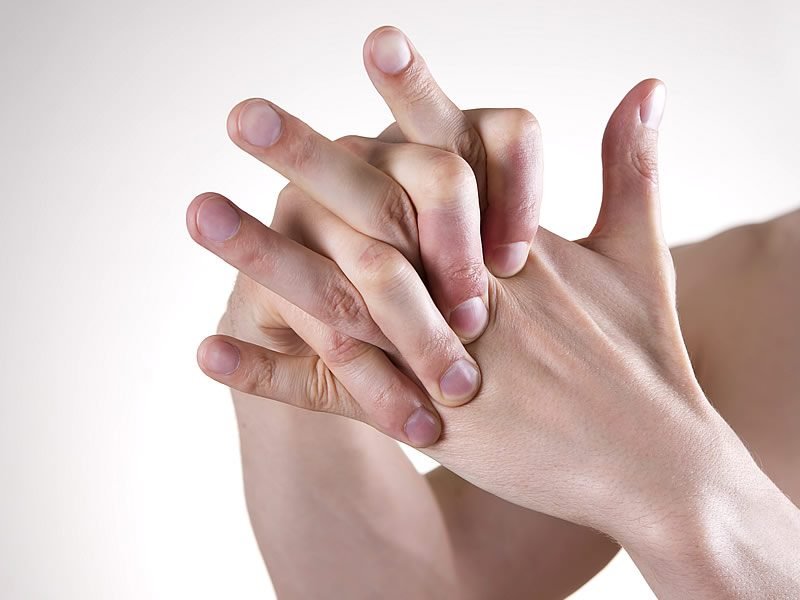
Your knuckle joints are bathed in synovial fluid, a lubricant that contains dissolved gases, mainly carbon dioxide. When you pull or bend the joint to crack it, you stretch the joint capsule and drop the pressure inside it — and dissolved gas rushes together to form a bubble. The pop is the sound of that bubble forming (imaging work with real-time MRI suggests the sound coincides with the bubble’s appearance rather than its collapse, which is the current best explanation). Either way, the crucial point is what the sound is not: it is not bone grinding on bone, and it is not anything tearing.
This mechanism also explains the refractory period: after a crack, that joint will not crack again for roughly 20 minutes. The gas needs time to redissolve into the fluid. If a “crack” can be repeated instantly, endlessly, it is probably a tendon snapping over a joint rather than a knuckle crack at all — a different sound with a different meaning.
Does cracking your knuckles cause arthritis?
No — this is the rare health myth with a genuinely satisfying investigation behind it. The most famous piece of evidence is disarmingly simple: a California doctor, Donald Unger, cracked the knuckles of his left hand at least twice a day for more than 50 years while leaving his right hand uncracked, specifically to test his mother’s warning. At the end, neither hand had arthritis and the two hands showed no meaningful difference. Larger comparisons of habitual crackers and non-crackers have pointed the same way: no increased rate of hand arthritis among the crackers. The myth probably survives because both cracking and arthritis are common and arrive in the same decades of life — correlation wearing a costume.
Honesty requires one footnote: “no arthritis link” is not the same as “no effects of any kind, ever.” A small body of research has explored whether very habitual, forceful cracking relates to hand swelling or slightly reduced grip strength, with mixed and inconclusive results. The fair summary is that gentle, pain-free cracking appears harmless to the joints, and the catastrophic warnings are simply wrong.
Why does it feel so good?
Part of the pleasure is mechanical: stretching a joint stimulates receptors that temporarily relax the muscles around it and increase the joint’s range of motion for a few minutes, which registered stiff hands genuinely appreciate. Part is neurological: the pop is a small, controllable sensory event with a beginning and a satisfying end, which is catnip to a brain that likes completed actions. And part, for habitual crackers, is pure loop — cue, crack, tiny reward, repeat — the architecture of any habit. Understanding which part dominates for you matters, because the answer changes what (if anything) you should do about it, as the habit question below explains.
Can cracking help stiff hands in the morning?
It can make them feel looser, briefly, for the reason above. But morning stiffness that lasts more than about 30 to 45 minutes, or stiffness with swelling, warmth, or aching in the joints, is not a cracking problem — prolonged morning stiffness is a classic early sign of inflammatory conditions such as rheumatoid arthritis, and it deserves a doctor’s attention rather than a louder crack. Gentle range-of-motion movement — opening and closing the hands slowly, wrist circles, warm water over the hands — is a better morning routine for stiff fingers regardless. For a bigger joint behaving badly, the pattern is the same as with why your knee hurts when you go down stairs: noise plus pain means something different from noise alone.
When is a pop a problem?
The joint’s own report is the rule. Cracking that is painless is, by the evidence, a non-event. Cracking accompanied by any of the following leaves the harmless category: pain at the moment of the pop; swelling of the joint; a joint that locks, catches, or gives way; reduced range of motion; or cracking that began after an injury. The most common real injury from knuckle cracking is from the aggressive version — forcing joints with the other hand, hard, many times a day — which can strain ligaments or, rarely, dislocate a finger. The habit’s genuine medical risk profile is mostly that: enthusiasm, not chemistry. MedlinePlus’s overview of joint disorders is a sensible reference for which joint symptoms warrant an appointment.
Why do I do it so much — and should I cut down?
Watch when you crack. For many people it clusters around concentration, boredom, or low-grade stress — the hands get busy when the mind is idling or anxious. That makes knuckle cracking a useful signal rather than a vice: a rising crack rate is often your earliest indicator that stress is accumulating. You do not need a medical reason to reduce the habit; social ones are legitimate (the colleague across the desk is also a person), and so is simple curiosity about what is driving it. If you want to cut down, habit mechanics beat willpower: notice the cue, keep the hands occupied with a substitute — a pen, a stress ball, interlaced stretching — and let the urge pass, which it does in under a minute. The joints will not miss the cracking. The habit might, briefly, and then it fades like every unattended loop.
What about cracking other joints — neck, back, toes?
The same gas-bubble mechanism pops in most synovial joints, which is why toes, ankles, and shoulders can all produce the sound, and why the sound alone is not a diagnosis anywhere in the body. Two cautions separate the spine from the knuckles, though. The neck and back contain the spinal cord and the arteries to the brain, and forceful self-manipulation — wrenching your own neck with your hands, or having an untrained friend “walk on” your back — is a genuinely different risk category from a knuckle pop, with rare but real injuries on record. Gentle stretching that happens to produce a pop is unremarkable; force applied to make a pop happen is where the line sits. The second caution is frequency as a symptom: a back or neck that needs cracking every twenty minutes to feel right is telling you its muscles are fatigued and its posture is costing it — the crack is the smoke, not the fire. Stretching, strengthening, and fixing the chair answer the fire. This is also why a joint that cracks with pain, or one that started cracking after an injury, earns an examination: sound plus symptoms is a different file from sound alone.
A seven-day plan for cracking less
If you have decided to cut down — for a partner’s sanity, a colleague’s, or your own curiosity — treat it like any habit and give it a week of structure. Days one and two are pure observation: tally each crack with a dot on your phone’s notes app, and write down what you were doing. Most people are startled by both the count and the pattern; the tally itself often halves the habit, because an automatic behavior dislikes being watched. Days three to five, install the substitute at the two or three moments your tally says are hottest — the pen to roll during calls, the stress ball in the drawer, hands flat on the desk for three slow breaths when the urge arrives at the keyboard. Days six and seven, review: keep the substitutes that worked, drop the theater that didn’t. Expect the urge to spike around day three and fade by day seven; loops starve quickly when the reward stops arriving. And if the tally reveals the cracking rides along with a specific stressor — a meeting, a manager, a deadline — you have learned something more useful than anything about your joints: where your stress actually lives, and what might deserve the attention your knuckles have been requesting.
So, is it bad to crack your knuckles every day?
Every day, gently, without pain: no. The arthritis warning is a myth with an unusually well-tested debunking. Treat your joints like instruments with feedback — pain, swelling, or locking changes the answer and earns an examination — and treat the habit itself as information about your stress level. That is the whole file on knuckle cracking: a gas bubble, a debunked warning, and a small daily habit that tells you more about your state of mind than about the future of your hands. Crack on, gently, if it pleases you — and let any crack that arrives with pain have the final word.