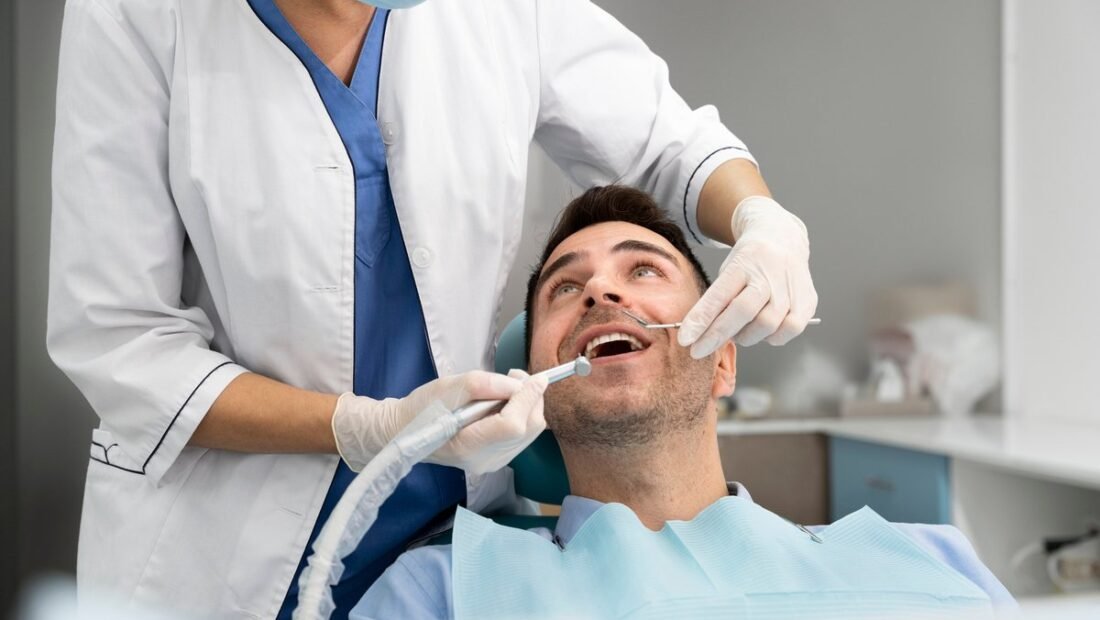
Here is the arithmetic nobody puts in the brochure: a routine teeth cleaning without insurance typically costs between $100 and $200 in most US areas. Skip it for years, and the appointment you eventually book can turn into deep scaling, fillings, and a crown — a rescue bill that can pass $2,000. Prevention is not cheap, but neglect is extravagantly priced. If you have no dental insurance, you have more options than the private-practice rack rate, and they differ a lot in price, convenience, and what they will and will not do. Here they are, weighed honestly.
Option 1: A private dental practice, paying cash
The default route, and for many people still the right one. A standard adult cleaning appointment at a private practice usually includes the exam, X-rays on the schedule the dentist sets, the cleaning itself (a prophylaxis, in the billing code sense), and a fluoride treatment that may be billed separately. The $100–$200 range covers the cleaning in most areas; a first visit with full X-rays can run higher, and prices in expensive coastal cities sit above the range while much of the Midwest and South sits below it.
The uninsured have more leverage here than they realize. Many practices quietly offer cash-pay discounts, and new-patient specials — exam, X-rays, and cleaning bundled at an introductory price — are common and legitimate, designed to win a long-term patient. Asking about both can cut 20–30%, and asking costs nothing. The advantages of this route are continuity (the same dentist watches your mouth over years and spots change early) and completeness (any problem found can be treated in the same office). The disadvantage is simply the sticker, and the fact that a cleaning that discovers problems becomes the entrance to a price list nobody enjoys.
Option 2: A dental school clinic
The best-kept secret in American dentistry. Dental schools run teaching clinics where students treat patients under the supervision of licensed faculty, at fees commonly a third to a half of private rates. Cleanings are the bread and butter of these clinics, and the work is checked at every step — the supervision is the point. The trade-off is time. An appointment that takes an hour in private practice can take three at a school, because every stage gets inspected, and getting accepted as a patient can involve a screening visit and a wait. If your schedule is flexible and your budget is not, this is the strongest value in this entire comparison, and the dentistry itself is careful to a degree private schedules rarely allow.
Option 3: A community health center
Federally funded community health centers provide dental services on sliding fee scales based on income, which makes them the floor of the price system — a cleaning can cost a small fraction of the private rate for qualifying patients. The federal HRSA health center locator finds them by ZIP code. Expect waits: these clinics are in high demand, dental departments are smaller than medical ones, and appointment books run weeks or months out in many areas. For a routine cleaning planned ahead rather than a toothache this week, they are exactly what they were built to be — proof that the cleaning itself is not inherently a $200 service, only priced that way in some settings.
Option 4: A dental hygiene school or hygiene program clinic
Distinct from dental schools and often cheaper still: programs that train dental hygienists run clinics focused specifically on cleanings, exams for gum health, and X-rays, supervised by licensed hygienists and dentists. Fees are frequently the lowest in any given city, sometimes nominal. The catch mirrors the dental school one — appointments are long, availability follows the academic calendar, and if the cleaning uncovers a cavity, the clinic refers you elsewhere rather than treating it. As a maintenance route for a basically healthy mouth, it is hard to beat.
Option 5: A dental membership or discount plan
Not insurance, whatever the brochure implies. These plans charge an annual fee — either to a network that negotiates discounts, or directly to one practice as an in-house membership — in exchange for included cleanings and reduced rates on other work. The math works if you actually attend twice a year and would otherwise pay full price at that practice; it fails if you buy the plan and drift, or if the discounts are calculated from inflated list prices. Read what the two included cleanings cover and what the exam and X-rays cost on top. For a fuller picture of how health coverage costs compare when you are weighing plans of any kind, see how much health insurance costs on average.
What a cleaning should include — and what raises the price
Whichever route you choose, know what you are buying so you can compare like with like. A routine cleaning removes plaque and tartar above the gumline, polishes the teeth, and should come with an exam of teeth and gums. The price jumps when the appointment stops being routine: if tartar has built up below the gumline and gums are inflamed, the dentist may recommend scaling and root planing — “deep cleaning” — which is a different, multi-visit treatment at a very different price, and the one most often upsold. It is a real treatment for real gum disease, and also the line item to ask questions about: which teeth, what measurements (pocket depths of 4mm or more are the clinical marker), and can it wait until after a routine cleaning and a re-check? Good practices answer without flinching. The American Dental Association’s MouthHealthy site explains these procedures in plain language if you want a neutral reference before you go.
Two ways to pay less at almost any office
Beyond choosing the venue, two habits lower the bill wherever you go. First, ask for the cash price in writing before the appointment and confirm exactly what it includes — cleaning only, or cleaning plus exam and X-rays — because the difference between those two bundles is where surprise bills are born. Second, if the cleaning turns up treatment, ask for the plan in phases: what hurts or is actively getting worse now, what can be monitored, what is cosmetic. Dentistry is one of the few kinds of healthcare where a second opinion is easy to get and nobody takes offense, and on a multi-thousand-dollar plan the second quote is the highest-paying hour an uninsured patient can buy. In a growing number of states, licensed hygienists may also provide cleanings directly in certain settings without a dentist visit first, which can trim the cost of pure maintenance further — worth checking locally if your mouth is healthy and your goal is simply to keep it that way.
How often do you actually need one?
The twice-a-year rhythm is worth one honest paragraph. It is a tradition so old it feels like physiology, but the evidence for exactly two visits for everyone is thinner than most people assume, and many dentists now set the interval by risk instead: a low-risk adult with healthy gums may do well on an annual cleaning, while someone with gum disease, braces, a dry mouth from medication, or a history of rapid decay genuinely needs three or four visits a year. The practical approach for the uninsured is to ask, at your first cleaning anywhere on this list, which risk group you are in and what interval the dentist recommends — then budget for that, rather than either defaulting to twice a year out of habit or stretching to never out of hope. The worst schedule, at every price level, is the irregular one: long neglect punctuated by emergency visits, paying crisis prices for what routine prices would have prevented.
The verdict
If you can afford it, a private practice where you are a regular, paying cash with the discount asked for, buys continuity that has real clinical value. If money is the binding constraint, a dental school or hygiene clinic gives you careful work at the lowest prices, paid for in time instead. Community health centers are the safety net, planned ahead. Membership plans are arithmetic — run yours before signing. What none of the options justify is the sixth route, the one where the cleaning simply never happens because the first quote was $190. At $100–$200 once or twice a year against $2,000 rescue missions, the cleaning is not the expensive option on this page. It is the cheap one, wearing a price tag that makes it look otherwise. So make the call this week — to the practice whose special you saw, the school clinic with the waiting list, the health center across town. The appointment you book at a routine price is the single easiest money decision in this entire article, and it stays easy only as long as it stays routine. Put it on the calendar the way you would an oil change — unglamorous, scheduled, and much cheaper than the alternative — and let everything else on this page be a menu you never urgently need.