
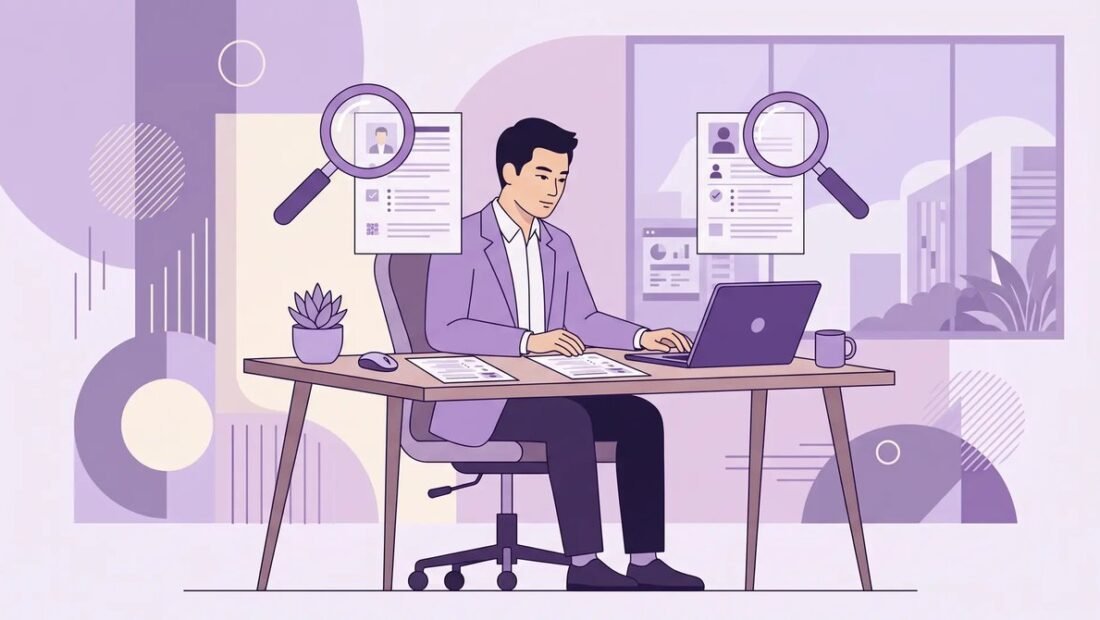
By the fortieth cover letter of the morning, a recruiter can usually tell within two lines whether a chatbot wrote it. Not because of one magic giveaway word, but because the fortieth letter sounds almost exactly like the thirty-nine before it: same smooth opening, same confident adjectives, same paragraph that could be pasted into an application for any job, at any company, anywhere. If you are wondering whether using AI on your cover letter helps or hurts, the honest answer from the hiring side of the desk is this: it depends far less on the tool than on the mistakes you let it make for you.
Mistake 1: Sending the first draft the tool gives you
The default AI cover letter is polished in the way a hotel lobby is polished — clean, pleasant, and completely impersonal. It opens with some version of “I am excited to apply for the position of…” and rolls on through “passionate team player” and “proven track record” without ever saying one thing that is true of you and nobody else. Recruiters do not read these letters with anger. They read them with a shrug, which is worse. A shrug means your application has become background noise.
Here is the part applicants rarely hear: a cover letter was never mainly about proving you can write in complete sentences. Plenty of people can. It is the one place in an application where you can connect your actual history to this specific job — the two years you spent doing the unglamorous version of this work, the project that went wrong and what you did next. Software that has never met you cannot write that paragraph. When it is missing, recruiters notice the absence, not the polish.
Mistake 2: Letting the AI describe a person you are not
Chatbots are eager to please, and a cover letter prompt like “write me a strong letter for a marketing manager role” produces claims on your behalf: campaigns led, budgets managed, teams of twelve. If any of it is inflated or invented and you send it anyway, you have created a landmine that goes off at the interview, when you are asked a simple follow-up question about work you never did. Hiring managers forgive modest experience. They do not forgive discovering, mid-conversation, that the letter and the person do not match.
The same habit that wrecks cover letters wrecks resumes, and it is worth reading the risks of using AI to write your resume before your next application, because the two documents usually get screened together.
Mistake 3: Writing to every company instead of this one
Recruiters can smell a mass-produced letter, AI or not. Nothing in it mentions the company’s actual product, its customers, its recent news, or the specific problem the role exists to solve. An AI draft is especially prone to this because the tool only knows what you told it — if your prompt contained nothing about the company, the letter contains nothing about the company. Two or three sentences grounded in the real posting (“Your team is expanding into X; in my last role I did the smaller version of exactly that”) do more work than four paragraphs of generic enthusiasm.
Mistake 4: Smoothing out every trace of your own voice
There is a particular rhythm to unedited AI text: balanced sentences, tidy transitions, zero risk. Experienced recruiters and hiring managers have now read thousands of these letters, and many describe the same reaction — the letter feels like it was written by a competent stranger who knows nothing. Oddly, small human imperfections help you: a specific detail, a short blunt sentence, a number with a story behind it. “I cut our response time from two days to same-day” is not elegant, but it is believable, and believable beats elegant every time.
Mistake 5: Using AI where honesty is the whole point
Some parts of an application should never be delegated at all. Anything that explains a gap in your work history, a career change, or why you left a job needs your real reasoning in your real words. These sections are read precisely to judge your judgment. An obviously generated explanation of a personal situation strikes recruiters as evasive, even when the facts are perfectly innocent.
Why the sameness problem keeps getting worse
There is a numbers problem underneath all of this. When a cover letter took an evening to write, applications were fewer and each one carried at least the signal that the applicant cared enough to spend the evening. Now that a passable letter takes ninety seconds, popular postings draw far more applications, and a much larger share of them read like variations on one document. Recruiters respond the way anyone would: they spend less time per letter and lean harder on quick signals — a familiar company name, a keyword match, a referral. In that environment, a generic AI letter does not merely fail to help you. It quietly trains the reader to skim, and skimming is where good-but-quiet candidates get lost.
This is also why the strongest applications increasingly lead with things software cannot generate: a portfolio link with real work, a short note from someone inside the company, a result that can be checked. The letter still matters, but it matters as the place where those proofs get explained in plain language — why this project, why this result, why this company — rather than as a self-contained piece of persuasive writing.
Two openings, side by side
Consider what an unedited AI opening usually looks like: “I am writing to express my strong interest in the Customer Support Specialist position at your esteemed company. With my passion for helping others and my proven ability to thrive in fast-paced environments, I am confident I would be a valuable asset to your team.” Every word is acceptable and none of it is information. A recruiter learns nothing except that a tool was opened.
Now the same applicant, same job, after ten honest minutes of editing: “Your posting says the weekend queue is the one customers complain about. I worked the weekend queue at my last job for two years — it is where I learned that most angry customers calm down the moment someone answers with a specific time instead of a script.” That version could only have been written by one person, and it answers the employer’s actual worry before being asked. The difference between the two letters is not talent. It is whether the applicant supplied the raw material — a real detail, a real problem, a real memory — and used the software for polish instead of substance.
So what do recruiters actually respect?
Talk to people who screen applications for a living and a consistent picture emerges. Very few object to AI as a tool. What they object to is being handed identical, content-free letters by the stack, and what they reward has barely changed since before chatbots existed: evidence that you read the posting, a concrete example of relevant work, and a reason for wanting this job rather than any job. Many recruiters will also tell you, off the record, that they use AI themselves to summarize and sort applications — the technology is not the scandal. The emptiness is.
A workflow that keeps you on the right side of that line looks like this. Start with your own rough draft, even a bad one, built from two or three real details: a result you produced, a skill that maps directly onto the posting, one true sentence about why this company. Then use the AI for the mechanical work — tightening sentences, cutting repetition, catching typos, suggesting a stronger opening line you then rewrite in your own words. Finally, read the letter aloud once. If any sentence describes a person you would not recognize, cut it. Resources like Indeed’s guide to writing a cover letter cover the expected structure well; your job is to fill that structure with things only you can say.
Length is part of that workflow, too. A cover letter is not a memoir: three or four focused paragraphs are plenty, and recruiters quietly appreciate the applicant who proves a point in half a page over the one who fills a full page proving the same point. If your draft runs long, the AI is genuinely useful here — asking it to cut a draft by a third while keeping your two best details is exactly the kind of mechanical job it does well.
One more practical point: follow the employer’s own rules. Some companies now state plainly in the posting whether AI assistance is acceptable, and government and academic employers can be strict about it. Ignoring a stated policy is the one AI mistake that is disqualifying all by itself.
The bottom line from the hiring side is almost boring in its simplicity. An AI-written cover letter is not an automatic rejection, and a hand-written one earns no bonus points for effort. Recruiters feel the way readers always feel: they reward the letter that tells them something true, specific, and relevant, and they forget the one that sounds like everyone else’s. Use the tool to edit yourself, never to replace yourself, and you will be on the right side of that judgment.



1 Comment