A tight band squeezing your forehead by mid-afternoon — again. No throbbing, no nausea, just a vise that arrived quietly while you were answering email and now owns the rest of the day. That is the classic tension headache, the most common headache there is, and the good news is how mechanical its causes usually are: tight muscles, dehydration, posture, caffeine timing. Mechanical problems take mechanical fixes. Here is the sequence, in the order to run it, starting the next time the band tightens.
Step 1: Drink a large glass of water before anything else
Dehydration is the most under-suspected headache driver in office life, because it rarely announces itself as thirst first. A large glass of water at the first sign resolves a surprising number of tension headaches within about 30 minutes — cheap, immediate, and diagnostic: if the ache fades as you rehydrate, you have learned something permanent about your afternoons. Coffee and soda do not count toward this glass; caffeine is a mild diuretic and a variable in its own right (Step 5). Keep a bottle at the desk and treat finishing it by lunch as part of the job. No other step on this list has a better effort-to-payoff ratio, which is why it goes first.
Step 2: Heat on the neck, cold on the forehead
The two-temperature trick sounds like folklore and works like physiology. A warm compress, heating pad, or hot shower aimed at the neck and shoulders for about 15 minutes relaxes the tight muscles that drive most tension headaches — warmth increases blood flow and tells guarded muscles they can stand down. Simultaneously or alternatively, cold on the forehead or temples (a cold pack, a bag of frozen peas in a cloth) numbs and constricts, dulling the ache while the heat does the deeper work. Many people find the combination better than either alone. MedlinePlus’s headache overview lists these same measures among its self-care basics, alongside the warning signs in the final section here.
Step 3: Massage the suboccipital muscles
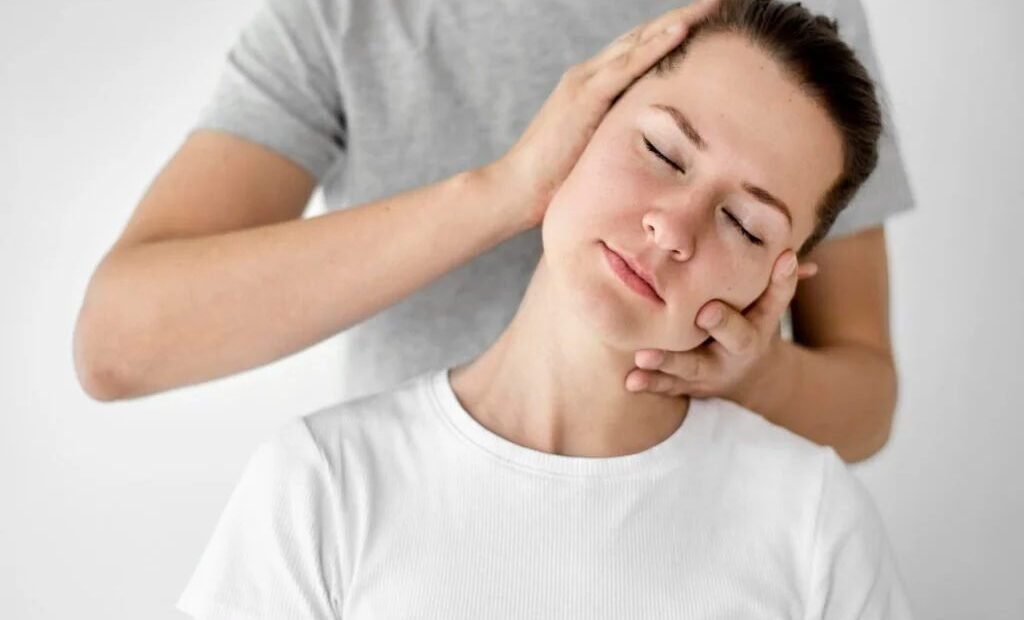
Now go to the source. At the base of your skull, either side of the spine, sits a cluster of small muscles — the suboccipitals — that connect your head’s posture to your headache. They are tender in almost everyone who works at a screen. Technique: interlace your fingers behind your head, or lean the base of your skull into two tennis balls in a sock on the floor, and apply slow, firm pressure for 60 to 90 seconds, breathing out as you press. Work the jaw too — clenching through concentration or through the night loads the temples directly — and the tops of the shoulders, where tension physically accumulates. Two minutes of this routinely does what an hour of “trying to relax” does not, because it addresses the tissue, not the intention.
Step 4: Reset your posture, right now
Stand up. The tension headache’s favorite habitat is a head drifted inches forward of the shoulders, held there for hours by a too-low screen and a chair that lost its argument with your spine. Do the 30-second reset: chin tucked gently back, shoulders rolled down and back, shoulder blades squeezed for five seconds, three slow breaths with the exhale longer than the inhale. Then fix the geometry that caused it: screen top at eye level, roughly an arm’s length away; feet flat; the chair supporting the lower back. If your headaches keep a work-hours schedule, posture is not a contributing factor — it is the diagnosis, and our companion routine for the twin problem, the difference between a migraine and a regular headache, is worth reading alongside this one to make sure you are treating the right condition in the first place.
Step 5: Caffeine — a small dose, early, with a warning
Caffeine constricts blood vessels and genuinely helps many headaches, which is why it is an ingredient in commercial headache remedies. A small cup of coffee at the onset can take the edge off. Two conditions: keep the dose small and early — caffeine after mid-afternoon trades today’s headache for tonight’s shallow sleep, which manufactures tomorrow’s — and respect the rebound. Daily heavy caffeine creates withdrawal headaches on the days you miss it, and a person treating five headaches a week with coffee may be chasing a cycle of their own manufacture. Used occasionally and deliberately, it is a tool. Used as a drip, it is a cause.
Step 6: Dim, quiet, and breathe for ten minutes
Finish the sequence by lowering the inputs: lights down or off, door closed, phone face-down, ten minutes of slow breathing — in for four counts, out for six — in the quietest spot you can claim. Tension headaches feed on sustained low-grade arousal; this step is the deliberate downshift your nervous system has been requesting since the band first tightened. If a full stop is impossible, a walk outside comes closest — daylight, distance vision, and movement release the neck-and-shoulder pattern better than any desk-bound remedy, and it is why so many afternoon headaches quietly die somewhere around the block.
Prevention: the pattern log and the boring basics
If these headaches visit weekly, treat them as data. For two weeks, note the time, the day, last night’s sleep, water and caffeine so far, hours at the screen, and anything skipped (lunch is the repeat offender). Patterns surface fast: the 3 p.m. headache that only follows 1 a.m. nights; the Monday special that is actually caffeine withdrawal from lazy weekend mornings; the end-of-quarter edition that is pure jaw clenching. Prevention then writes itself — regular sleep and meal times, water before thirst, screen breaks on a timer, and the afternoon walk defended like an appointment. People who fix the pattern typically watch a “chronic” problem become an occasional one within the month.
A note on painkillers, since everyone asks
This sequence deliberately leads with non-drug fixes, because for the classic afternoon tension headache they usually suffice — but there is no virtue in suffering, and an occasional over-the-counter pain reliever used as directed is a reasonable part of the toolkit when the band will not lift. The trap is frequency. Using acute painkillers on more than about 10 to 15 days a month, month after month, can itself generate headaches — medication-overuse headache, in which the treatment becomes the cause and the only exit is a supervised taper. If you notice your pill days climbing toward that territory, the pattern log becomes urgent and so does a conversation with your doctor, because you are no longer treating occasional tension headaches; you are managing a cycle. The non-drug sequence above is partly strategic for exactly this reason: every headache it resolves is a pill day that never enters the count.
The desk kit: five objects that prevent more than they cost
Prevention turns out to be mostly furniture. One: a water bottle with a known size, finished and refilled on a rhythm. Two: a heat source that lives at the desk — a microwaveable neck wrap or an electric pad — so Step 2 takes ninety seconds to start. Three: a book, box, or stand that brings the screen to eye level permanently, not on the days you remember. Four: a timer, app, or watch alert that enforces the hourly stand-and-roll for two minutes; willpower is not a scheduling system. Five: a spare pair of the glasses you are supposed to wear for screens, kept at the desk, because uncorrected vision and squinting feed the forehead muscles all day. Total cost, modest. Total effect, measured in headaches that never happen — which never appear in any diary, and are the entire point.
Is it tension, and when should a headache worry you?
Tension headaches are bilateral (both sides), pressing or tightening rather than throbbing, mild to moderate, and not worsened by ordinary activity; they come without nausea and usually without strong sensitivity to light or sound. Migraine is the main alternative: often one-sided and pulsing, frequently with nausea and genuine light and sound sensitivity, sometimes with visual aura — a different condition with its own treatments, which is why the comparison linked above matters. And then the red flags, which outrank every step on this page: a sudden headache that peaks within a minute (“the worst of my life”), headache with fever and a stiff neck, headache after a head injury, headache with weakness, confusion, vision loss, or trouble speaking, or a new headache pattern after age 50. Those go to urgent care or emergency evaluation, not to Step 1. Everything else — the band, the vise, the afternoon appointment — starts with a glass of water and fifteen minutes of heat, and most days, that is where it ends too. Run the sequence in order the next three times the band tightens, and keep the little log beside it. By the third run you will know which step your particular headache obeys — most people have one lever that does most of the work — and a problem with a known lever stops being a daily ambush and becomes a brief, boring errand you know how to run.