
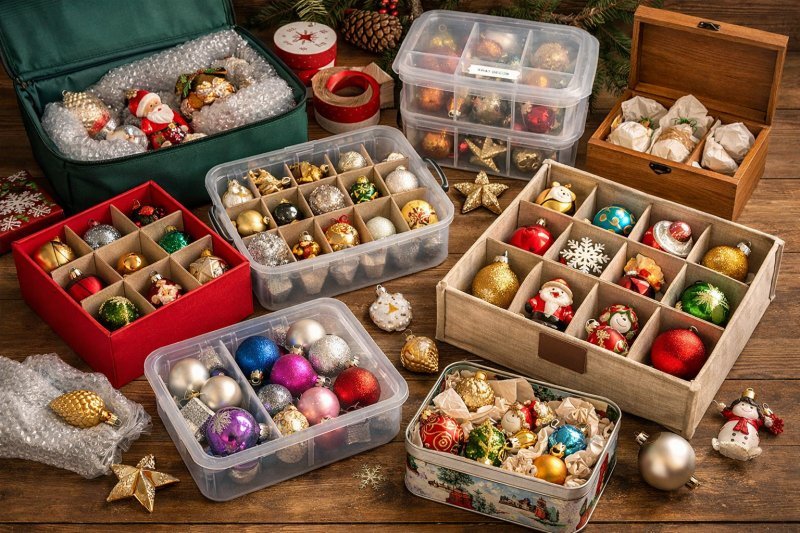
Every January, I used to shove ornaments into grocery bags and swear I’d organize them ‘next year.’ Every December, I paid for it with tangled lights, broken ornaments, and a decorating session that started with an hour of untangling. The storage is the hobby; decorating is just the reward.
The best way to store seasonal decorations isn’t complicated — it’s just deliberate. The right bins, the right wrapping for fragile items, labels that future you can read, and a system where every holiday has its home. One good afternoon of organizing saves you years of December frustration.
Here’s the complete system, holiday by holiday.
The Bin System: One Home Per Holiday
Buy uniform, clear, stackable bins — one or two per major holiday. Clear matters: you can see contents without opening. Uniform matters: they stack stably and look intentional on shelves. Label every bin on two sides with big text: ‘CHRISTMAS — TREE DECOR’ beats a cryptic ‘Xmas 2.’ Future you is tired and cold; make it obvious.
Within bins, use smaller containers or zip bags for categories: all ornament hooks in one bag, all tree-topper parts together, light clips with the lights. The ‘bag of random holiday stuff’ is where decorations go to die — subdivide or suffer. Take a photo of the bin’s contents before closing it; tape the photo to the lid or keep a digital album. Next year you’ll know exactly what’s inside.
Climate matters more than people think. Attics bake (heat warps candles, melts adhesives, fades colors) and basements flood. The ideal is a climate-controlled space — a closet, under-bed storage, or a garage shelf if it’s dry. If the attic is your only option, avoid storing candles, photos, and anything adhesive up there. Our declutter guide helps you make space in better locations first.
Fragile Items: Ornaments, Lights, and Wreaths
Ornaments: the gold standard is compartmentalized storage — either purpose-made ornament boxes ($15–$25) or DIY with egg cartons, divided wine boxes, or plastic cups glued in a bin. Wrap each fragile ornament in tissue paper; never newspaper (the ink transfers). Heirlooms get individual boxes or padded bags — they’re irreplaceable, treat them that way.
Lights: wrap each strand around a piece of cardboard or a purpose-made reel, secure the ends with the plug, and label working vs. needs-checking. Test every strand before storing — discovering dead lights during decorating is a special December misery. Store light strands in their own bin or bag so the wires don’t snag ornaments.
Wreaths and garlands: hang them, don’t crush them. A wreath storage bag hung on a hook preserves the shape; stuffed in a bin, it’s a flat disappointment next year. Artificial trees: keep the original box if you have it, or buy a tree storage bag ($20) — and photograph the assembly before disassembly. That photo saves a yearly argument.
The Take-Down Ritual (Where the System Lives or Dies)
The system works only if take-down day follows the rules. Schedule it — don’t let decorations linger until February out of inertia. Work holiday by holiday: take down, sort immediately into ‘keep,’ ‘donate,’ and ‘trash’ (broken items don’t get stored — that’s just delayed trash with extra steps), then pack into the labeled bins as you go.
Purge annually. If you didn’t put it up this year, you won’t next year — donate it now while it’s still in your hands. Decorations accumulate silently; the yearly cull keeps the bins from multiplying. One in, one out applies to holiday decor too: new garland means old garland goes.
End with the inventory: snap the bin-content photos, update labels if categories shifted, and stack bins with the next holiday most accessible. Then — and this is key — write yourself a note for next year: ‘bought new lights, old ones in donate bag’ or ‘need more ornament hooks.’ Tape it to the top bin. Future you will be so grateful.
The Best Way to Store Seasonal Decorations: The Donation Station
Here’s the advanced move for holiday storage: the permanent donation station. Keep one bag or box labeled ‘donate’ in your storage area year-round. Every time you unpack decorations and think ‘I don’t love this anymore,’ it goes straight in the bag — not back in the bin. Every time you buy something new, something old goes in the bag. By the time take-down day arrives, the cull is already half done, and the bag goes straight to donation without a second decision. This single habit prevents the slow bin-multiplication that afflicts every decorator.
For storage inspiration and product picks, the Spruce’s holiday organization guides have genuinely useful reviews of ornament boxes, wreath bags, and tree storage — worth browsing before you buy, because the right container lasts decades and the wrong one lasts one season. And apply the same thinking to the rest of the house: the decoration bins are a microcosm of household clutter. If the bins are multiplying, the house probably is too — our cozy apartment guide (the principles work for houses too) helps you think about what deserves space in your home.
Seasonal Storage Essentials
- Uniform clear stackable bins, labeled on two sides
- One to two bins per holiday, subdivided with zip bags
- Photo of each bin’s contents taped to the lid
- Ornament boxes or DIY dividers; tissue wrap, never newspaper
- Heirlooms in individual padded storage
- Lights wrapped on cardboard reels, tested before storing
- Wreaths hung in storage bags, never crushed
- Tree bag + assembly photo before disassembly
- Climate-controlled storage preferred over attic/basement
- Annual purge: broken = trash, unused = donate
- Take-down day scheduled; sort as you go
- Note to future self taped on the top bin
An Hour Now Saves a December
Proper storage takes maybe an extra hour during take-down. It saves triple that next December — no untangling, no broken surprises, no digging through mystery bins. And there’s a genuine pleasure in opening a well-organized bin: everything where it should be, ready to make the house festive.
Start this take-down season. Buy the bins, print the labels, take the photos. Next December, when decorating takes an afternoon instead of a weekend, you’ll wonder why you ever did it the hard way.



