
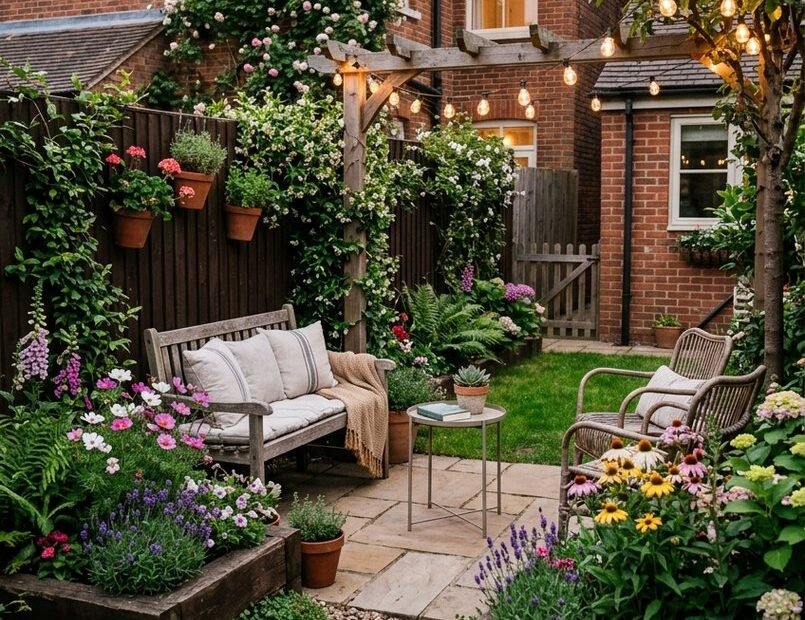
My backyard is 30 by 40 feet — basically a generous parking spot with grass. But visitors consistently guess it’s bigger, because I’ve spent years learning the visual tricks that make small outdoor spaces feel expansive. None of them involve moving fences. I wanted to “make a small backyard feel bigger” without spending much — then I discovered the cheapest trick of all: lighting it for the night.
Making a small backyard feel bigger is about manipulating perception: long sight lines, layered planting, defined zones, and hiding the boundaries. Landscape designers use these same principles in tiny urban gardens that feel like estates. They work at any scale.
Here are 18 tricks, from the instant to the ambitious.
Borrow Space With Sight Lines and Layers
The number-one trick: create a long diagonal view. The eye reads the longest visible line as the space’s size, so arrange paths, plantings, and focal points along the diagonal, not straight across. A winding path that disappears behind planting feels twice as long as a straight one — the hidden curve suggests space beyond, and the brain fills it in generously.
Layer your planting in three depths: low in front, medium in the middle, tall at the back. This forced depth reads as distance. And blur the boundaries — cover fences with vines, tall grasses, or espaliered trees so the eye can’t find the edge. An invisible boundary feels infinite; a visible fence feels like a box. Even painting a fence dark green makes it visually recede.
Borrow the neighbors’ landscape: frame a view of their tree or the distant hills with your planting, and your brain counts it as your space. (This is a real design principle called ‘borrowed scenery’ — Japanese gardens perfected it centuries ago.) A strategically placed mirror on a fence or wall doubles the perceived space, though use them carefully to avoid confusing birds — decals or angling downward helps.
Zone It: Small Rooms Feel Bigger Than One Box
Counterintuitively, dividing a small yard into zones makes it feel larger — just like rooms make a house feel bigger than a studio. Create two or three distinct areas: a dining nook, a lounging corner, a small garden bed. Use changes in ground material (deck to gravel to grass), low plantings, or a trellis to suggest separation without walls.
Keep each zone’s furniture scaled to the space — oversized furniture in a small yard screams ‘small yard.’ A bistro set beats a six-person dining table; a loveseat beats a sectional. And choose multi-functional pieces: storage benches, fold-down tables, ottomans that become side tables. Every piece should earn its footprint twice.
Go vertical everywhere: trellises, wall planters, hanging baskets, espalier fruit trees, climbing roses. Vertical growing adds enormous planting area without using ground space, and height draws the eye up, which reads as spaciousness. A 6-foot trellis of jasmine gives you a garden wall that smells incredible and takes one square foot of ground.
Light, Color, and the Details
Light extends usable hours and perceived space: string lights overhead create a ‘ceiling’ that makes the yard feel like an outdoor room, while uplights on trees add nighttime depth. Keep lighting warm and layered — a few sources at different heights, just like indoors. Solar path lights along that diagonal path emphasize the long view after dark.
Color strategy: cool colors (blues, purples, silvers) recede and suggest distance — plant them at the far end. Warm colors (reds, oranges) advance — keep them near the house. This is painter’s perspective applied to planting, and it genuinely stretches the perceived depth. Limit your palette too; a restrained 3–4 colors looks designed and spacious, while a riot of everything looks cluttered and small.
Finally, keep it tidy — small spaces show mess mercilessly. A quick weekly 15-minute tidy (sweep, deadhead, put tools away) maintains the illusion. And hide the utilities: screen the AC unit, trash cans, and hoses behind lattice or planting. Every visible utility shrinks the perceived ‘garden’ and grows the perceived ‘yard work.’
Make a Small Backyard Feel Bigger: The Night Garden
Here’s the trick nobody mentions: a yard you only use by day is half a yard. Outdoor lighting — string lights, a few solar path lights, uplights on one tree — effectively doubles your usable space by making evenings magical. A small yard with warm lighting feels like a private resort after dark; the same yard unlit feels like a dark patch you’re slightly afraid of. Solar lights cost almost nothing now, string lights are $15, and the transformation is instant. You’ll start eating dinner outside, reading outside, living outside — the yard gets bigger because your life in it gets bigger.
For layout ideas specific to small spaces, This Old House’s small-yard guides have practical before-and-afters that show these principles in action — worth studying before you buy a single plant. And remember the maintenance angle: a small yard is a gift, not a limitation. Fifteen minutes a week keeps it perfect, versus the weekend-eating maintenance of a big property. If you’re new to the whole property game, our new homeowner guide covers the first-month essentials — and for the inevitable rainy weekends when the yard’s off-limits, we’ve got you covered there too.
18 Tricks for a Bigger-Feeling Backyard
- Run paths and sight lines on the diagonal
- Use winding paths that disappear behind planting
- Layer planting: low front, medium middle, tall back
- Cover fences with vines or tall grasses
- Paint fences dark green to recede visually
- Borrow neighboring views (‘borrowed scenery’)
- Use mirrors strategically on walls/fences
- Divide into 2–3 zones with different ground materials
- Scale furniture down: bistro sets, loveseats
- Choose multi-functional furniture (storage benches)
- Grow vertically: trellises, wall planters, espaliers
- String lights overhead for an ‘outdoor room’ ceiling
- Uplight trees for nighttime depth
- Cool colors far, warm colors near
- Limit palette to 3–4 colors
- Weekly 15-minute tidy — small spaces show mess
- Screen utilities behind lattice or planting
- Keep lawn edges crisp — neatness reads as spacious
Think in Views, Not Square Feet
Stop measuring your yard and start composing it. Every design decision should serve the views: the long diagonal from the back door, the layered depth from the patio chair, the hidden curve that suggests more. Small yards are actually easier to perfect than big ones — every change is visible, every dollar goes further.
Start with one weekend project: the diagonal path or the fence-covering vines. Then layer in zones and lighting over the season. By summer’s end, you’ll have the yard that makes guests ask how big it is — and you’ll just smile.



